
 By
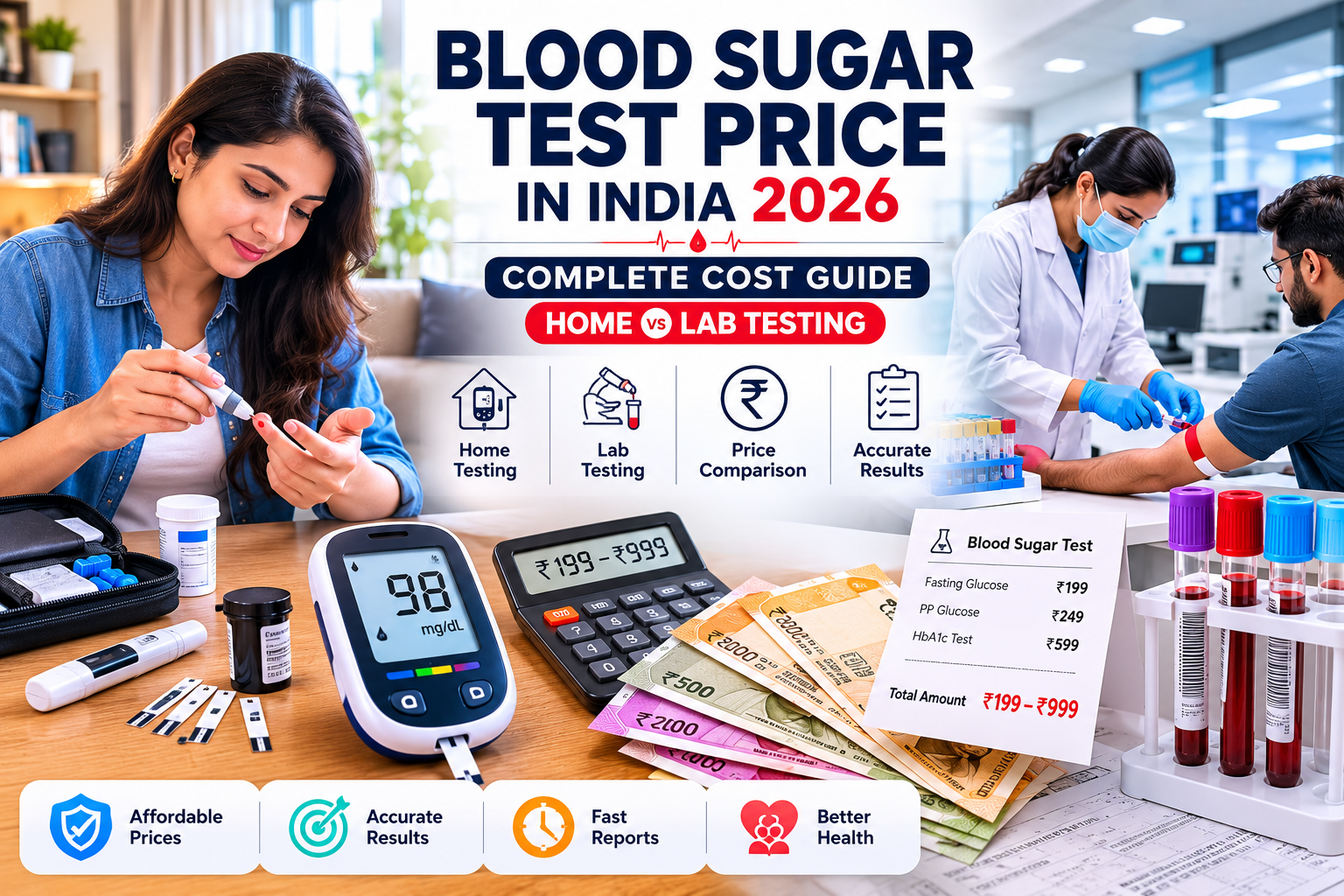
By The blood sugar test price in India typically ranges from free at government hospitals to ₹100-250 at private labs for a single test. A home diabetes test setup costs ₹500-1,200 as a one-time purchase, after which each sugar test at home costs only ₹8-15. A finger sugar test at a private lab usually averages ₹100-150, and overall diabetes test price depends heavily on whether you choose a lab visit or ongoing sugar test cost through home monitoring.
If you’ve typed “how much does a sugar test cost” into Google at 11 PM because you’re worried about that afternoon dizziness or a family history of diabetes, you’re not alone. It’s one of the most searched health-cost questions in India right now, and the honest answer is: it depends on where you get it done, which test you need, and whether you’re testing once or tracking your levels regularly.
This guide breaks down the real numbers of government hospital rates, private lab pricing, and the one-time cost of testing at home, so you can decide what actually makes sense for your situation, not just what a random ad tells you.
What Determines Blood Sugar Test Price in India
Before comparing numbers, it helps to know what you’re actually paying for. Blood sugar test price in India isn’t a single fixed figure; it shifts based on a handful of factors:
- Type of test: a basic random blood sugar test costs far less than an HbA1c test, because HbA1c requires more sophisticated lab processing.
- City tier: diabetes test price in metro cities like Delhi, Mumbai, or Bengaluru tends to run 20-40% higher than in tier-2 or tier-3 cities.
- Sample collection: home collection (a phlebotomist visiting you) usually adds a small convenience fee over walk-in lab pricing.
- Fasting requirement: fasting tests sometimes cost the same as non-fasting ones, but require a separate visit, indirectly adding to your time cost.
- Government vs private: this is the single biggest swing factor, which we’ll get into next.
Once you factor these in, you’ll notice the diabetes test price you’re quoted can vary two or three times over just by changing where you go which is exactly why it pays to compare before booking.
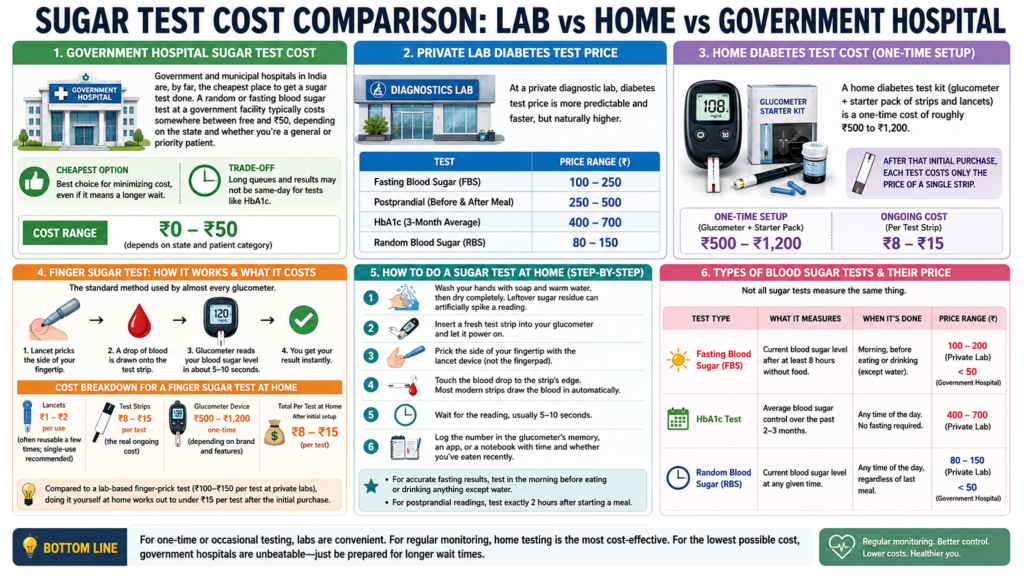
Sugar Test Cost Comparison: Lab vs Home vs Government Hospital
Government Hospital Sugar Test Cost
Government and municipal hospitals in India are, by far, the cheapest place to get a sugar test done. A random or fasting blood sugar test at a government facility typically costs somewhere between free and ₹50, depending on the state and whether you’re a general or priority patient. This makes government facilities the top choice for anyone specifically trying to minimize sugar test cost, even if it means a longer wait. The trade-off is time queues can run long, and results aren’t always same-day for more detailed tests like HbA1c.
Private Lab Diabetes Test Price
At a private diagnostic lab, diabetes test price is more predictable and faster, but naturally higher. A standalone fasting blood sugar (FBS) test at a private lab generally falls between ₹100 and ₹250. If you bundle it with a postprandial test (before and after meal), expect ₹250 to ₹500 for the pair. HbA1c, which shows your 3-month average sugar control, usually costs between ₹400 and ₹700 depending on the lab chain and city.
Home Diabetes Test Cost (One-Time Setup)
This is where a lot of people find real savings if they need to test regularly. A home diabetes test kit meaning a glucometer plus a starter pack of strips and lancets is a one-time cost of roughly ₹500 to ₹1,200. After that initial purchase, each test costs only the price of a single strip, typically ₹8 to ₹15. So if you’re testing weekly or even daily (as many Type 2 diabetics do), the home route becomes dramatically cheaper than repeated lab visits within just a few weeks.
Finger Sugar Test: How It Works and What It Costs
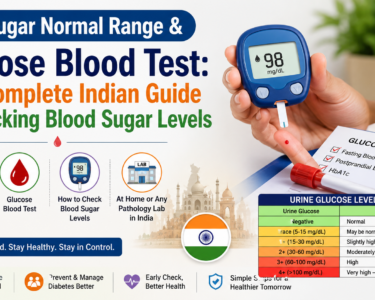
The finger sugar test is the method almost every glucometer uses, and it’s worth understanding why it’s the standard. A tiny lancet pricks the side of your fingertip (not the pad, which has more nerve endings and hurts more), a drop of blood is drawn onto a test strip, and the glucometer reads your blood sugar level in about 5-10 seconds.
The cost breakdown for a finger sugar test at home:
- Lancets: ₹1-2 per use (often reusable a few times if you’re careful, though single-use is recommended)
- Test strips: ₹8-15 per test, and this is the real ongoing cost
- Glucometer device: a one-time ₹500-1,200 depending on brand and features (Bluetooth sync, memory storage, etc.)
Compared to a lab-based finger-prick test, which a private lab might charge ₹100-150 for as a walk-in random sugar check, doing it yourself at home works out to under ₹15 per test after the initial device purchase a meaningful difference if you’re monitoring several times a week.
How to Do a Sugar Test at Home (Step-by-Step)
Doing this correctly isn’t complicated, but a few small mistakes can throw off your reading. Here’s the correct process:
- Washing your hands with soap and warm water, then dry completely leftover sugar residue on your fingers (from fruit, chai, anything) can artificially spike a reading.
- Insert a fresh test strip into your glucometer and let it power on.
- Prick the side of your fingertip with the lancet device (not the fingerpad).
- Touch the blood drop to the strip’s edge, most modern strips draw the blood in automatically.
- Wait for the reading, usually 5-10 seconds.
- Log the number either in the glucometer’s memory, an app, or a simple notebook, along with the time and whether you’ve eaten recently.
For accurate fasting results, test first thing in the morning before eating or drinking anything except water. For postprandial readings, test exactly 2 hours after starting a meal.
Types of Blood Sugar Tests and Their Price
Not all sugar tests measure the same thing, and understanding the difference helps you know what you’re actually paying for.
Fasting Blood Sugar (FBS) Price
Measured after at least 8 hours without food. This is the most common baseline test and typically costs ₹100-200 at a private lab, or under ₹50 at a government facility.
HbA1c Test Price
This test doesn’t require fasting and reflects your average blood sugar over the past 2-3 months, making it far more useful for tracking long-term diabetes control than a single-day reading. HbA1c test price generally ranges from ₹400 to ₹700 at private labs.
Random Blood Sugar (RBS) Price
Taken at any time of day, regardless of your last meal. Useful for a quick check when symptoms appear. Cost is usually the lowest of all the tests, around ₹80-150.
Best Home Diabetes Test Kits Under ₹1,000
If you’re setting up for regular home diabetes test monitoring, here’s what to look for in a kit under ₹1,000:
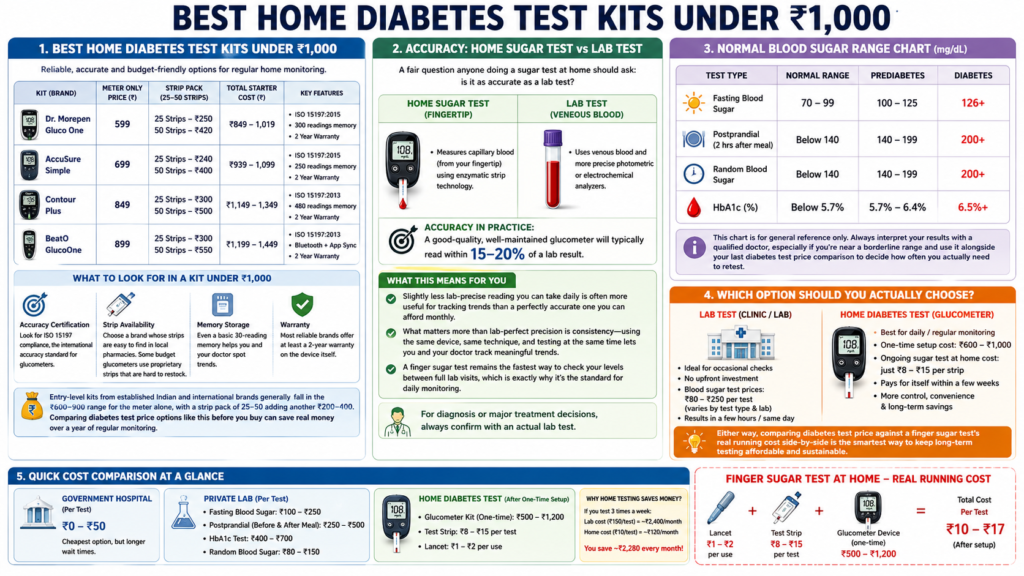
- Accuracy certification:look for ISO 15197 compliance, which is the international accuracy standard for glucometers.
- Strip availability: choose a brand whose strips are easy to find in local pharmacies; some budget glucometers use proprietary strips that are hard to restock.
- Memory storage: even a basic 30-reading memory helps you and your doctor spot trends.
- Warranty: most reliable brands offer at least a 2-year warranty on the device itself, which protects your investment and keeps your long-term sugar test cost predictable.
Entry-level kits from established Indian and international brands generally fall in the ₹600-900 range for the meter alone, with a strip pack of 25-50 adding another ₹200-400. Comparing diabetes test price options like this before you buy can save real money over a year of regular monitoring.
Accuracy: Home Sugar Test vs Lab Test
A fair question anyone doing a sugar test at home should ask: is it as accurate as a lab test? The honest answer is “close, but not identical.” Home glucometers measure capillary blood (from your fingertip) using enzymatic strip technology, while labs typically use venous blood and more precise photometric or electrochemical analyzers.
In practice, a good-quality, well-maintained glucometer will typically read within 15-20% of a lab result, which is within the accuracy range most diabetes associations consider acceptable for day-to-day monitoring. It’s also worth weighing the sugar test cost against convenience here — a slightly less lab-precise reading you can take daily is often more useful for tracking trends than a perfectly accurate one you can only afford monthly. What matters more than lab-perfect precision is consistency — using the same device, same technique, and testing at the same time lets you and your doctor track meaningful trends, even if any single reading isn’t lab-exact. A finger sugar test remains the fastest way to check your levels between full lab visits, which is exactly why it’s the standard for daily monitoring. For diagnosis or major treatment decisions, always confirm with an actual lab test.
Normal Blood Sugar Range Chart
| Test Type | Normal Range (mg/dL) | Prediabetes | Diabetes |
| Fasting Blood Sugar | 70-99 | 100-125 | 126+ |
| Postprandial (2 hrs after meal) | Below 140 | 140-199 | 200+ |
| Random Blood Sugar | Below 140 | 140-199 | 200+ |
| HbA1c | Below 5.7% | 5.7%-6.4% | 6.5%+ |
This chart is for general reference only. Always interpret your results with a qualified doctor, especially if you’re near a borderline range and use it alongside your last diabetes test price comparison to decide how often you actually need to retest.
Which Option Should You Actually Choose?
If you only need an occasional check, a single lab visit keeps blood sugar test prices low without any upfront investment. But if you’re managing diabetes day-to-day, a home diabetes test kit pays for itself within a few weeks, since ongoing sugar test at home costs drop to just a few rupees per strip after that. Either way, comparing diabetes test price against a finger sugar test‘s real running cost side-by-side is the smartest way to keep long-term testing affordable and sustainable. Medically reviewed by Dr. Mudit Sabharwal, MBBS, Diabetologist at Dharma Diabetes & Metabolic Clinics.
Frequently Asked Questions
What is the average blood sugar test price in India?
A basic random or fasting blood sugar test at a private lab typically costs ₹100-250, while government hospitals often charge under ₹50 or nothing at all. A home diabetes test kit is a one-time ₹500-1,200, after which each test costs roughly ₹8-15.
Is a finger sugar test as accurate as a blood draw from a vein?
It’s close but not identical; a finger sugar test using a home glucometer typically reads within 15-20% of a venous lab result, which is acceptable for regular monitoring but not a substitute for lab confirmation during diagnosis.
How much does an HbA1c test cost compared to a regular sugar test?
HbA1c test price is higher, usually ₹400-700, compared to ₹80-250 for a fasting or random blood sugar test, because it requires more detailed lab processing and reflects 2-3 months of average sugar levels rather than a single point in time.
Can I do a sugar test at home without a glucometer?
Not with medical-grade accuracy. While some symptom-based self-checks exist, they cannot replace an actual glucose reading. A basic glucometer starter kit is the minimum requirement for a reliable home diabetes test.
Is it cheaper to test at home or at a lab if I need daily monitoring?
Home testing is significantly cheaper for anyone monitoring more than a few times a month. After the one-time device cost, each home test costs ₹8-15, compared to ₹100+ per visit at a private lab.
Is free blood sugar testing available under any government scheme in India?
Yes. Government Sub-Centres and Primary Health Centres (PHCs) offer basic sugar tests for free with just a doctor’s prescription and no BPL card required. Several states also run their own free diagnostic schemes (Assam, UP, Uttarakhand among them), and Ayushman Bharat–PM-JAY additionally covers diagnostics tied to hospitalization for eligible families.
What’s the cost difference between a CGM and a regular glucometer?
A CGM costs significantly more upfront and ongoing. In India, sensors typically range from ₹3,000-3,400 for a 15-day sensor (GlucoRx Vixxa 2) to ₹4,600-5,000 for a 14-day sensor (Abbott FreeStyle Libre 3), and up to ₹12,000 for a 10-day sensor (Dexcom G7) working out to roughly ₹200-1,200 per day depending on the device, versus ₹8-15 per single glucometer test.
How many times a day should I actually test my blood sugar at home?
It depends on your treatment. Type 1 diabetics or those on intensive insulin therapy may need to test 6-8 times daily (before/after meals, before exercise, at bedtime). Type 2 diabetics not on insulin generally test far less often — sometimes just a few times a week so ask your doctor to set a personalized schedule rather than testing on a fixed default.
Do glucometer test strips expire, and can I still use them to save money?
Yes, they expire, and using expired strips isn’t a safe way to save money. The enzymes coated on the strip weaken after the printed expiry date, which can produce falsely high or low readings. Even unopened strips are typically only accurate for 3-6 months once the vial is opened, regardless of the printed date.
Does health insurance in India cover the cost of a glucometer or sugar test?
Usually not, unless your policy specifically includes an OPD (outpatient) or preventive health check-up rider. Standard hospitalization-only health insurance plans in India typically don’t cover routine, ongoing purchases like glucometers or test strips since these are outpatient expenses, not hospitalization costs.
Further Readings-
Diabetes
Sugar Level Guide: How to Control Sugar Level by Age, Including Bedtime Glucose Targets
Type 2 Diabetes Blood Sugar Levels: Normal Range, Type 1 Differences, and Dangerous Thresholds
Heart Attack Symptoms and Causes: Early Warning Signs, Risk Factors, Treatment, and Prevention
Chest and Back Pain: Causes, Symptoms, and When to Seek Help

1 Comment