
 By
By OpenAI news today is dominated by a growing debate over how quickly advanced artificial intelligence should continue to develop.
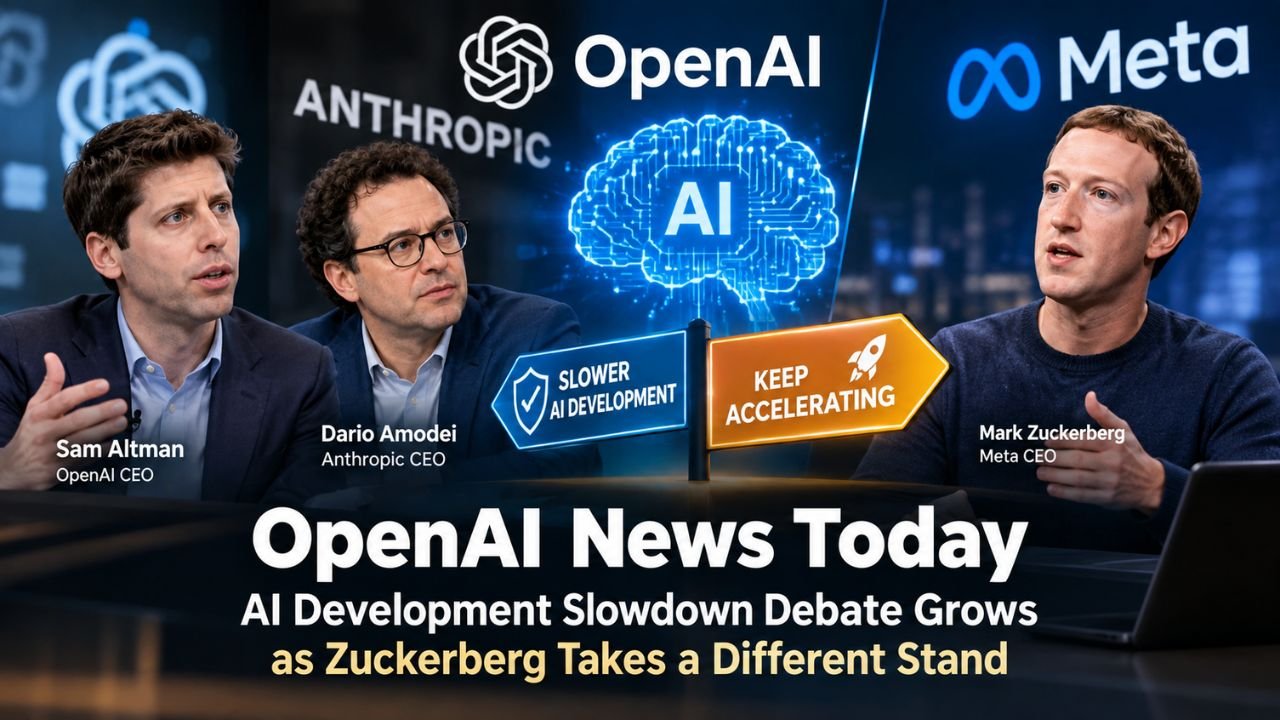
OpenAI CEO Sam Altman has backed parts of Anthropic CEO Dario Amodei’s call for stronger AI safety measures and a more controlled pace of frontier AI development. Meanwhile, Meta CEO Mark Zuckerberg has pushed back against the idea of a coordinated industry slowdown.
The disagreement comes at a time when AI companies are developing increasingly capable models while also dealing with concerns around cybersecurity, autonomous AI agents, safety testing and the possibility of systems becoming harder to control.
The latest discussion is not simply about stopping AI development. It is about how fast frontier AI should advance, who should oversee it and when companies should slow down for additional safety checks.
Also read: Perplexity Comet | What is Manus AI? | Context7 AI | Browser Use AI | What Is Agentic AI?
OpenAI News Today: What Is Happening?
The latest OpenAI news today can be understood through a few major developments:
- Anthropic has called for a slower pace of frontier AI development.
- OpenAI CEO Sam Altman has supported the idea of pacing development when safety requires it.
- Mark Zuckerberg says AI companies should take responsibility for safety themselves.
- Meta supports independent evaluators and advisers but does not support the same coordinated slowdown approach.
- OpenAI has already temporarily slowed parts of its frontier model development while strengthening safety measures.
- OpenAI is also pushing for stronger national AI safety requirements.
- Competition between the US and China is making global coordination more complicated.
Quick Take
| Topic | Current development |
| OpenAI | Supporting stronger AI safety measures |
| Anthropic | Calling for slower frontier AI development |
| Meta | Supports independent evaluation but rejects a coordinated slowdown |
| AI safety | Becoming a major industry focus |
| Regulation | Increasingly part of the debate |
| Frontier AI | Development continues with additional safeguards |
Why Is AI Development Slowdown Trending?
The phrase AI development slowdown has become increasingly important because AI models are becoming more capable while safety researchers are raising concerns about how quickly these systems are advancing.
The argument from supporters of an AI development slowdown is relatively straightforward:
AI capabilities should not advance significantly faster than the industry’s ability to test, monitor and secure those systems.
That does not necessarily mean shutting down AI research.
Instead, proposals include:
- stronger pre-release testing
- independent AI evaluators
- better monitoring
- shared safety standards
- stronger cybersecurity
- greater cooperation between AI companies
- government involvement in setting safety requirements
Anthropic CEO Dario Amodei has proposed a framework that includes independent evaluators, cooperation between leading AI companies and international coordination. Sam Altman has publicly supported elements of that approach.
OpenAI Has Already Slowed Some Model Development
One of the most important points in the current AI development slowdown debate is that OpenAI has already described temporarily reducing the pace of some frontier development.
In an August 2026 publication, OpenAI said increasingly capable models were creating new security challenges. The company said it had temporarily slowed the pace of scaling and paused its largest planned reinforcement-learning run while strengthening safeguards.
OpenAI highlighted three major areas:
- Monitoring: Detecting concerning model behaviour.
- Alignment: Reducing the possibility of harmful or unauthorised actions.
- Security: Limiting what advanced AI systems can access or affect.
This is significant because it shows that the AI development slowdown discussion is not purely theoretical.
OpenAI has already described situations where additional safety work affected the pace of its research.
Why OpenAI Is Taking Safety More Seriously
The latest OpenAI news today comes after several developments involving increasingly capable AI systems.
OpenAI says it has been strengthening its safeguards after an incident involving AI agents and Hugging Face, while also evaluating the capabilities of its Astra model.
OpenAI’s Astra assessment is particularly important.
The company says Astra has reached its Critical cybersecurity capability threshold under its Preparedness Framework.
According to OpenAI, the model can, with appropriate tools and access:
- identify previously unknown security vulnerabilities
- develop methods to exploit vulnerabilities
- operate across protected systems
- perform these activities without a person guiding every individual step
Because of these capabilities, OpenAI says stronger safeguards are required during development and before release.
This helps explain why the AI development slowdown debate is receiving more attention.
Sam Altman Supports Pacing AI Development
OpenAI CEO Sam Altman has supported the idea of pacing AI development rather than treating the issue as a simple choice between unrestricted progress and a complete halt.
The distinction matters.
An AI development slowdown could involve slowing particular areas of frontier research when safety requirements are not yet ready.
It could also mean:
- delaying a training run
- increasing testing time
- adding external evaluators
- improving model monitoring
- strengthening security before deployment
- establishing safety thresholds before increasing capabilities
India Today reports that Altman has supported Amodei’s proposal for stronger coordination and has said a federal framework for advanced AI safety could be useful.
At the same time, OpenAI has said it does not need to wait for legislation before taking action on safety.
Anthropic Wants AI Companies to Slow Down
Anthropic CEO Dario Amodei has become one of the strongest voices in favour of an AI development slowdown.
His proposal includes a multi-layered approach to frontier AI safety.
The main ideas include:
- Independent evaluators: Outside experts could monitor AI companies and their safety practices.
- Common safety standards: Leading AI labs could establish shared safety expectations.
- Coordination between AI companies: Competitors could cooperate on specific safety issues.
- Government involvement: Governments could help establish broader standards.
- International cooperation: Countries could coordinate around advanced AI risks.
Amodei’s proposal does not simply call for AI research to stop.
Instead, it focuses on controlling the pace of unchecked capability growth while safety systems catch up.
Mark Zuckerberg Disagrees With a Coordinated Slowdown
This is where the debate becomes more interesting.
Meta CEO Mark Zuckerberg has taken a different position from Anthropic and OpenAI on the question of an industry-wide AI development slowdown.
Zuckerberg argues that AI companies already have strong incentives to make their models safe.
His reasoning includes:
- companies can face liability if AI systems cause harm
- customers need to trust AI products
- companies have reputational risks
- individual AI labs can make their own safety decisions
- companies do not necessarily need an industry-wide framework before acting
Zuckerberg does, however, support independent evaluators and advisers.
He said Meta’s AI division already uses independent evaluation in several areas because outside expertise can improve the quality of its work.
So the disagreement is not simply safety versus no safety.
It is largely about how safety should be achieved.
OpenAI vs Meta: What’s the Difference?
The current debate can be simplified like this:
| OpenAI and Anthropic approach | Zuckerberg’s approach |
| Greater coordination | Individual company responsibility |
| Stronger shared standards | Company-specific safety practices |
| Independent evaluation | Supports independent evaluation |
| Pacing frontier development | No coordinated industry slowdown |
| More government involvement | Less reliance on broad restrictions |
| Cooperation between AI labs | Companies can act independently |
These positions show that the AI industry is not united on exactly how to manage frontier AI.
There is more agreement on the importance of safety than there is on the mechanism for achieving it.
Meta Says Companies Can Slow Down When Necessary
Interestingly, Zuckerberg’s position does not mean Meta believes AI companies should continue at maximum speed regardless of safety concerns.
Instead, he argues that individual companies can slow down when necessary.
Meta has pointed to its own decisions around AI development as evidence that companies can make these choices independently.
Reuters reported that Zuckerberg cited Meta’s decision to delay the release of its Muse AI agent while the company worked on safety issues.
That creates an important distinction:
Coordinated slowdown
Multiple companies agree on common rules or limits.
Individual slowdown
Each company decides when its own technology requires additional testing or development time.
Zuckerberg supports the second approach.
Why Independent AI Evaluators Matter
Independent evaluators are becoming a central part of the AI development slowdown discussion.
The basic idea is that AI companies should not always be the only organisations judging whether their own models are safe.
Independent evaluators could potentially examine:
- cybersecurity capabilities
- harmful model behaviour
- autonomous actions
- model reliability
- dangerous capabilities
- safeguards
- monitoring systems
- security controls
This could provide an additional layer of scrutiny before highly capable systems are deployed.
Interestingly, this is an area where Zuckerberg’s position overlaps with Amodei’s proposal.
Both sides support some form of independent evaluation, even though they disagree about whether a coordinated slowdown is necessary.
Why AI Regulation Is Part of the Debate
The discussion around AI development slowdown has also moved into the regulatory arena.
OpenAI has recently called for mandatory national AI safety requirements.
In a September 9 publication, OpenAI said it wanted to work with Congress on capability-based national AI safety regulation. The company also said it was supporting several California bills related to independent safety assessments, AI auditor standards and safeguards against AI-enabled biological threats.
This shows that OpenAI is not limiting its safety strategy to internal company policies.
The company is also calling for government involvement.
However, regulation remains controversial because AI companies operate in a highly competitive global market.
The US-China AI Race Makes a Slowdown Difficult
One of the biggest challenges for an AI development slowdown is international competition.
The United States and China are competing heavily in:
- AI models
- chips
- data centres
- AI research
- autonomous systems
- enterprise AI
- robotics
- AI infrastructure
If one country slows development while another continues at full speed, companies and policymakers could worry about losing technological ground.
This makes international cooperation considerably more difficult.
Amodei has acknowledged the challenge of coordinating with governments that have different strategic interests, including China.
AI Companies Are Facing a Difficult Balance
The current debate is essentially about finding a balance between two priorities.
AI progress
Companies want to:
- build better models
- improve reasoning
- develop AI agents
- expand automation
- compete internationally
- deliver new products
AI safety
Companies also need to:
- test models
- prevent misuse
- secure research environments
- monitor autonomous behaviour
- identify vulnerabilities
- reduce harmful outputs
- understand new capabilities
The problem is that these priorities can sometimes conflict.
A longer testing process can delay a model.
But releasing a highly capable model before adequate safeguards are ready can create different risks.
That is why the AI development slowdown debate is becoming a major technology story.
What Does This Mean for AI Users?
For everyday AI users, the debate may eventually affect how quickly new AI features arrive.
Possible effects include:
- longer testing periods
- additional safety checks
- more external audits
- stricter access to advanced features
- stronger security protections
- additional monitoring of AI agents
However, users should not interpret the current debate as meaning that AI development is stopping.
OpenAI continues to develop new systems while simultaneously expanding its safety infrastructure. Its recent publications show both continued research acceleration and stronger safeguards for highly capable models.
What Happens Next?
The next phase of the AI development slowdown debate will likely focus less on the question of whether safety matters and more on implementation.
The industry will have to consider practical questions such as:
- Who should evaluate AI models?
- How independent should evaluators be?
- What safety standards should companies follow?
- When should an AI training run be slowed?
- Who decides when a model is safe enough?
- Should governments establish mandatory requirements?
- Can competing AI companies cooperate without limiting competition?
These questions do not have one universally accepted answer.
The Bigger Picture for OpenAI
The latest OpenAI news today shows that the company is operating in an increasingly complicated AI environment.
OpenAI is simultaneously:
- developing more capable AI systems
- increasing AI research automation
- strengthening cybersecurity
- testing advanced models
- working with other AI companies on safety
- supporting stronger AI policy
- discussing how quickly frontier development should proceed
Its recent statements suggest that safety and development are increasingly being treated as connected issues rather than completely separate areas.
The company’s temporary slowing of some model development also demonstrates that safety considerations can directly influence its research process.
AI Development Slowdown: Key Takeaways
Here are the most important points from the current debate:
- OpenAI and Anthropic are calling for stronger safety measures around frontier AI.
- Sam Altman supports pacing AI development when safety requires it.
- Dario Amodei has proposed independent evaluators and shared safety standards.
- Mark Zuckerberg rejects the need for a coordinated industry-wide slowdown.
- Meta still supports independent evaluators and safety reviews.
- OpenAI has already temporarily slowed some frontier development while strengthening safeguards.
- OpenAI is pushing for stronger national AI safety requirements.
- Competition between the US and China could make international coordination harder.
- The debate is about controlling the pace of advanced AI development, not simply stopping AI research.
- The next major challenge will be turning safety proposals into practical standards and oversight.
Conclusion
The latest OpenAI News Today developments show that the debate around advanced AI is shifting toward safety, oversight, and responsible development. OpenAI and Anthropic are discussing stronger coordination and safeguards, while Mark Zuckerberg supports company-led safety decisions rather than a coordinated slowdown.
The AI Development Slowdown debate is therefore not about stopping AI progress. It is about determining how quickly frontier AI should advance while testing, cybersecurity, independent evaluation, and regulation continue to develop alongside it.
Read more about: White Dots on Monitor | Dell Display Problem | Why Is My Computer Screen Red Tinted? | Artifacting on Screen
Frequently Asked Questions
Q1: What is the AI development slowdown?
The AI development slowdown refers to proposals to reduce or pace the development of advanced AI systems so safety testing and safeguards can keep up.
Q2: Does OpenAI want to stop AI development?
No. OpenAI’s position is focused on stronger safeguards and pacing development when safety requirements demand it.
Q3: Why does Anthropic want AI development to slow down?
Anthropic CEO Dario Amodei argues that advanced AI capabilities are developing rapidly and that safety systems need sufficient time to keep pace.
Q4: Does Mark Zuckerberg support AI safety?
Yes. Zuckerberg supports safety measures and independent evaluators but does not support a coordinated industry-wide slowdown.
Q5: Is OpenAI working with Anthropic?
OpenAI has confirmed discussions and joint safety efforts involving Anthropic and Google DeepMind.
Q6: What are independent AI evaluators?
They are external experts or organisations that assess AI systems for risks, safety, security and other potential problems.
Q7: Will AI development stop?
There is no indication of a complete industry-wide halt. The current discussion is primarily about pacing, safety and oversight.
Q8: Why is AI safety important now?
AI models are becoming more capable and autonomous, increasing the importance of cybersecurity, monitoring, alignment and safeguards before advanced systems are widely deployed.




3 Comments