
 By
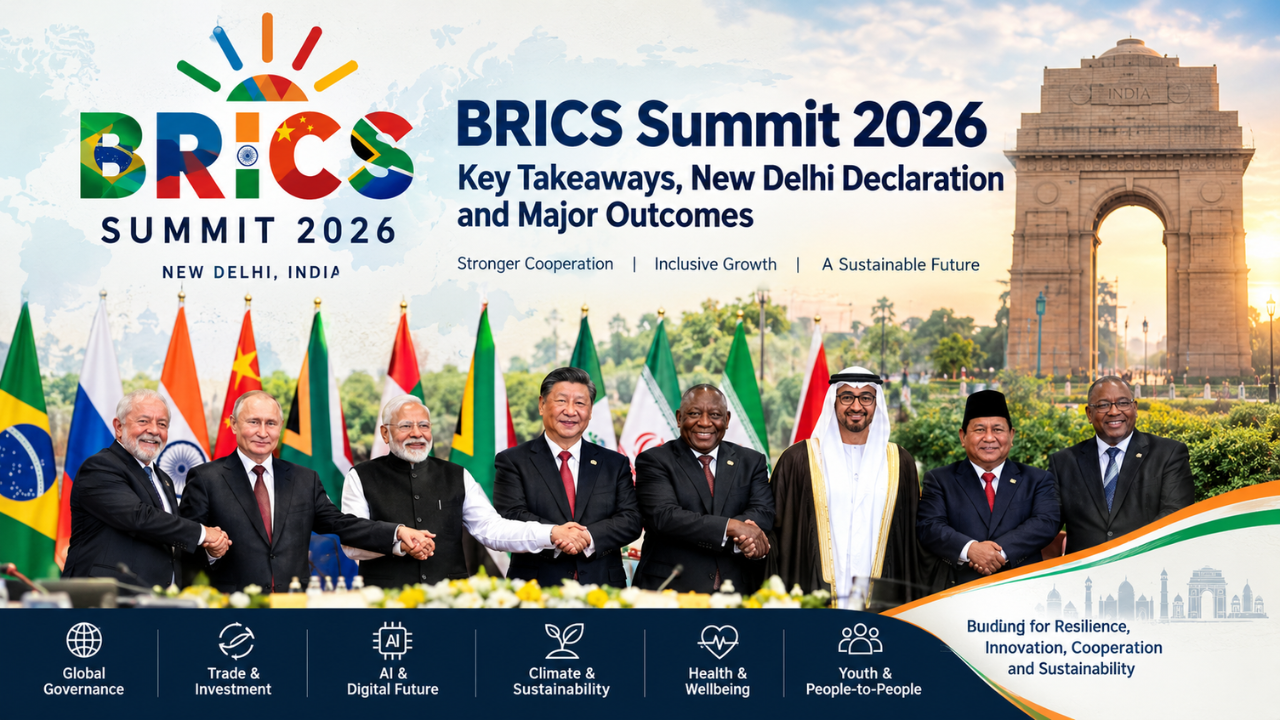
By The BRICS Summit 2026 was held in New Delhi, India, from September 12 to 13, bringing together leaders of the expanded BRICS grouping at a time of major geopolitical, economic and technological changes. India hosted the 18th BRICS Summit under the theme “Building for Resilience, Innovation, Cooperation and Sustainability.”
The meeting produced the New Delhi Declaration, covering global governance, international security, trade, finance, artificial intelligence, digital infrastructure, health, climate change, industrial cooperation and people-to-people exchanges.
The summit also marked two decades of BRICS cooperation. The expanded grouping now includes 11 members and represents a significant share of the world’s population and global economic output.
What Is the BRICS Summit 2026?
The BRICS Summit 2026 was the 18th leaders’ summit of the grouping and was hosted by India in New Delhi.
According to the New Delhi Declaration, more than 400 meetings and engagements were organised during India’s 2026 BRICS Chairship across 30 Indian cities. These involved ministers, parliamentarians, officials, experts, businesses and people from participating countries.
The summit focused on strengthening practical cooperation rather than limiting BRICS discussions to geopolitical issues.
Also read: OpenAI News Today | What Is Agentic AI? | Agentic AI Risks
BRICS Summit 2026 at a Glance
| Detail | Information |
| Summit | 18th BRICS Summit |
| Host country | India |
| Host city | New Delhi |
| Dates | September 12–13, 2026 |
| Theme | Building for Resilience, Innovation, Cooperation and Sustainability |
| Key document | New Delhi Declaration |
| BRICS members | 11 |
| Next chair | China |
| Next summit | 2027 |
The declaration reaffirmed cooperation across three broad pillars: political and security cooperation, economic and financial cooperation, and cultural and people-to-people cooperation.
Why Was the BRICS Summit 2026 Important?
The BRICS Summit 2026 took place amid international tensions involving conflicts, trade restrictions, sanctions, energy security and disruptions to global supply chains.
The expanded BRICS grouping also contains countries with different foreign-policy interests. This makes consensus an important part of the organisation’s functioning.
The New Delhi Declaration therefore placed considerable emphasis on dialogue, consultation, international law, multilateralism and practical cooperation.
Al Jazeera reported that BRICS leaders adopted the declaration despite differences concerning conflicts in the Middle East and Ukraine. The declaration called for restraint and diplomacy while avoiding direct naming of several parties to the conflicts.
BRICS and Global Governance
One of the central themes of the BRICS Summit 2026 was reform of global governance.
The New Delhi Declaration called for a more representative, effective, democratic and accountable international system. BRICS members reiterated their support for greater participation of emerging markets and developing countries in global decision-making.
The declaration also emphasised the importance of the United Nations and its Charter while supporting stronger representation for developing countries.
Global Governance Priorities
| Area | BRICS Position |
| Multilateralism | Strengthen international cooperation |
| Global representation | Greater participation of developing countries |
| UN system | Support reform and wider representation |
| Multipolarity | Promote a more representative international order |
| Developing economies | Increase participation in global decision-making |
| International law | Reaffirm commitment to UN Charter principles |
India’s chairship placed particular emphasis on giving emerging markets and developing countries a greater role in shaping international discussions.
BRICS Summit 2026 and Global Conflicts
International security was another important part of the summit.
The declaration expressed concern over escalating tensions in the Middle East and called for maximum restraint. According to Al Jazeera, the final language avoided explicitly naming the United States, Israel, Iran or Gulf states in this section.
The declaration also expressed concern about attacks affecting civilian infrastructure and peaceful nuclear facilities protected by International Atomic Energy Agency safeguards.
Key Conflict-Related Issues
| Issue | Position Reflected in Summit Documents |
| Middle East | Call for restraint and diplomacy |
| Civilian infrastructure | Concern over deliberate attacks |
| Nuclear facilities | Emphasis on protection of safeguarded peaceful facilities |
| Ukraine | Support for dialogue and diplomatic resolution |
| Sanctions | Opposition to unilateral measures outside UN Security Council authorisation |
| Palestine | Support for Palestinian statehood and a two-state solution |
On Ukraine, the declaration called for disputes to be addressed through dialogue, consultation and diplomacy without specifically naming Ukraine in that passage. It also criticised unilateral sanctions that are not authorised by the UN Security Council.
BRICS Summit 2026 on Palestine and Gaza
The declaration contained explicit language concerning Palestine.
BRICS expressed opposition to the forced displacement of Palestinians and to attempts to change the geography or demography of occupied Palestinian territory.
It also supported humanitarian access, UNRWA and full UN membership for Palestine, while reiterating support for a two-state solution based on the 1967 borders, with East Jerusalem as the capital of a sovereign Palestinian state.
This section was among the more detailed geopolitical positions included in the summit declaration.
Trade and Tariffs Take Centre Stage
Global trade was another major issue discussed during the BRICS Summit 2026.
The declaration raised concerns about unilateral tariff and non-tariff measures that can distort international trade. It also stressed the importance of stable supply chains, energy flows and maritime security.
Instead of focusing only on individual tariff disputes, the declaration discussed broader cooperation to make global value chains more resilient.
BRICS Trade Priorities
| Trade Area | Main Focus |
| Tariffs | Opposition to unjustified unilateral protectionist measures |
| Supply chains | Greater resilience and stability |
| Global value chains | More participation by developing economies |
| Trade facilitation | Digitisation and improved connectivity |
| Manufacturing | Greater access to higher-value segments |
| Technology transfer | Encourage cooperation |
| MSMEs | Improve market access |
| Special Economic Zones | Promote trade and investment |
The declaration also supported the development of the BRICS Global Value Chains Action Plan 2026–2030, with an emphasis on helping emerging markets and developing economies move into higher-value activities.
BRICS Summit 2026 and Local Currency Payments
Financial cooperation remained a major part of the agenda.
The BRICS Payment Task Force continued work on cross-border payment mechanisms and interoperability between payment and messaging channels.
The declaration also noted discussions about trade settlements and investment using BRICS members’ local currencies. It did not establish a single common BRICS currency. Instead, the focus remained on practical payment cooperation and respect for national priorities.
Financial Cooperation
| Initiative | Purpose |
| BRICS Payment Task Force | Explore efficient cross-border payments |
| Local currencies | Facilitate trade settlements and investment |
| Payment interoperability | Improve connections between payment systems |
| New Development Bank | Support development financing |
| Tax cooperation | Improve coordination and knowledge sharing |
| Customs cooperation | Simplify and strengthen cross-border processes |
This approach indicates that financial integration is being developed through several practical mechanisms rather than one single monetary framework.
Artificial Intelligence Becomes a Major BRICS Priority
Artificial intelligence received substantial attention during the BRICS Summit 2026.
The declaration recognised AI’s potential to support economic growth and sustainable development while stressing safety, security, inclusiveness and reliability.
BRICS also highlighted the need for greater accessibility to AI resources, AI research and international cooperation, particularly for countries in the Global South.
AI Priorities
| AI Focus | Objective |
| AI safety | Reduce potential risks |
| Accessibility | Expand access to AI resources |
| Innovation | Promote AI research |
| Economic growth | Use AI for development |
| Social good | Apply AI to public benefit |
| Global governance | Strengthen international cooperation |
| Energy efficiency | Encourage more efficient AI systems |
| Global South | Address developing-country needs |
The declaration also referenced India’s AI Impact Summit held in February 2026 and China’s World AI Conference and High-Level Meeting on Global AI Governance.
Digital Public Infrastructure
Digital public infrastructure was another area highlighted during India’s chairship.
The declaration recognised resilient, secure, inclusive and interoperable digital public infrastructure as an important foundation for economic development and social inclusion.
BRICS members noted a proposal to create a digital public infrastructure repository and pilot projects involving digital public infrastructure solutions.
This could provide a platform for BRICS countries to exchange experiences in areas such as digital services, public platforms and technology-enabled service delivery.
Health Cooperation
Health was also included in the BRICS Summit 2026 agenda.
The declaration supported people-centred digital healthcare systems and welcomed a compendium covering digital health architecture and access to healthcare in remote areas.
BRICS also identified non-communicable diseases and obesity as major public health challenges.
Major Health Initiatives
| Initiative | Focus |
| Digital health architecture | Improve continuity of care |
| Remote healthcare | Expand access |
| Healthy Lifestyle Mission | Preventive and promotive healthcare |
| Healthy Lifestyle Roadmap | Cooperation from 2026–2029 |
| Mental health network | Training and centres of excellence |
| Digital healthcare | People-centred systems |
The declaration also supported the establishment of a BRICS Training Hub Network and a BRICS Network of Centres of Excellence, with NIMHANS serving as the coordinating centre of excellence for the mental-health initiative.
Industry, Startups and Innovation
The BRICS Summit 2026 also placed emphasis on industrial development, startups and technological innovation.
The declaration highlighted cooperation under the Partnership on the New Industrial Revolution, commonly known as PartNIR.
It also welcomed the establishment of the BRICS Incubator Network and further consideration of a BRICS Startup Innovation Fund.
Innovation and Industry
| Area | Initiative |
| Industry 4.0 | Greater technological cooperation |
| Startups | BRICS Incubator Network |
| Innovation | Startup and research cooperation |
| SMEs | Deeper cross-border engagement |
| Solar industry | Photovoltaic cooperation roadmap |
| Science | BRICS Science and Research Repository |
| Young innovators | Young Innovators Prize |
The declaration also encouraged greater cooperation among startups and small and medium enterprises and supported technology transfer, manufacturing and productivity improvements.
Climate Change and Sustainability
Sustainability formed one of the four pillars of India’s BRICS chairship theme.
BRICS members reaffirmed their commitment to the UN Framework Convention on Climate Change and the Paris Agreement.
The declaration also addressed climate finance, adaptation, loss and damage, debt sustainability and the financial constraints faced by developing countries.
Sustainability Priorities
| Area | Focus |
| Climate change | Implement Paris Agreement |
| Adaptation | Strengthen resilience |
| Climate finance | Improve support for developing countries |
| Water | Support sustainable water management |
| Waste | Improve integrated waste management |
| Circular economy | Promote resource efficiency |
| Urban development | Build resilient and liveable cities |
The summit also highlighted sustainable lifestyles, recycling, waste management and resource efficiency.
Urban Development and Resilient Cities
Urbanisation was another area of cooperation.
The BRICS Urbanisation Forum was convened in New Delhi, and members supported cooperation on housing, water, sanitation, mobility, waste management and other urban services.
The declaration also welcomed the establishment of the BRICS Urban Research and Knowledge Network.
This initiative is intended to support research, knowledge sharing and capacity building related to sustainable urban development.
Youth, Women and People-to-People Cooperation
The BRICS Summit 2026 also expanded its focus beyond government-to-government relations.
The declaration recognised young people as important contributors to resilience, innovation and sustainable development.
Areas identified for youth cooperation included education, skills, entrepreneurship, science and technology, health, sports, environment and social participation.
The summit also welcomed initiatives supporting women’s entrepreneurship and economic participation through the BRICS Women’s Business Alliance.
People-Centred Priorities
| Group/Area | Focus |
| Youth | Skills, entrepreneurship and innovation |
| Women | Business and economic participation |
| Researchers | Scientific collaboration |
| Startups | Innovation and networking |
| Workers | Skills and social protection |
| Civil society | Dialogue and exchanges |
What Did India Achieve as BRICS Chair?
India’s 2026 chairship placed practical cooperation at the centre of the BRICS agenda.
The declaration commended India’s work in organising more than 400 meetings and engagements across 30 cities.
India also advanced initiatives involving digital public infrastructure, artificial intelligence, health, industrial cooperation, urbanisation, growth and development.
Another important element was the BRICS Task Force on Growth and Development, created as a platform for discussing shared development challenges and economic policy issues affecting BRICS and other emerging and developing economies.
Key Outcomes of BRICS Summit 2026
The BRICS Summit 2026 produced a wide-ranging declaration covering both geopolitical and development issues.
Major Outcomes at a Glance
| Category | Key Outcome |
| Global governance | Greater representation for developing countries |
| Trade | Opposition to unjustified unilateral protectionism |
| Payments | Continued work on cross-border payment systems |
| Local currencies | Support for trade settlement discussions |
| AI | Cooperation on safe and inclusive AI |
| Digital infrastructure | Proposed BRICS DPI repository |
| Health | Healthy Lifestyle Mission and mental-health cooperation |
| Industry | Startup and Industry 4.0 cooperation |
| Climate | Stronger sustainability and climate cooperation |
| Urbanisation | BRICS Urban Research and Knowledge Network |
| Growth | BRICS Task Force on Growth and Development |
| Youth | Expanded youth cooperation |
| Women | Greater economic participation |
What Happens After the BRICS Summit 2026?
The summit declaration is not the end of the process. Many initiatives will require further meetings, national implementation and cooperation between institutions.
The declaration states that China will take over the BRICS Chairship in 2027 and host the 19th BRICS Summit.
The continuing focus is expected to include economic cooperation, technology, payments, development, climate action and international governance.
For BRICS, the central challenge will be translating broad commitments into practical projects while maintaining consensus among an increasingly diverse membership.
Conclusion
The BRICS Summit 2026 in New Delhi covered a much wider agenda than geopolitics alone. The New Delhi Declaration addressed global governance, trade, financial cooperation, AI, digital infrastructure, healthcare, industrial development, climate change, urbanisation and youth participation.
The summit demonstrated both the breadth and complexity of the expanded BRICS framework. Members were able to reach consensus on a broad declaration while using carefully negotiated language on several international conflicts.
For India, the summit provided an opportunity to promote practical cooperation around resilience, innovation, sustainability and development. For the wider BRICS grouping, the next stage will involve turning the initiatives announced during India’s chairship into sustained cooperation.
The New Delhi Declaration therefore provides a roadmap for the group’s next phase, with China set to take over the chairship in 2027.
Read more about: Dell Display Problem | Jantar Mantar Delhi Protests | Nitin Gadkari’s Ethanol Push
Frequently Asked Questions
Q1: What is BRICS Summit 2026?
The BRICS Summit 2026 was the 18th leaders’ summit, hosted by India in New Delhi on September 12–13, 2026.
Q2: What was the theme of BRICS Summit 2026?
The theme was “Building for Resilience, Innovation, Cooperation and Sustainability.”
Q3: Where was BRICS Summit 2026 held?
The summit was held in New Delhi, India.
Q4: What is the New Delhi Declaration?
It is the joint declaration adopted by BRICS leaders at the 18th summit, covering political, economic, technological, social and environmental cooperation.
Q5: Did BRICS create a common currency in 2026?
No. The declaration focused on cross-border payment cooperation and the use of local currencies for trade settlements and investments rather than creating a single BRICS currency.
Q6: What did BRICS say about artificial intelligence?
BRICS supported international cooperation on safe, secure, inclusive and reliable AI and highlighted AI’s potential for economic growth and sustainable development.
Q7: Which country will host BRICS in 2027?
China will hold the BRICS Chairship in 2027 and host the 19th BRICS Summit.
Q8: What were the major topics at the BRICS Summit 2026?
Major topics included global governance, trade, tariffs, cross-border payments, AI, digital public infrastructure, health, climate change, industrial cooperation, urban development and youth participation.

1 Comment