 By
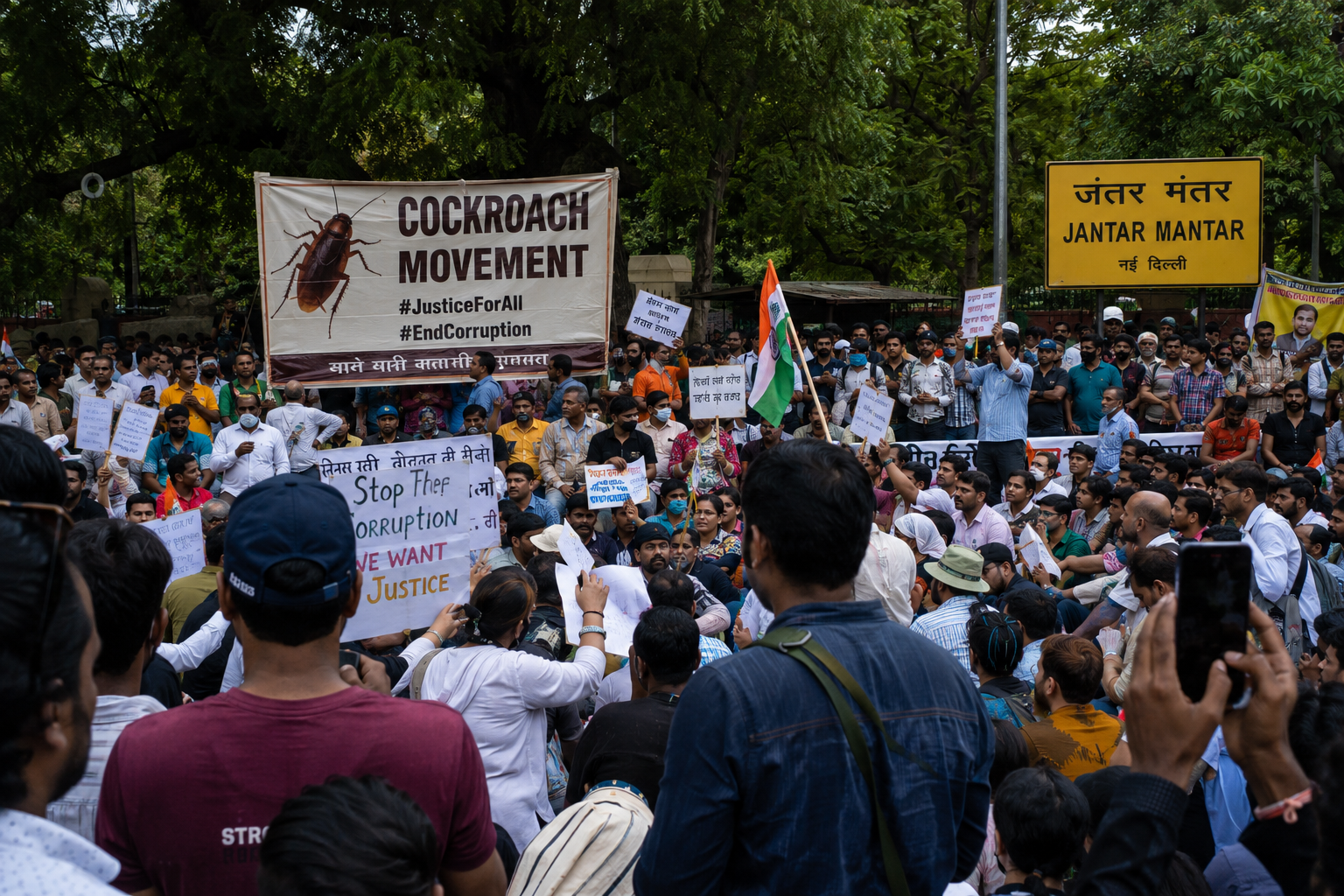
By New Delhi’s Jantar Mantar is back at the centre of national attention. For over a month, the protest ground has hosted thousands of young Indians camping through the summer heat, and the last three days have pushed this Jantar Mantar Delhi protest into one of the most closely watched political stories of 2026. A police crackdown, a hospitalised hunger striker, and a Parliament disrupted by opposition MPs have all happened within 72 hours and both sides are now telling very different versions of events.
Here’s what’s confirmed so far, what’s disputed, and what each side is saying.
What Happened in the Last Three Days
The last three days turned a month-long sit-in into a national flashpoint.
On Monday, July 20, thousands of supporters of the youth-led Cockroach Janta Party (CJP) tried to march from Jantar Mantar toward Parliament. Delhi Police stopped them, and officers used tear gas and batons to push the crowd back. According to Delhi Police, close to 180 people were injured, 118 police personnel and around 60 protesters. Protesters and opposition leaders have questioned the police account of events and called the force used disproportionate to a peaceful march; an independent count of injuries has not been published.
By Tuesday, July 21, hundreds of protesters were still camped at the site, saying they would stay until their demands were addressed. A separate protest was held outside Prime Minister Narendra Modi’s residence, led by Congress leader Rahul Gandhi, who accused the government of avoiding accountability.
On Wednesday, July 22, opposition MPs disrupted Parliament’s Monsoon Session and gathered outside the building demanding Education Minister Dharmendra Pradhan’s resignation. Solidarity marches were also reported in Mumbai, where police detained several demonstrators. That same day, Pradhan broke his public silence, accusing the Congress and opposition of “exploiting students for political gain” and saying the government had already offered to hold a detailed discussion on the alleged NEET-UG irregularities.
Why the Protest Started
The Cockroach Janta Party was founded on May 16, 2026, after Chief Justice of India Surya Kant made a remark comparing unemployed youth to “cockroaches” during a Supreme Court hearing a comment he later said was misquoted. The satirical movement, started by political strategist Abhijeet Dipke, grew fast online, crossing millions of Instagram followers within days.
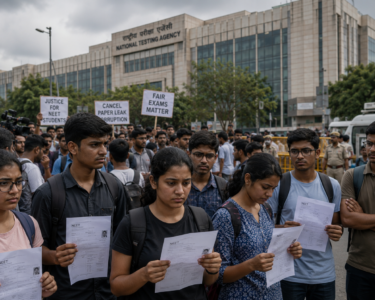
Three weeks later, on June 6, the group turned that online momentum into a physical sit-in at Jantar Mantar. The trigger was more serious than a courtroom remark: this year’s NEET-UG medical entrance exam was hit by an alleged paper leak, followed by a chaotic re-exam process and, protesters say, poor communication from the education ministry including in the case of a student’s suicide in Odisha after failing the re-conducted exam. Beyond Pradhan’s resignation, protesters and allied student groups such as the Students Federation of India and the All India Students Association have also demanded a scrapping of the National Testing Agency and broader reform of how competitive exams are run in India, a system that every year draws lakhs of anxious candidates competing for a limited number of seats.
Sonam Wangchuk’s Hunger Strike
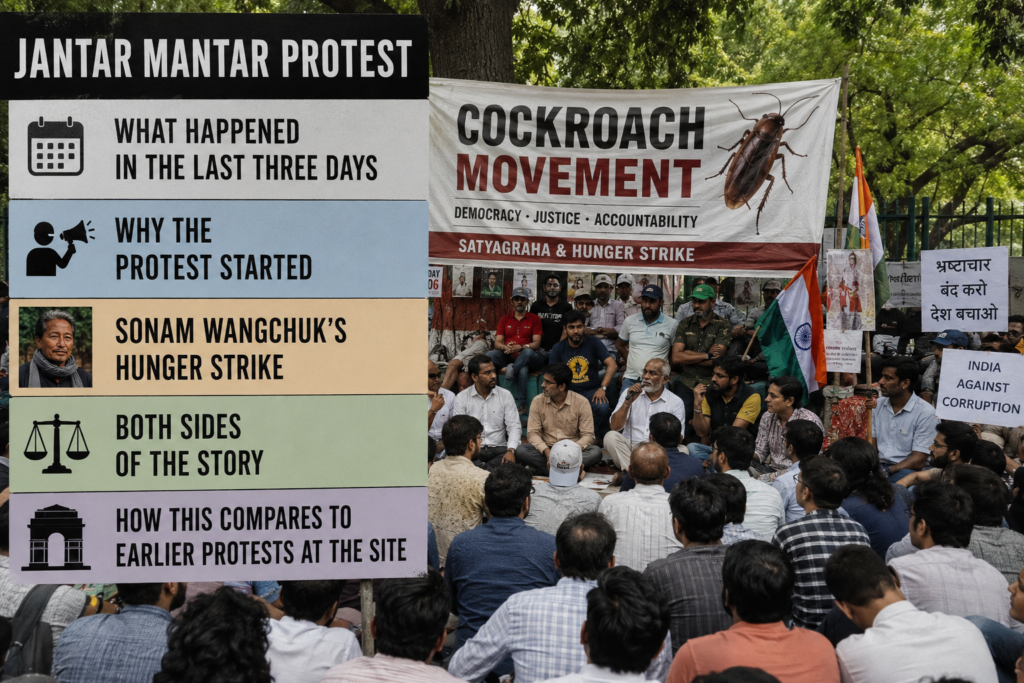
Ladakhi activist Sonam Wangchuk joined the protest with an indefinite hunger strike starting June 28. Over three weeks, his health declined, and on July 18 reportedly on court-ordered medical grounds he was moved to Safdarjung Hospital. His wife, Gitanjali Angmo, said the move happened without prior notice to her or Wangchuk, and that hospital staff would not share his medical reports with her; hospital authorities have not issued a detailed public account of the transfer to counter this. Doctors monitoring him have said he is stable but flagged a risk of hypokalemia (dangerously low potassium). Angmo said she would lead the planned march in his place.
Who’s Involved
- Cockroach Janta Party (CJP): Leading the sit-in, founded by Abhijeet Dipke.
- Sonam Wangchuk: Hunger-striking activist, currently hospitalized.
- Student groups: Students Federation of India, AISA, and AISF.
- Opposition parties: Congress (Rahul Gandhi), with former Delhi CM Arvind Kejriwal joining on July 16.
- Dharmendra Pradhan and the education ministry: Have rejected resignation calls and offered talks on the NEET-UG issue.
- Delhi Police: Managing the site and Monday’s march, disputing claims that the response was excessive.
Both Sides of the Story
Protesters describe the movement as a peaceful, youth-led demand for accountability on exam fairness, and say Monday’s police response was heavy-handed against a largely unarmed crowd. Delhi Police, meanwhile, points to the 118 injured officers as evidence that the march itself turned volatile before force was used, and maintains that Jantar Mantar remains an approved protest site under normal conditions.
On the political question, Pradhan and the BJP have argued that the opposition is using genuine student grievances to disrupt a parliamentary session, noting that resignation demands over exam controversies are a recurring opposition tactic rather than new. Congress and allied parties counter that repeated exam failures NEET-UG, UGC-NET, and CBSE evaluation issues among them show a pattern the ministry has been unwilling to address directly. Neither claim has been independently adjudicated, and readers should treat both as competing political positions rather than settled fact.
How This Compares to Earlier Protests at the Site
Jantar Mantar has been India’s designated protest ground for decades, hosting everything from the 2012 Nirbhaya demonstrations to farmer sit-ins and earlier Ladakh statehood marches. What makes this Jantar Mantar Delhi protest different is its combination of online reach and physical staying power: the CJP crossed 10 million Instagram followers within days of forming, and the camp itself has now run continuously for over a month through peak Delhi summer heat. That mix of virality and endurance is a large part of why it has pulled in opposition leaders, state chief ministers, and now a direct public response from the education minister even though, by the government’s own account, none of the underlying demands have been agreed to yet.
What’s Next
Two things will likely decide how this plays out. First, Wangchuk’s health: doctors say his condition needs close monitoring, and any serious deterioration could shift public sentiment quickly regardless of the political back-and-forth. Second, whether the government’s offer of “detailed discussion” on NEET-UG turns into an actual scheduled meeting or parliamentary debate so far, no date has been confirmed for either. Until one of those moves, expect the Jantar Mantar Delhi protest to continue as a running standoff: opposition MPs raising it in Parliament, CJP supporters holding the site, and both sides sticking to their current positions.
Jantar Mantar Delhi Protest: Frequently Asked Questions
What is the Jantar Mantar Delhi protest about?
It is a sit-in by the Cockroach Janata Party and student groups demanding Education Minister Dharmendra Pradhan’s resignation and NEET-UG exam reforms, following an alleged paper leak.
When did the Jantar Mantar Delhi protest start?
The Cockroach Janta Party was founded on May 16, 2026; the sit-in at Jantar Mantar itself began on June 6, 2026.
Why is it called the Cockroach Janta Party?
The name comes from a Supreme Court remark where Chief Justice Surya Kant allegedly compared unemployed youth to “cockroaches.” The party turned this into a satirical symbol of resilience.
What is the NEET-UG 2026 controversy?
A “guess paper” with around 410 questions was allegedly circulated before the May 3 exam. About 120 of those questions matched the actual Chemistry section, leading to the exam’s cancellation and a CBI probe.
Is Sonam Wangchuk still on hunger strike?
He was moved to Safdarjung Hospital on July 18, 2026 after his health declined; doctors describe him as stable but are monitoring him for hypokalemia.
Who is leading the Jantar Mantar Delhi protest?
Abhijeet Dipke of the Cockroach Janta Party, with support from student unions, Sonam Wangchuk, and opposition leaders including Rahul Gandhi and Arvind Kejriwal.
How many people were injured in the July 20 clash?
Delhi Police reported close to 180 injuries, 118 police personnel and 60 protesters, a figure protesters and opposition leaders have disputed as incomplete.
Has the government responded to the protesters’ demands?
Education Minister Dharmendra Pradhan has rejected calls to resign and said the government is willing to hold discussions on the NEET-UG irregularities, while accusing the opposition of political exploitation.
How long will the Jantar Mantar Delhi protest continue?
Protesters say they will stay until their demands are met. There is no confirmed end date, and the standoff is expected to continue until there is a concrete government response or a significant shift in Wangchuk’s health.
Where is the Jantar Mantar Delhi protest taking place?
At Jantar Mantar on Parliament Street in central New Delhi, near Connaught Place.
Further Readings-
NEET Exam Paper Leak 2026: Dharmendra Pradhan Resignation Demand, Political Fallout Explained
Nitin Gadkari’s Ethanol Push | What E85 and E100 Mean for India