
 By
By India’s UPI payment system is entering a new phase from October 15, 2026, and the announcement has created confusion among millions of digital payment users. The biggest question is simple: Will people have to pay for using UPI?
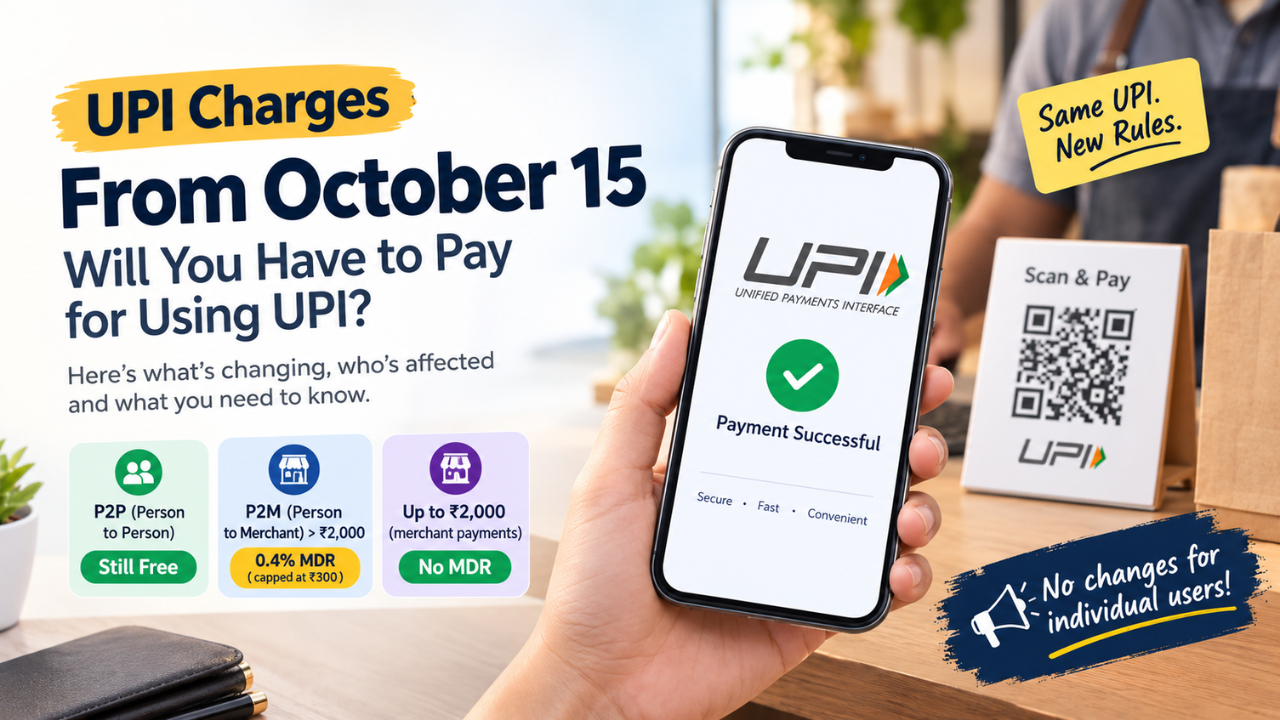
The answer is not a straightforward yes. The new framework introduces Merchant Discount Rate (MDR) on certain merchant payments above ₹2,000. However, person-to-person transfers will continue to remain free. Payments to merchants up to ₹2,000 will also remain free of MDR, while eligible small merchants will continue under the zero-MDR framework.
This means the new UPI Charges are mainly about how larger merchant transactions are handled inside the payment ecosystem, rather than turning UPI into a paid service for ordinary users.
Let’s break down exactly what is changing, who may be affected and what users should know before October 15.
Also read about: BRICS Summit 2026 | OpenAI News Today | Dell Display Problem | Getting Files Ready for Installation Stuck
UPI Charges From October 15: What Is Changing?
The major change is the introduction of MDR for specified person-to-merchant (P2M) UPI transactions above ₹2,000.
Under the new framework, eligible transactions above ₹2,000 will attract an MDR of 0.4%. For transactions worth ₹75,000 or more, the MDR will be capped at ₹300 per transaction.
But there is an important point that often gets lost in headlines about UPI Charges.
MDR is not the same thing as a customer transaction fee.
The government says the MDR is a charge within the merchant payment ecosystem and is distributed among participating entities such as banks and payment service providers. It is not a tax collected by the government or NPCI.
At a glance
| Transaction | What happens? |
| ₹500 to a merchant | No MDR |
| ₹2,000 to a merchant | No MDR |
| ₹5,000 eligible merchant payment | 0.4% MDR |
| ₹10,000 eligible merchant payment | 0.4% MDR |
| ₹50,000 eligible merchant payment | 0.4% MDR |
| ₹75,000 or more | MDR capped at ₹300 |
| Money sent to another person | Free |
So, the new UPI Charges framework is targeted rather than universal.
Will UPI Users Have to Pay Any Charges?
For ordinary consumers, the announced framework does not introduce a direct UPI payment fee.
The government has specifically stated that individuals will continue to be able to send and receive money through UPI without transaction, platform or other charges. Banks have also been advised to ensure that merchants do not pass the MDR directly to customers.
This distinction matters because a headline saying “UPI will be chargeable” can easily make users believe that every scan-and-pay transaction will now carry an additional fee.
That is not what the framework says. Understanding these UPI Charges is important before assuming that every digital payment will cost extra.
For example, imagine that you purchase a product worth ₹5,000 from an eligible merchant.
The applicable MDR would be:
₹5,000 × 0.4% = ₹20
That ₹20 is part of the merchant payment ecosystem’s MDR arrangement. It does not mean that the customer should suddenly see a ₹20 UPI fee added to the bill.
The government’s framework specifically says consumers should not be charged the MDR separately.
Sending Money to Friends and Family Will Remain Free
One of the most important things to understand about UPI Charges is the difference between P2P and P2M payments.
P2P means Person-to-Person
Examples include:
- Sending ₹5,000 to a friend
- Sending ₹20,000 to your parents
- Transferring money to another personal bank account
- Sending money to a family member
- Moving money between your own accounts
These transactions remain outside the new MDR framework.
The government says all P2P UPI transactions will remain free regardless of the amount transferred.
So, sending ₹10,000 to a friend will not suddenly become a paid UPI transaction simply because the amount is above ₹2,000.
P2M means Person-to-Merchant
This is different.
Examples include:
- Paying a restaurant
- Buying electronics from a retailer
- Paying a business
- Paying a service provider
- Making an eligible commercial purchase
The new MDR framework mainly applies to specified P2M transactions above ₹2,000.
That P2P versus P2M distinction is the key to understanding the new UPI Charges.
What Happens to UPI Payments Below ₹2,000?
For merchant payments up to ₹2,000, the government says MDR will remain zero.
That means everyday small-value payments will continue without the new MDR. This is an important part of the UPI Charges framework because many everyday transactions fall below this threshold.
Think about the kinds of payments many people make every day:
- ₹100 for tea
- ₹250 for snacks
- ₹450 at a local shop
- ₹700 for groceries
- ₹1,200 at a restaurant
- ₹1,800 for a small purchase
These payments fall below the ₹2,000 threshold.
The government says approximately 96% of P2M transactions will remain unaffected, because they are either below the threshold or covered by the zero-MDR framework for small merchants.
This means the introduction of UPI Charges does not represent a blanket fee on every merchant payment.
How Much Is the New UPI MDR?
The standard MDR for specified merchant transactions above ₹2,000 is 0.4%.
Here is what that looks like in simple numbers:
| Payment amount | 0.4% MDR calculation |
| ₹3,000 | ₹12 |
| ₹5,000 | ₹20 |
| ₹10,000 | ₹40 |
| ₹25,000 | ₹100 |
| ₹50,000 | ₹200 |
| ₹75,000 | ₹300 |
| ₹1,00,000 | ₹400, but capped at ₹300 |
For transactions of ₹75,000 and above, the MDR is capped at ₹300 per transaction.
Therefore, the percentage calculation does not continue indefinitely for larger transactions. This cap is particularly relevant for high-value merchant payments covered by the new UPI Charges structure.
Some Sectors Will Have a ₹5 Flat MDR
Not every transaction above ₹2,000 will follow the standard 0.4% structure.
The government has created a separate flat MDR of ₹5 per transaction for certain essential and relatively thin-margin sectors.
These include categories such as:
- Railways
- Telecommunications
- Insurance
- Fuel
- Agricultural inputs
For eligible transactions above ₹2,000 in these categories, the flat MDR is ₹5.
For example, a qualifying ₹10,000 fuel payment would not automatically generate a 0.4% MDR of ₹40. Instead, the applicable flat MDR would be ₹5 under the specified category.
This sector-based structure is one reason why users should not assume that every large UPI transaction will have exactly the same UPI Charges.
What About Small Shops and Street Vendors?
Small merchants are another important part of the new framework.
The government says small merchants receiving up to ₹1 lakh per month through UPI QR codes under the P2PM category will continue to receive zero MDR on their transactions.
This provision is designed to protect businesses such as:
- Street vendors
- Small neighbourhood stores
- Local retailers
- Micro businesses
- Small service providers
It also means that one transaction above ₹2,000 does not automatically mean every small merchant will suddenly become liable for MDR.
The applicable classification and conditions matter. For India’s huge network of small businesses, this is an important part of the new UPI Charges framework.
What Is Merchant Discount Rate or MDR?
If you have never heard the term MDR before, it is quite simple.
MDR stands for Merchant Discount Rate.
It refers to the fee associated with processing certain merchant payments.
Under the new UPI framework, the MDR is shared among participants in the payment ecosystem, including banks, payment service providers and UPI application providers.
The government has clarified that MDR is not a government tax.
This is an important distinction because social media discussions have sometimes used the terms “tax” and “UPI Charges” interchangeably.
They are not the same thing.
The new MDR is a payment-processing charge within the ecosystem.
Why Is UPI Introducing MDR Now?
UPI has grown enormously over the years. As transaction volumes increase, the infrastructure supporting the system also needs continuous investment.
The government says the new framework is intended to support the long-term sustainability of UPI, while continuing to protect individuals and small merchants from additional charges.
The payment ecosystem requires investment in areas such as:
- Digital payment infrastructure
- Cybersecurity
- Fraud prevention
- Technology
- Payment networks
- System reliability
- Merchant acceptance infrastructure
The MDR framework creates a revenue mechanism for participants involved in processing eligible larger merchant transactions.
The government has therefore positioned the new UPI Charges framework as a sustainability measure rather than a general fee imposed on UPI users.
This is a good position because the article has already explained the official reason for introducing MDR. The screenshot can then introduce a different public perspective.
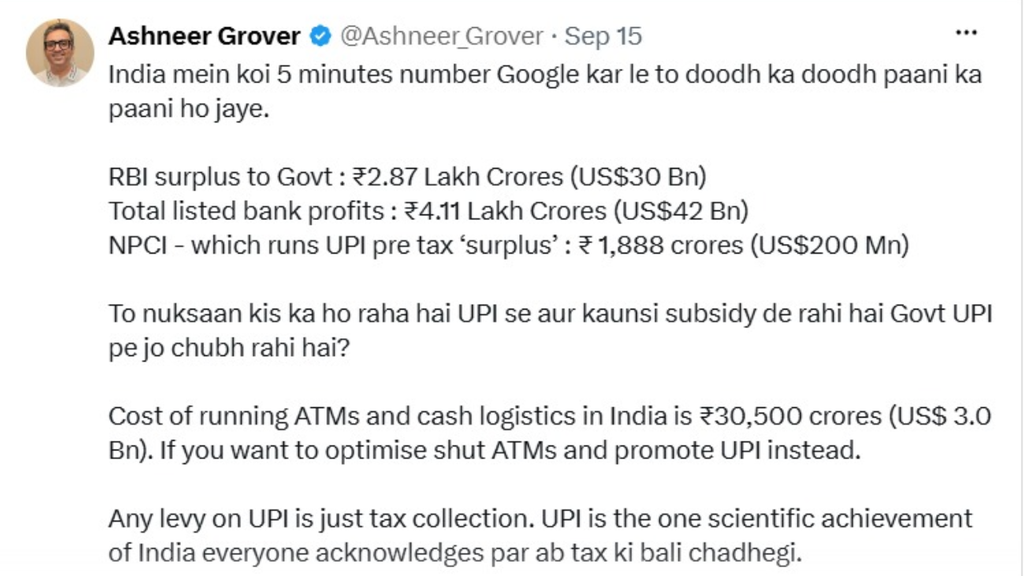
Importantly, present the statements in the screenshot as Ashneer Grover’s claims and questions, rather than presenting the figures in the post as independently verified facts.
RBI’s Explanation of the New UPI Charges
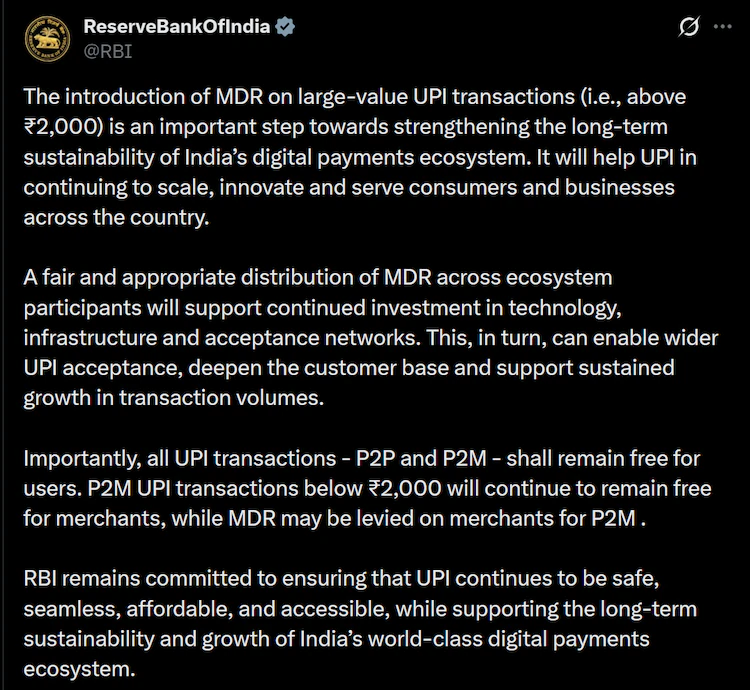
The Reserve Bank of India has also explained the change in terms of the long-term sustainability of India’s digital payment ecosystem.
The RBI says the introduction of MDR on large-value UPI transactions can support continued investment in technology, infrastructure and acceptance networks.
It has also emphasized that UPI transactions between individuals will remain free and that merchant payments below the applicable threshold will continue without MDR.
The broader objective is to allow UPI to continue expanding while creating a mechanism to support the infrastructure behind the system.
This image works particularly well here because it directly relates to the official explanation discussed in the section.
Using the two screenshots at these separate points also makes the article more engaging without interrupting the main explanation of UPI Charges.
Will UPI Become Expensive After October 15?
For everyday users, the answer under the announced framework is not in the way many headlines suggest.
There is no blanket charge for using UPI.
Instead, the framework creates different categories based on:
- Who is receiving the payment
- How much money is being transferred
- What type of merchant or service is involved
- Whether the merchant qualifies for zero MDR
- Whether the transaction falls into a special sector
This means two UPI payments of the same value can potentially have different MDR treatment depending on the transaction category.
For consumers, the most important point remains that the MDR is not supposed to be separately passed on as a UPI fee.
Understanding these categories is essential when reading reports about UPI Charges.
What About Mutual Funds and Stock Market Payments?
Capital-market payments have their own MDR structure.
Transactions involving categories such as mutual funds, securities, stockbrokers and dealers will attract an MDR of 0.02%, subject to a ₹300 cap per transaction.
This is considerably different from the standard 0.4% MDR for specified merchant transactions.
The separate rate reflects the fact that financial-market payments are treated as a distinct transaction category under the framework.
For people using UPI to make investment-related payments, this is another important distinction to keep in mind when reading about UPI Charges.
A Simple Example of How the New System Works
Let’s take four different situations.
Example 1: Paying a friend ₹10,000
This is P2P.
Result: No MDR.
There is no new UPI Charges fee simply because the transfer is above ₹2,000.
Example 2: Buying a television for ₹50,000
This is a merchant transaction.
If it falls within the specified standard P2M category:
0.4% of ₹50,000 = ₹200 MDR.
The MDR is a merchant-side payment ecosystem charge.
Example 3: Paying ₹10,000 for an eligible fuel transaction
This falls under a specified essential sector.
Applicable MDR: ₹5.
Example 4: Buying groceries for ₹1,500
The payment is below ₹2,000.
MDR: ₹0.
These examples show why simply saying “UPI will become chargeable” doesn’t explain the full picture of UPI Charges.
What Users Should Know Before October 15
There are five simple points worth remembering.
1. UPI is not becoming a paid service for everyone
The new framework does not impose a blanket fee on users. The announced UPI Charges apply through specific MDR categories rather than as a universal consumer fee.
2. P2P transfers remain free
Sending money to another person remains outside the MDR framework.
3. ₹2,000 is an important threshold
Specified merchant payments above ₹2,000 are where the standard MDR framework begins.
4. The standard rate is 0.4%
For eligible transactions, the MDR is 0.4%, with a maximum of ₹300 for transactions of ₹75,000 and above.
5. Most merchant transactions remain unaffected
The government estimates that approximately 96% of P2M transactions will remain unaffected.
These five points provide a quick overview of the announced UPI Charges changes.
What Does This Mean for India’s UPI Future?
The new framework marks a shift in how the economics of UPI payments are structured.
For years, users have become accustomed to making digital payments without thinking about the underlying payment infrastructure. A QR code scan may take only a few seconds, but behind that payment are banks, payment service providers, technology systems and security infrastructure.
The new MDR framework attempts to create a mechanism for supporting those participants on selected higher-value merchant transactions.
At the same time, the framework keeps the most common low-value payments and P2P transfers outside MDR.
That balance is likely to remain an important part of the conversation around UPI Charges after October 15.
As merchants and payment providers adapt to the new structure, users may also see more discussion around how UPI Charges affect different categories of payments.
UPI Charges: The Bottom Line
The upcoming changes do not mean that every UPI payment will suddenly carry a fee.
From October 15, 2026, specified merchant transactions above ₹2,000 will come under the new MDR framework. The standard MDR is 0.4%, capped at ₹300 for transactions of ₹75,000 and above. Certain essential sectors will have a flat ₹5 MDR, while capital-market transactions will have a separate 0.02% rate with a ₹300 cap.
Meanwhile, person-to-person UPI transfers remain free, merchant payments up to ₹2,000 remain free of MDR, and qualifying small merchants continue under the zero-MDR framework.
For consumers, the biggest takeaway is therefore simple:
You do not need to stop using UPI because of the new UPI Charges. The announced framework is targeted mainly at specified higher-value merchant transactions, not ordinary person-to-person payments.
The bigger discussion will be about how merchants, banks and payment companies adapt to the new MDR structure and how the additional revenue supports the infrastructure behind India’s rapidly expanding digital payment ecosystem.
The most important thing for users is to understand the difference between a merchant-side MDR and a direct consumer fee when reading about UPI Charges.
Also read: How to Clean Computer Screen Safely | White Dots on Monitor | Green Dots on Laptop Screen | Why Is My Computer Screen Red Tinted?
Frequently Asked Questions
Q1: When will UPI Charges start?
The new MDR framework is scheduled to apply from October 15, 2026. These UPI Charges relate to specified merchant transactions under the announced framework.
Q2: Will I have to pay a UPI fee?
No direct UPI transaction fee is being introduced for consumers under the announced framework. The new UPI Charges primarily concern MDR within the merchant payment ecosystem.
Q3: Will sending money to friends cost money?
No. Person-to-person UPI payments will remain free regardless of the amount.
Q4: What is the UPI MDR rate?
The standard MDR for specified merchant transactions above ₹2,000 is 0.4%, subject to a ₹300 cap for transactions of ₹75,000 and above.
Q5: Will UPI payments below ₹2,000 remain free?
Yes. Merchant payments up to ₹2,000 will continue with zero MDR.
Q6: What happens to fuel and insurance payments?
Eligible transactions above ₹2,000 in specified sectors such as fuel and insurance will have a flat ₹5 MDR.
Q7: Will small shops have to pay MDR?
Eligible small merchants under the zero-MDR framework will continue to receive payments without MDR, subject to the applicable conditions.
Q8: Is UPI MDR a tax?
No. The government says MDR is a payment ecosystem charge and is not a tax collected by the government or NPCI.
Q9: Will these UPI Charges affect every UPI payment?
No. The announced framework distinguishes between P2P payments, merchant payments, transaction values, merchant categories and specific sectors.
Q10: Will customers directly pay the new MDR?
The announced framework does not provide for the MDR to be separately passed on to consumers as a UPI transaction fee.