
 By
By A heart attack is an emergency that is extremely time sensitive. Each minute that passes, the chances of heart muscle damage become worse. Knowing how to treat and manage heart attacks is beneficial to people recovering from heart attacks. However, this knowledge is critical for people with precursor conditions and family members of people with a history of heart attacks. Heart Attack Treatment and Management begins with recognizing symptoms early and getting emergency medical care immediately.
This guide has information from emergency responses to lifestyle changes that may be necessary in the long term. It will help you understand the entire process from the time you are diagnosed, the treatment you will receive in the hospital, the medicine that you will take to help you recover and the changes you can make to prevent another heart attack. This guide is for heart attack patients and caregivers, and people who are interested in heart attack treatment options before it is an emergency. It will be a step by step guide to help you better understand heart attack treatment options based on the approaches that cardiologists endorse.
Medical Disclaimer: The information in this article is for general educational purposes only and is not a substitute for professional medical advice, diagnosis, or treatment. Heart attacks are medical emergencies requiring immediate medical attention. Do not self-diagnose or start, stop, or change medications without consulting a qualified doctor. If you experience chest pain, breathing difficulty, sweating, dizziness, or other heart attack symptoms, seek emergency medical care immediately. Always consult a cardiologist for personalized treatment and recovery guidance. This guide was last fact-checked in August 2026 against current cardiology treatment guidelines.
What Happens During a Heart Attack
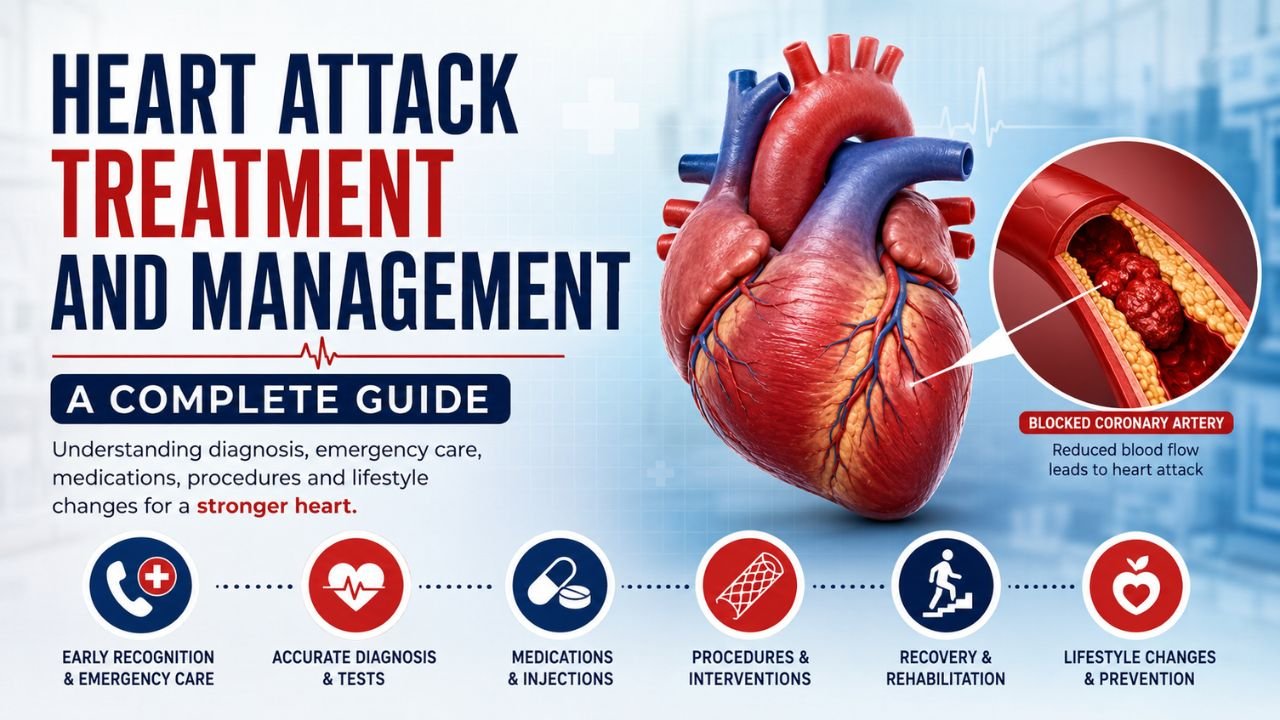
A heart attack, or myocardial infarction, happens when blood flow is blocked to a portion of the heart due to a clot lodged in a coronary artery. Heart muscle dies in minutes. This creates the urgency in heart attack treatment and management.
Management of a heart attack is time sensitive with a focus on the restoration of blood circulation. The flow of blood is restored to the heart, and additional heart muscle is preserved. Understanding Heart Attack Treatment and Management helps reduce heart muscle damage and improves survival.
The treatment of a heart attack is most successfully achieved with minimal time elapsed. The most crucial time sensitive treatment is the calling of emergency services. This treatment is most effective in the immediate recognition of the signs of a heart attack. Some of the signs are early chest pain or pressure; pain radiating to the arm, jaw, or back; shortness of breath; cold sweats; nausea; and lightheadedness. The effective treatment of a heart attack relies on the time measured in minutes and not in hours.
Also read: Heart Disease Explained | Burning Sensation in Chest
Diagnosing a Heart Attack: Tests and ECG Reports
The diagnosis of myocardial infarctions must be completed without delay prior to beginning treatment. The most common test utilized to diagnose a heart attack is an electrocardiogram (ECG or EKG) which uses a series of sticky electrodes placed on the chest to measure the heart’s electrical impulses.
Many patients want to know if there is a way to determine if the ECG report is normal at home or before the scheduled appointment. A very general answer is there should not be any significant ST segment elevation or depression, the rhythm should be regular, and there should be fairly uniform spacing of the identifications. Abnormal values in the report, however, can be almost undetectable. Sometimes even a report that looks normal to most people can be interpreted as the early sign of a myocardial infarction. Never attempt a diagnosis based on a report printout. The report should be reviewed by a cardiac specialist. Early diagnosis is the foundation of effective Heart Attack Treatment and Management.
An ECG will usually need to be supplemented with the following to determine a diagnosis of myocardial infarction:
- Blood tests for cardiac biomarkers (troponin): Troponin levels elevate upon injury of cardiac muscle.
- Chest X-ray: This is used to determine the size of the heart to assess whether it is over enlarged or to assist with the interpretation of the condition of the lungs.
- Echocardiogram: This is to assess the condition of the heart and the flow of blood.
- Coronary angiogram: This is used to determine the exact blockage to assist with a more invasive procedure.
In an emergency situation, a set of these tests permits myocardial infarction specialists to determine a diagnosis of heart attack in a matter of minutes. This is of utmost importance, as the course of treatment for a heart attack (clot-busting drugs or emergency angioplasty) is entirely contingent upon how rapidly and accurately the diagnosis has been made.
Emergency Medicine for Heart Attack
In emergency medicine, the first hour after the onset of heart attack symptoms is often referred to as the “Golden Hour.” There are specific treatments associated with this phrase.
1. Using oxygen to assist the heart’s tissue. Oxygen therapy supports Heart Attack Treatment and Management during emergencies.
2. Giving aspirin in the form of a chew (not a swallow) to begin the process of clot prevention. Aspirin is an important part of Heart Attack Treatment and Management.
3. Administering nitroglycerin to dilate the heart’s blood vessels to lessen the pain from a heart attack. Nitroglycerin helps improve Heart Attack Treatment and Management by reducing cardiac workload.
4. Lastly, Providing Morphine to lessen pain when nitroglycerin is ineffective. Pain control is another important aspect of Heart Attack Treatment and Management.
The goal of this rapid-response phase is to further facilitate emergency cardiac care by ensuring the patient is as stable as possible and as little damage to the heart has been incurred as possible. This phase also serves to create a time window for the possible start of more precise treatments (i.e. angioplasty, stent, or clot-busting drug) that are more involved and carry a higher risk than the treatments outlined above. Rapid Heart Attack Treatment and Management during the golden hour improves outcomes significantly.
Medications, Tablets, and Injections Used in Heart Attack Treatment
After heart attack patients are stabilized, treatment focuses on preventing blood clotting, easing the strain on the heart, and aiding in the long-term recovery of the patient. Four major medications comprise treatment after myocardial infarction:
- Anti-platelet medication: Anti-platelet therapies promote the smooth flow of blood.
- Beta blockers: Beta blockers decrease the workload of the heart by decreasing heart rate and blood pressure.
- ACE inhibitors: Like beta blockers, ACE inhibitors work to decrease the blood pressure and the long-term strain on the heart.
- Statins: Statins prevent future blockages in the arteries.
- Heparin: Heparin is a heart attack medication used during the heart attack to prevent blood clots.
Patients are most often concerned with the name of the heart attack medication they are prescribed. For example, some cardiologists in India prescribe anti-platelet combination medications like Elaxim 40. Elaxim 40 is used in combination with a number of other cardiac supportive medications, and is cited here as an example that patients may encounter in their prescriptions. This creates the urgency in heart attack treatment and management. As a general rule, patients should never self-prescribe or alter their dosage of any heart attack medications, as that type of decision should be made in consultation with a heart attack specialist. The kidney function of the patient, in addition to other medications, is a large factor in determining the appropriate course of treatment. Doctors personalize Heart Attack Treatment and Management based on each patient’s condition.
Heart Attack Recovery Timeline Week by Week
Recovery can be unpredictable. Still, there is a general timeline that most doctors follow for heart attack treatment and management. It is divided into phases of recovery. Continue following your Heart Attack Treatment and Management plan.
- In the first week: You rest in the hospital and begin the recovery process with light activity (like short walks).
- In the next one to three weeks: You are discharged and continue recovering at home. You will be fatigued, and get used to the new medication and scheduled doctor visits.
- In the first one to two months: You begin cardiac rehabilitation. This includes various exercises and training on eating right and managing stress.
- In the recovery months two to three: You can resume most daily activities and may be able to return to work.
- In the recovery months three to six: You continue to build strength and stamina and have follow-up visits to check if your medications should be adjusted.
Cardiologists should personalize recovery plans for their patients based on the heart attack and any subsequent interventions. Following the recommended Heart Attack Treatment and Management plan speeds recovery.
Medications After Heart Attack Side Effects
While many heart attack medications have side effects, most are manageable. Here’s a list of side effects that are normal vs. side effects that require medical attention:
- Aspirins/antiplatelets: Normal side effect is easy bruising or stomach irritation
- Beta blockers: Normal side effects are fatigue, and cold hands/feet, along with mild standing dizziness.
- Statins: Normal side effect is a muscle ache, however persistent pain should be reported to a doctor.
- ACE inhibitors: Dry cough is the normal side effect for some patients.
If the side effects that you experience are unusual, or persistent and severe, then you need to report them to your cardiologist. It is important that you do not self-manage. This is especially important for heart attack treatment and management, post-discharge. Patients should never stop Heart Attack Treatment and Management medicines without medical advice. This medicine plays an important role in Heart Attack Treatment and Management.
Cardiac Rehabilitation Program Near You
Cardiac rehabilitation is an excellent treatment and management option and is commonly overlooked. Cardiac rehabilitation is an exercise-focused program that offers stress management and nutrition education. Programs typically run for several weeks and are intentionally designed and medically supervised.
After a heart attack, patients who complete cardiac rehabilitation are shown to survive longer and have a reduced risk of subsequent heart attacks. Hospital protocols for cardiac rehabilitation vary, and in situations where patients are not automatically enrolled, speak to your care team and seek enrollment yourself. Do not wait for a referral. Cardiac rehabilitation is an essential part of Heart Attack Treatment and Management.
Heart-Healthy Diet Plan After Heart Attack: Indian Food Guide
From a financial perspective, nothing quite compares to the impact diet can have on long-term heart attack recovery and management. Don’t be mistaken, this doesn’t mean changing the foods you enjoy and love, especially influential meals on the Indian subcontinent. Just a change in preparation and cooking:
- Choose steaming, grilling with little to no oil in place of deep frying
- Replace refined flour with whole grains like brown rice, bajra, and jowar
- Introduce more legumes, dals, and vegetables
- Instead of ghee, butter, or coconut oil, use mustard or olive oil, in moderation of course
- Less added salt in pickles, papad, and packaged snacks
- In place of red meat, choose fish, chicken (preferably skinless), and plant proteins of your choice
Sustained heart recovery will be directly impacted by small slow changes integrated, more than the impact brought on by large temporary changes. A healthy diet supports long-term Heart Attack Treatment and Management. This dietary habit supports Heart Attack Treatment and Management.
Difference Between Angioplasty and Bypass Surgery
Two procedures dominate myocardial infarction treatment when medication alone isn’t enough:
- Angioplasty: This procedure requires minimal downtime because it is less invasive. A stent is guided to the blocked coronary artery by a catheter and balloon. Expect a shorter recovery time.
- Bypass surgery: This option is the more invasive, open heart surgery of the two. It creates a new pathway for blood to circulate through the heart by removing a healthy blood vessel from a different part of the body and placing it around the blocked coronary artery. This procedure is usually required when multiple heart blockages are present.
The severity and location of your blockages as revealed by your angiograms will determine which procedure your cardiologist will recommend. Both procedures are important options in Heart Attack Treatment and Management.
How Long Does a Stent Last After a Heart Attack?
Modern stents, especially the drug-eluting type, are meant to be permanent and keep the artery open indefinitely. They are not mechanical parts that need to be ‘replaced’; however, some type of antiplatelet medication will be needed long-term to minimize clot formation around the stent, which is likely to occur particularly in the first few months after stent placement. Regular follow-up is necessary after Heart Attack Treatment and Management involving stents.
Chest Pain After Stent Placement: Is It Normal?
Some level of discomfort or tenderness at the site of catheter insertion is normal in the days following the procedure. However, if you experience chest pain that resembles your heart attack symptoms, such as pressure, pain that radiates, or shortness of breath, this is not something you monitor at home. This is an emergency situation that requires immediate care, as this may mean a new obstruction or emergency concern has developed. Women should seek immediate Heart Attack Treatment and Management if symptoms appear.
Can You Fully Recover From a Heart Attack?
Following a heart attack, numerous patients go on to live long lives, and with heart attack treatments and management of their heart health via medications, cardiac rehabilitation, and changes to their lifestyle, this becomes even more likely. Because heart attacks vary so greatly from patient to patient, there is no standard for what “full recovery” even looks like. Following a heart attack, many patients with the right medical care and health screenings post-event are able to live a life complete with the level of activity they engaged in prior to the attack, or nearly.
Silent Heart Attack Symptoms in Women
Women can experience heart attacks in ways that differ from the “conventional” crushing chest pain. These atypical symptoms can include:
- Fatigue that can last for several days
- Difficulty breathing that can occur without any chest pain
- Nausea, back pain or jaw pain, and indigestion
- Profuse sweating without physical exertion
Due to the seemingly harmless nature of these symptoms, women are more likely to experience a silent heart attack that goes undiagnosed until a myocardial infarction is diagnosed. Because of this, early detection becomes very important for cardiovascular disease prevention for women. Women should seek immediate Heart Attack Treatment and Management if symptoms appear.
Exercise After Heart Attack: How Soon Can You Start?
Light activity, such as short, supervised walks, begins a few days after you are discharged from the hospital. Most supervised exercise through cardiac rehab begins 4 to 6 weeks after the event. This is because your cardiologist needs to confirm the heart has stabilized during the follow-up after the event. Exercise clearance is one of the most important safety checkpoints after a heart attack that you should never ignore. Exercise should always follow your Heart Attack Treatment and Management plan.
Heart Attack vs Cardiac Arrest: What’s the Difference?
These terms are used synonymously, but they do not refer to the same thing.
- A heart attack refers to a circulation issue. The arteries are blocked and therefore blood cannot reach a part of the heart muscle. The affected individual is usually still conscious and breathing when the attack occurs.
- Cardiac arrest refers to an electrical issue. The heart is unable to beat effectively and ceases to function. The individual loses consciousness immediately when this occurs. CPR and defibrillation are vital to this condition. The standard heart attack treatment is not sufficient for this.
An untreated heart attack can result in cardiac arrest. This emphasizes the need for an emergency response for heart attack patients. Prompt Heart Attack Treatment and Management prevents life-threatening complications.
Second Heart Attack Risk Factors and Prevention
First heart attack risk factors for a repeat event include high cholesterol, blood pressure, smoking, diabetes, and obesity. Not taking prescribed medications is also a risk. Continuous management of the heart attack and regular monitoring of labs and checkups reduce the risk during the course of treatment.
How to Prevent Another Heart Attack Naturally
While we will always support the use of medications, we also support natural, lifestyle-based strategies that people can use to help support long-term recovery. These strategies include the following:
- Once your doctor gives permission, do at least 30 minutes of moderate activity most days of the week.
- Make sure you are getting sufficient sleep (which is 7-9 hours per night).
- Stress can be managed by mindfulness, support groups, or counseling. All of these are great ways to minimize stress.
- Both smoking and alcohol should be avoided.
- Make sure you are seeing the doctor regularly to pay attention to your blood pressure, cholesterol, and blood sugar.
These natural strategies should complement the medication and medical follow-ups you are doing. Lifestyle changes complement Heart Attack Treatment and Management. This habit strengthens Heart Attack Treatment and Management outcomes.
Insurance Coverage for Heart Attack Treatment in India
The cost of angiograms, blood tests, and interventional procedures for the treatment of heart attacks can be very high. Since the cost for emergency heart care is typically included in most comprehensive health insurance policies, purchasing emergency health insurance policies can be a good option, however, the completeness of the coverage can be very different between the insurer, the specific policy, and case-to-case based pre-existing conditions. It is highly recommended that patients examine the specific details of their health insurance policy related to cardiac care, and the hospitals where cashless services can be availed, because implementing health insurance is an extremely difficult task that will cause severe delays during the treatment of an active heart attack compared to the time required to read the insurance policy and understand its coverage. Financial planning is also an important aspect of Heart Attack Treatment and Management.
Warning Signs Before a Heart Attack: Days Before
Some patients report early symptoms before a heart attack, including:
- Unexplained tiredness or weakness
- Chest pain that comes and goes and is mild
- Breathing that is more difficult for ‘normal’ activity
- Sleeping problems or heightened levels of anxiety
Although easy to miss, these symptoms should be reported to a doctor as an early diagnosis of a heart attack improves prognosis significantly compared to the patient waiting for a heart attack that is a fully developed emergency. Recognizing these warning signs supports early Heart Attack Treatment and Management.
Cardiac Rehabilitation Exercises at Home
Many patients perform light home exercises as a part of their recovery plan between supervised therapy sessions. These exercises might include:
- Increasing the duration of short walks on the ground
- Gentle stretching and mobility exercises done from a chair
- Breathing exercises to help improve lung capacity
- Light resistance work once given the green light by a cardiac rehab specialist
Exercises you do at home should always follow the specific guidance or exercises of your rehab program. These home exercises are a means of enhancing the rehab program and should never be a means of substituting the exercises given by the rehab program. Home-based rehabilitation complements Heart Attack Treatment and Management under medical supervision.
Mental Health After Heart Attack: Depression and Anxiety
Undergoing a heart attack is a frightening experience, adapting post-event often involves psychological trauma in the form of anxiety, sadness, or the fear of reoccurrence. Sadly, even if the management and treatment of the physical trauma have improved, the same can’t be said for the treatment of the psychological aftermath. Some cardiac rehabilitative programs have started integrating counseling and/or the recommendation of support groups. If you feel your mood has not improved or are still dealing with anxiety, it is critical to communicate your concerns to your healthcare team. Do not let anxiety and mood issues go unchecked. Mental health support improves overall Heart Attack Treatment and Management outcomes.
How Soon Can You Go Back to Work After a Heart Attack?
This really depends on the treatment you received and the nature of your job. For patients who underwent angioplasty with stent placement, it is common that they can return to work that involves sitting after 1-2 weeks. However, for patients who underwent bypass surgery, returning to work may take 6-8 weeks or even longer in the case of patients whose job is physically active. Your cardiologist will help you with this decision as they will be managing your heart attack treatment. These recommendations cover every stage of Heart Attack Treatment and Management, from emergency care to long-term recovery.
Conclusion
Heart Attack Treatment and Management is a lifelong process. Committed to heart health, this process begins with the recognition of symptoms and immediate care, then the taking of medications to promote health, a change in diet, physical activity, regular follow up visits to the doctor. The process is essential to recovery from heart attack and to the prevention of further heart issues. Timely management of symptoms and early diagnosis of heart attack can increase chances of survival and the quality of life of the patient. Even after a heart attack has happened, significant improvements can be made to heart function with the right lifestyle changes.
In the case of attack symptoms, do not hesitate to call for emergency services. The help given by first responders is essential. Make sure to follow up and meet with a cardiologist after symptoms of a heart attack. The cardiologist will be able to develop a plan of management and treatment specific to the individual in order to promote overall improvement to the individual and prevent heart issues in the future.
Also read: Black Fungus Treatment | Right Side Chest Pain | Left Side Chest Pain Causes | Angina Pectoris Drugs
Frequently Asked Questions
Q1: What should I do first during a heart attack?
Call emergency medical services immediately and avoid driving yourself to the hospital.
Q2: How is a heart attack diagnosed?
Doctors commonly use an ECG, blood tests for troponin, echocardiography, and coronary angiography.
Q3: What medicines are used after a heart attack?
Treatment may include antiplatelets, beta blockers, ACE inhibitors, statins, and other medicines prescribed by your doctor.
Q4: How long does heart attack recovery take?
Recovery varies by person and treatment, but it may take several weeks to months with medical follow-up and cardiac rehabilitation.
Q5: Is cardiac rehabilitation necessary after a heart attack?
Cardiac rehabilitation can support recovery through supervised exercise, nutrition guidance, education, and stress management.
Q6: Can you exercise after a heart attack?
Yes, but exercise should restart gradually and only according to your cardiologist’s recommendations or cardiac rehabilitation plan.
Q7: Can a person fully recover after a heart attack?
Many people can return to active lives with appropriate treatment, medication, rehabilitation, and healthy lifestyle changes.
Q8: How can I reduce the risk of another heart attack?
Take prescribed medicines, avoid smoking, follow a heart-healthy diet, stay physically active as advised, manage risk factors, and attend regular checkups.


1 Comment