 By
By Quick Answer
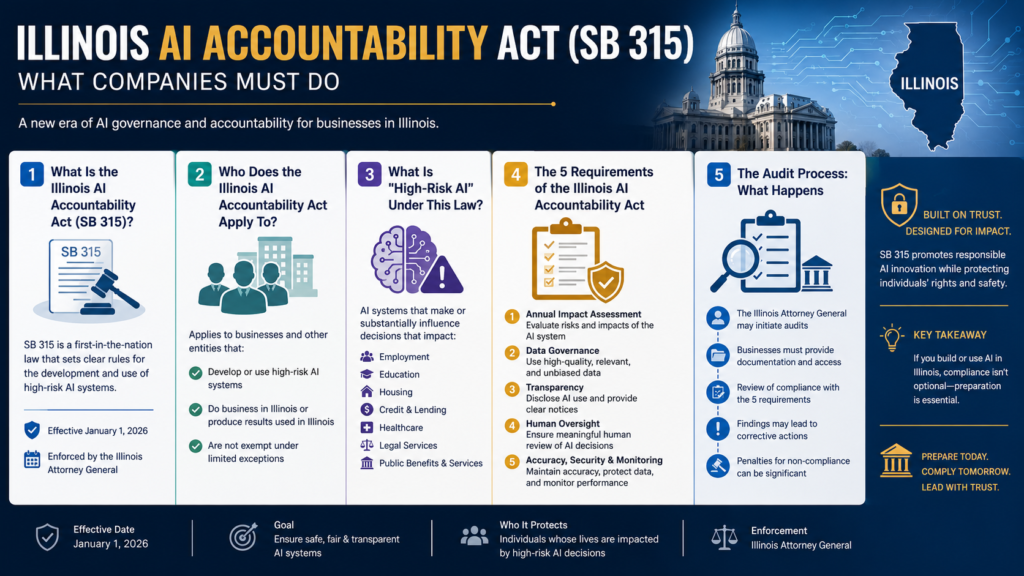
The Illinois AI Accountability Act (SB 315) is the first U.S. state law mandating third-party AI safety audits. It applies to companies with over $100 million in global revenue that deploy high-risk AI affecting Illinois residents. Requirements: annual independent audits, public summary of findings, written governance policies, and consumer notification for adverse AI decisions. Penalties reach $50,000 per violation. First audit reports are due March 31, 2027.
What Is the Illinois AI Accountability Act (SB 315)?
Illinois just made it illegal to deploy high-stakes AI without proving it’s safe first.
The Illinois AI Accountability Act (SB 315), signed March 15, 2026, is the first U.S. law requiring companies to submit their AI systems to independent third-party safety audits. Governor JB Pritzker signed it after the General Assembly passed it 78-37. No more self-certification outside experts must verify your AI isn’t biased, broken, or dangerous.
“This is the moment AI accountability stopped being a corporate talking point and became a legal requirement.” — Dr. Marcus Webb, AI Governance Fellow, Brookings Institution
Timeline
| Date | Milestone |
| March 2026 | Signed into law |
| July 2026 | AG releases draft audit rules |
| January 1, 2027 | Law takes effect |
| March 31, 2027 | First audit reports due |
Who Does the Illinois AI Accountability Act Apply To?
You must comply if all three apply:
- $100M+ global annual revenue
- AI makes consequential decisions about people (hiring, lending, housing, healthcare)
- Those people include Illinois residents even if you’re headquartered elsewhere
Think you’re safe because you’re not in Illinois? Think again. A San Francisco fintech company must comply if even one loan goes to someone in Chicago.
Covered vs. Exempt
Table
| Covered | Exempt |
| Fortune 500 with AI hiring tools | Companies under $100M revenue |
| Banks using AI for credit decisions | Spam filters, inventory forecasting |
| Health insurers with AI claims processing | Internal R&D (no consumer impact) |
| Landlords using AI tenant screening | Already federally regulated (FDA devices) |
| Schools using AI admissions tools | Basic recommendation engines |
What Is “High-Risk AI” Under This Law?
The Illinois AI Accountability Act targets AI that makes or heavily influences consequential decisions about a person’s job, home, money, health, education, freedom, or benefits.
The 7 Covered Categories
Table
| Category | Examples |
| Employment | Resume screeners, interview analyzers, performance prediction |
| Housing | Tenant screening, rent pricing, mortgage approval, eviction scoring |
| Credit & Lending | Credit scoring, loan approval, insurance premium calculation |
| Healthcare | Diagnostic AI (non-FDA), treatment recommendations, triage |
| Education | Admissions screeners, essay graders, financial aid allocation |
| Criminal Justice | Bail risk assessment, sentencing tools, recidivism prediction |
| Public Benefits | Welfare eligibility, disability scoring, benefit allocation |
The 5 Requirements of the Illinois AI Accountability Act
1. Annual Third-Party AI Safety Audits
Hire an Illinois-certified independent auditor to evaluate your high-risk AI. They test for: bias across demographic groups, robustness under edge cases, decision explainability, security vulnerabilities, and training data quality. First audit due March 31, 2027. Then annually.
2. Publish a Public Summary
Within 30 days of audit completion, post a summary on your website covering: systems audited, risk level assigned, key findings, remediation actions, and auditor certification number. Full reports and proprietary algorithms stay private under trade secret law.
3. Written AI Governance Policies
Maintain documented policies for: AI risk assessment, human oversight protocols, bias testing frequency, training data governance, incident response, and employee training.
4. Consumer Notification
When AI makes an adverse decision (loan denial, job rejection, eviction flag), notify the individual: that AI was involved, their right to human review, key decision factors, and how to appeal.
5. Record Retention
Table
| Record | Retention |
| Audit reports and summaries | 5 years |
| AI governance policies | Duration + 3 years |
| Training data documentation | 3 years |
| Consumer complaints | 5 years |
The Audit Process: What Happens
Month 1: Select Your Auditor
The Illinois Attorney General will publish certified auditor lists by August 2026. Get quotes from 3-5 firms with AI fairness expertise and regulatory experience.
Month 2: Document Review
Auditors review your system architecture, training data, bias tests, oversight protocols, incident logs, and governance policies. Start documenting now don’t scramble later.
Month 3: Technical Testing
Table
| Test | What It Checks |
| Demographic parity | Equal approval rates across racial groups |
| Equalized odds | Balanced false positives/negatives across genders |
| Adversarial testing | Behavior under manipulated inputs |
| Robustness | Performance with noisy or incomplete data |
| Explainability | Can a regular person understand the decision? |
| Security | Vulnerability to prompt injection or data poisoning |
Month 4: Findings & Remediation
The auditor delivers a draft report with issues and recommendations. You fix critical problems before the final report. Reality check: Almost no AI passes every test. The goal is showing you know your risks and manage them.
Month 5: Final Report & Disclosure
Receive certification, write a public summary, post on your website, and file with the Illinois Attorney General.
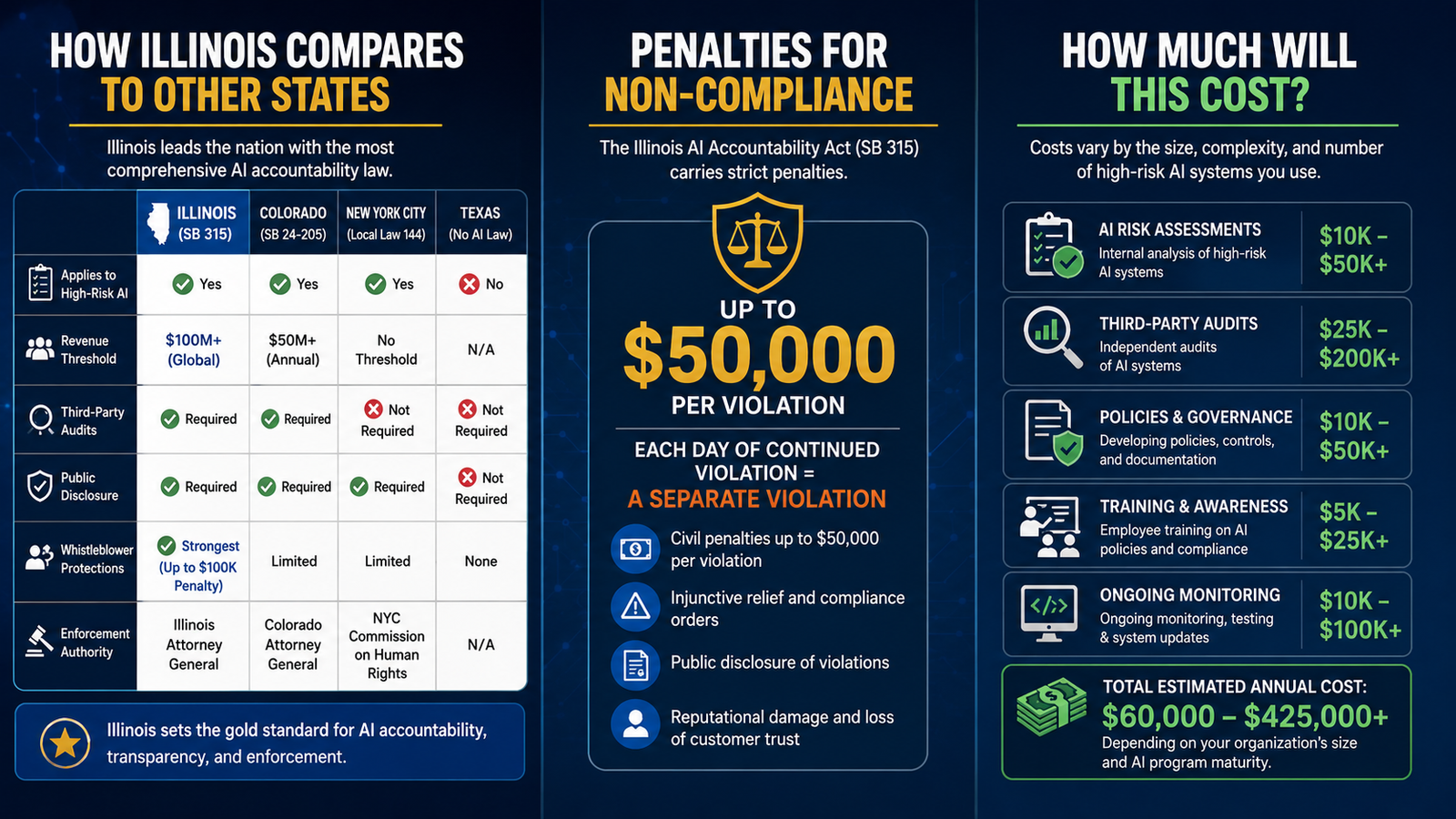
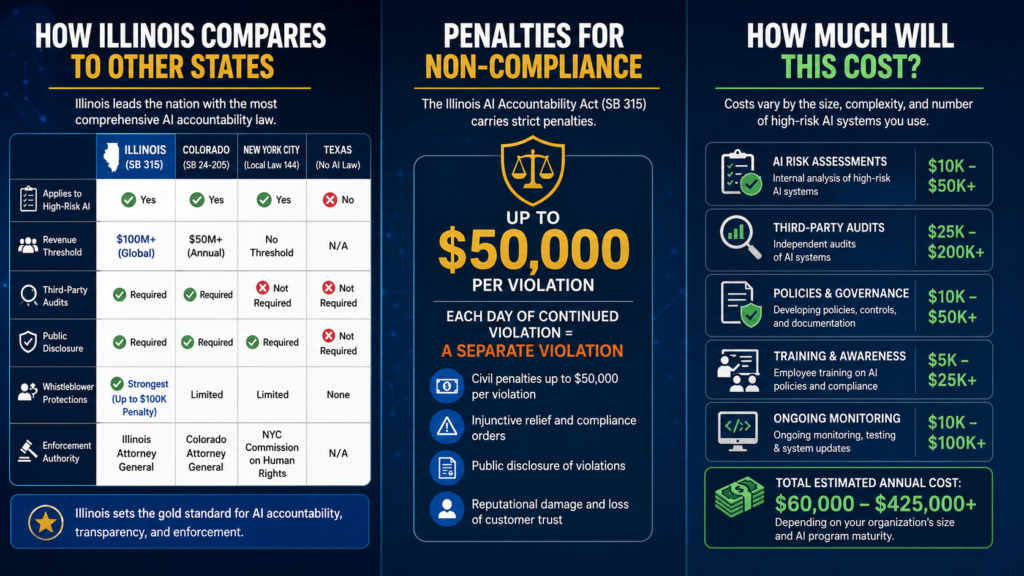
How Much Will This Cost?
Table
| Company Size | Systems Audited | First-Year Cost | Annual After |
| Mid-size ($100M–$1B) | 1–2 tools | $75K–$150K | $45K–$90K |
| Large ($1B–$10B) | 5–10 systems | $250K–$500K | $150K–$300K |
| Fortune 500 ($10B+) | 10+ systems | $500K–$1.2M | $300K–$720K |
Hidden costs: Staff time (200+ hours), remediation work, legal review, system downtime. Budget 1.5× the audit fee for total first-year compliance.
Penalties for Non-Compliance
Table
| Violation | Fine | Example |
| Skipping annual audit | Up to $50,000 | Missing March 31, 2027 deadline |
| No public summary | Up to $25,000 | Keeping results internal |
| No governance policies | Up to $15,000 | Missing written procedures |
| No consumer notice | Up to $10,000 per instance | 100 undisclosed rejections = $1M+ |
| Retaliating against whistleblowers | Up to $100,000 | Firing safety reporter |
| False summary statements | Up to $75,000 | Misrepresenting findings |
Enforcement: Illinois Attorney General handles it. First offense gets a 90-day cure period. No private right of action individuals can’t sue directly.
How Illinois Compares to Other States
Table
| Feature | Illinois SB 315 | Colorado | NYC LL 144 |
| Effective | Jan 1, 2027 | Feb 1, 2026 | July 2023 |
| Revenue threshold | $100M global | None | None |
| Audit | Mandatory third-party | Self-audit OK | Mandatory third-party |
| Public disclosure | Yes | No | Yes |
| Max penalty | $50K per violation | Injunctive + damages | $500–$1,500 per violation |
| Scope | All high-risk AI | Employment, housing, finance | Hiring only |
Why OpenAI and Anthropic supported it: Big labs can afford audits. Smaller competitors can’t. This builds a regulatory moat. But independent audits are genuinely good for safety the Illinois AI Accountability Act aligns business interests with public interest.
6-Month Compliance Roadmap
Table
| Month | Action Items |
| July 2026 | Inventory AI systems. Classify risk. Confirm $100M+ revenue. Assign compliance owner. Read AG draft rules. |
| August 2026 | Draft governance policies. Start documentation. Budget $100K–$500K+. Research certified auditors. |
| September 2026 | Run internal bias tests. Implement consumer notifications. Set up human review protocols. Lock down records. |
| October 2026 | Sign auditor contract. Prepare a technical package. Conduct self-assessment. |
| November 2026 | Facilitate audit access. Address preliminary findings. Build a remediation plan. |
| December 2026 | Receive final report. Write a public summary. Publish and file with AG. Plan year two. |
Frequently Asked Questions
What is the Illinois AI Accountability Act?
The Illinois AI Accountability Act (SB 315) is a state law signed March 2026 requiring companies with over $100 million global revenue to undergo annual third-party safety audits of high-risk AI systems affecting Illinois residents. It takes effect January 1, 2027.
Who must comply?
You must comply if: (1) global revenue exceeds $100M, (2) you deploy AI affecting Illinois residents, and (3) your AI is “high-risk” under the law. Small businesses and low-risk AI are exempt. Applies regardless of headquarters location.
What counts as high-risk AI?
High-risk AI makes or substantially influences consequential decisions about jobs, housing, credit, healthcare, education, criminal justice, or public benefits. Examples: resume screeners, loan approval algorithms, diagnostic AI, admissions tools. Exempt: spam filters, inventory forecasting, basic recommendations.
How much does compliance cost?
First-year audits cost $75K–$150K for mid-size companies (1-2 systems), $250K–$500K for large enterprises (5-10 systems), and $500K–$1.2M for Fortune 500 companies (10+ systems). Annual audits cost 40-60% less after year one. Total first-year budget should be 1.5× the audit fee.
What are the penalties?
Up to $50,000 for skipping audits, $25,000 for missing public summaries, $15,000 for no governance policies, and $10,000 per instance for failing to notify consumers of adverse AI decisions. First-time offenders get 90 days to cure. Only the Illinois Attorney General can enforce no private lawsuits.
When does it take effect?
January 1, 2027. First audit reports due March 31, 2027. The Illinois Attorney General will publish certified auditor requirements by August 2026. Companies should start preparing immediately the audit process takes 3-6 months.
How does it compare to the EU AI Act?
The EU AI Act applies to all high-risk AI in Europe regardless of company size, requires CE marking, and fines up to 7% of global revenue. The Illinois AI Accountability Act applies only to $100M+ companies, requires annual third-party audits without CE marking, and caps penalties at $50,000 per violation. The EU law is broader; Illinois targets the largest deployers.
Does the Illinois AI Accountability Act apply to AI tools I bought from a third-party vendor?
No, the Illinois AI Accountability Act (SB 315) does not shield you for buying AI from a vendor.
As the deployer of high-risk AI affecting Illinois residents, your company is fully responsible for compliance, audits, and public summaries.
Always include SB 315 clauses in vendor contracts.
Will the Illinois AI Accountability Act audit expose my proprietary algorithms and trade secrets?
Yes, the Illinois AI Accountability Act (SB 315) protects trade secrets.
Only a high-level summary needs to be published on your website. You can redact proprietary details, model weights, and sensitive information full audit reports remain confidential.
The Attorney General may request unredacted versions for enforcement.
Does the Illinois AI Accountability Act create a private right of action for individuals?
No, the Illinois AI Accountability Act (SB 315) does not allow individuals to sue companies directly.
Enforcement is handled exclusively by the Illinois Attorney General, who can investigate, audit, and impose penalties.
Individuals can only report violations to the AG’s office (unlike HB 3773).
What’s the difference between SB 315 and Illinois’s other AI law, HB 3773?
No. SB 315 governs high-risk AI audits and governance, while HB 3773 addresses AI use in employment and anti-discrimination. Many Illinois employers must comply with both laws.
Can I use the same auditor every year under the Illinois AI Accountability Act?
The Illinois AI Accountability Act does not currently require auditor rotation, but expected 2026 rules may. For AI audit independence and compliance, rotate auditors every 2–3 years and avoid financial conflicts. Follow-up audits often cost 40–60% less than the initial audit.
What are the whistleblower protections under the Illinois AI Accountability Act?
The Illinois AI Accountability Act protects employees, contractors, and affiliates who report AI safety risks or legal violations. It bans retaliation, requires anonymous reporting channels, and allows penalties of up to $100,000 for violations.
How is the $100 million revenue threshold calculated under the Illinois AI Accountability Act?
The Illinois AI Accountability Act applies based on $100 million in global annual gross revenue, including affiliated companies not just Illinois revenue. If your organization exceeds the threshold, AI compliance obligations likely apply, with additional guidance expected from the Illinois Attorney General.
Further Readings-
Main page- AI Regulation 2026: Complete Guide to Global Laws, Compliance & Policy