
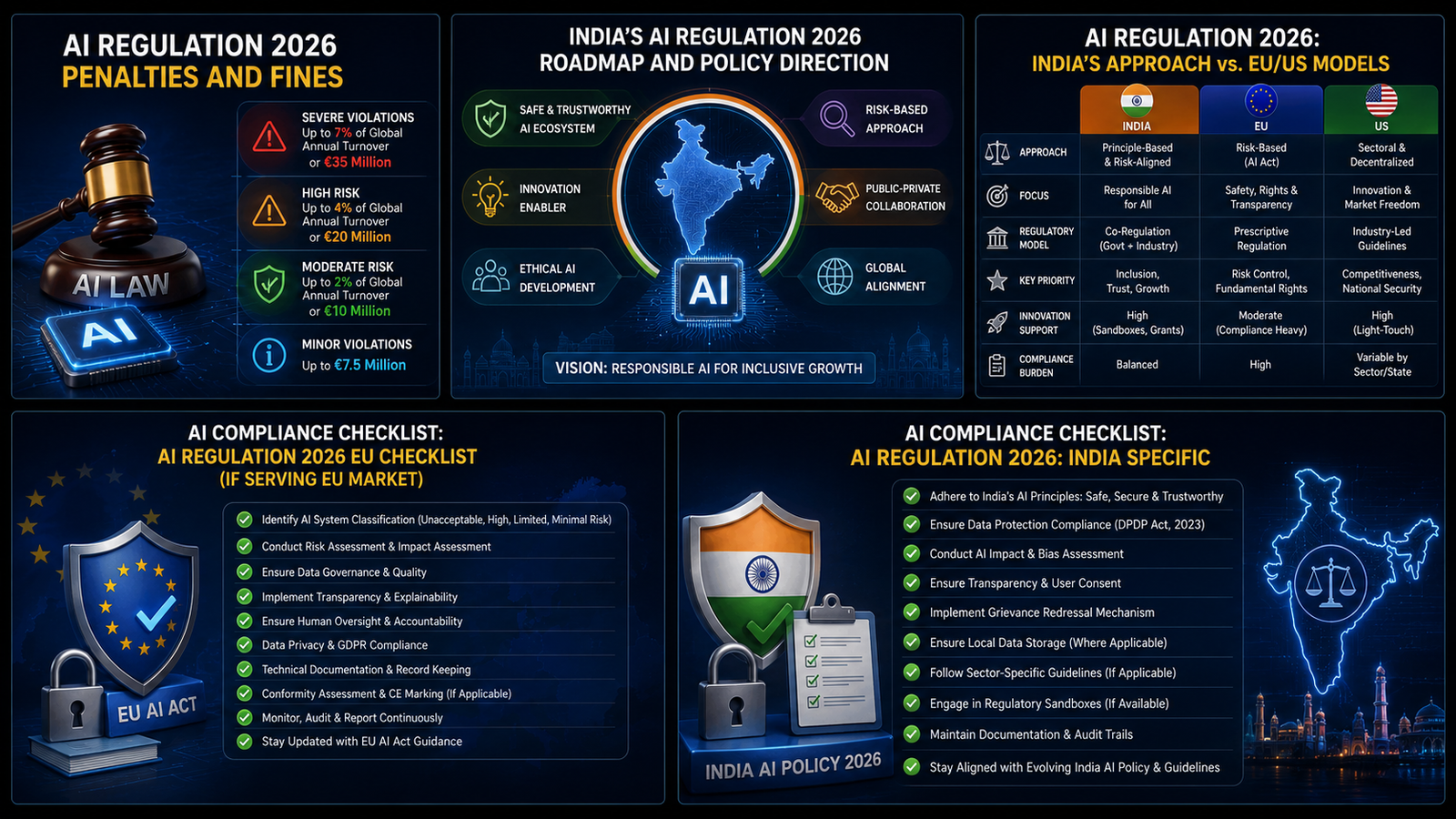
 By
By Quick Answer
AI regulation 2026 is shaping up as a patchwork of global, federal, and state laws governing how artificial intelligence is developed, deployed, and audited. Key frameworks include the EU AI Act (fully enforced August 2026), the U.S. state-led approach led by Illinois SB 315 and Colorado’s AI law, and India’s emerging Digital India Act. Under AI regulation 2026, companies must comply with risk-based classifications, mandatory safety audits, transparency requirements, and sector-specific rules for high-risk applications like healthcare, hiring, and finance.
What Is AI Regulation?
AI regulation refers to the laws, policies, and frameworks that govern the development, deployment, and use of artificial intelligence systems. AI regulation 2026 frameworks aim to ensure AI is safe, transparent, fair, and accountable while fostering innovation.
As AI capabilities expanded dramatically in 2024–2025, governments worldwide moved from voluntary guidelines to binding legislation. By mid-2026, AI regulation 2026 has produced three distinct regulatory models emerging:
• Risk-based (EU AI Act): Classifies AI by risk level and applies stricter rules to high-risk applications
• State-led (United States): No federal law yet; individual states create their own rules
• Principles-based (India, UK): Flexible frameworks with voluntary compliance for most applications
AI Governance Framework: Key Components of AI Regulation 2026
| Component | Description | Example |
| Risk Classification | Categorizing AI by potential harm | EU’s four-tier system (minimal, limited, high, unacceptable) |
| Transparency Requirements | Disclosing when content is AI-generated | Watermarking AI-generated images and text |
| Safety Audits | Mandatory third-party evaluations | Illinois SB 315 requires annual audits for large companies |
| Liability Frameworks | Determining responsibility when AI causes harm | AI liability laws still debate product vs. developer responsibility |
| Data Governance | Rules for training data quality and bias | Requirements for diverse, representative datasets |
| Human Oversight | Mandating human review for high-stakes decisions | Healthcare AI diagnosis requires doctor confirmation |
Expert Insight: “The fundamental tension in AI regulation is balancing innovation with safety. Too strict, and you stifle competition; too loose, and you risk harm. The EU chose strict; the U.S. chose fragmented, India chose flexible.” — Dr. Sarah Chen, AI Policy Fellow, Stanford HAI.
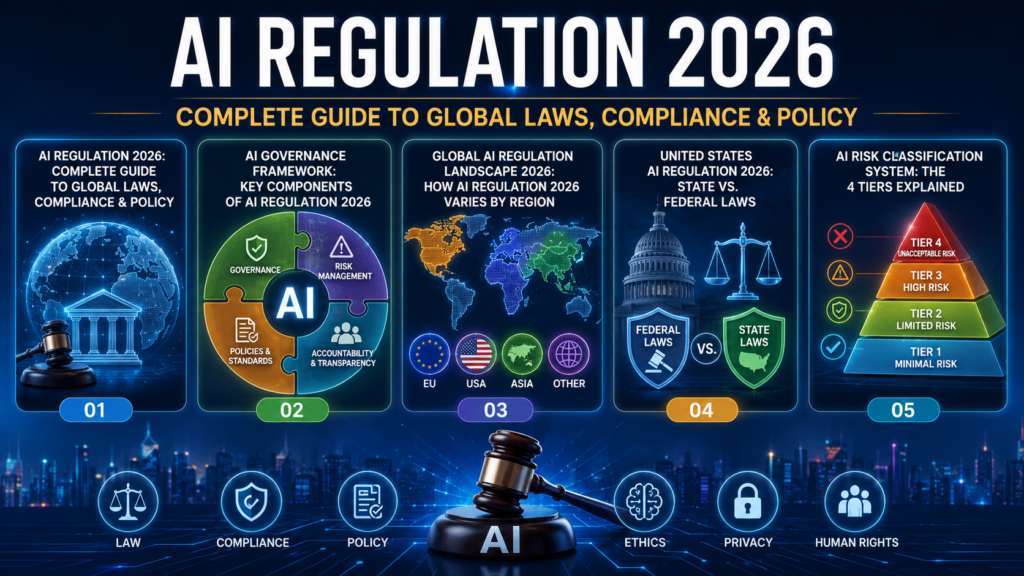
Global AI Regulation Landscape 2026: How AI Regulation 2026 Varies by Region
As of July 2026, no single global AI treaty exists for AI regulation 2026. Instead, regional frameworks create a complex compliance map for multinational companies.
Regional Comparison Table
| Region | Key Law/Policy | Status (July 2026) | Risk Approach | Penalties |
| European Union | EU AI Act | Fully enforced (Aug 2026) | Risk-based (4 tiers) | Up to €35M or 7% global turnover |
| United States | State-led (IL, CO, CA) | Active, no federal law | Sector-specific | Varies by state |
| India | Digital India Act (draft) | Under consultation | Principles-based | Not yet defined |
| China | AI Governance Regulations | Active | Strict, state-controlled | Severe, including business suspension |
| United Kingdom | AI White Paper | Voluntary framework | Context-specific | None (voluntary) |
| Brazil | AI Bill (PL 2338) | Under debate | Risk-based | Up to 2% of revenue |
| Singapore | AI Verify Framework | Voluntary | Risk-based | None (voluntary) |
| Japan | AI Governance Guidelines | Voluntary | Principles-based | None (voluntary) |
Which Country Has the Strictest AI Regulation?
The European Union currently has the strictest and most comprehensive AI regulation. The EU AI Act, a pillar of AI regulation 2026, is binding law with severe penalties, extraterritorial reach (applies to any company serving EU customers), and detailed technical requirements. China’s regulations are also strict but focus more on content control and state oversight than safety and transparency.
For companies navigating AI regulation 2026 globally, compliance complexity is highest in the EU due to the four-tier risk classification system, mandatory CE marking for high-risk AI, and detailed documentation requirements.
United States AI Regulation 2026: State vs. Federal Laws
Why Is There No Federal AI Law Yet?
Understanding AI regulation 2026 in the United States is critical because the country remains fragmented no comprehensive federal AI statute exists yet. The Biden Administration’s 2023 Executive Order on AI established voluntary frameworks for federal agencies, but binding legislation covering private sector AI development has stalled in Congress due to partisan disagreements over scope, enforcement mechanisms, and preemption of state laws.
This gap in AI regulation 2026 at the federal level has created a state-led regulatory patchwork that complicates compliance for national companies. This state AI laws US 2026 tracker covers Illinois, Colorado, California, and emerging legislation nationwide.
Illinois AI Accountability Act (SB 315)
The Illinois AI Accountability Act made Illinois the first U.S. state to mandate third-party AI safety audits when Governor JB Pritzker signed the Illinois AI Accountability Act (SB 315) into law in March 2026.
Key Provisions:
• Applies to: Companies with annual revenue over $100M that deploy high-risk AI systems in Illinois
• Audit Requirements: Annual third-party safety audits by certified evaluators
• Transparency: Public disclosure of audit summaries (not full reports)
• Enforcement: Civil penalties up to $50,000 per violation
• Effective Date: January 1, 2027 (preparation period)
Why It Matters: Illinois SB 315 is significant because it’s the first state law to require independent audits rather than self-certification. This development in AI regulation 2026 is notable because both OpenAI and Anthropic publicly supported the bill, signaling industry acceptance of external accountability mechanisms.
Colorado AI Law
Colorado’s AI law (SB 24-205), another key piece of AI regulation 2026, signed in June 2025, focuses on algorithmic discrimination in consequential decisions.
Key Provisions:
• Applies to: Developers and deployers of high-risk AI systems used in employment, housing, healthcare, and financial services
• Bias Testing: Mandatory annual bias audits for covered systems
• Consumer Rights: Right to explanation when AI makes adverse decisions
• Effective Date: Fully effective February 1, 2026
California’s Proposed AI Safety Bills
California is debating multiple AI safety bills as part of AI regulation 2026, including:
• SB 1047 (revised): Requires safety testing for large AI models before deployment
• AB 2930: Mandates bias impact assessments for automated decision tools
• AB 2013: Requires transparency in AI-generated political content
State AI Laws Tracker: State-by-State Comparison
| State | Law | Status | Key Requirement |
| Illinois | SB 315 | Enacted (Mar 2026) | Mandatory third-party audits |
| Colorado | SB 24-205 | Enforced (Feb 2026) | Bias testing for high-risk AI |
| California | Multiple bills | Pending (2026) | Safety testing, bias assessments |
| New York | Local Law 144 | Enforced (2023) | Bias audits for hiring AI |
| Texas | HB 4 (proposed) | Pending | AI transparency in government |
| Washington | SB 6280 | Enacted (2022) | Facial recognition restrictions |
EU AI Act and AI Regulation 2026: Full Enforcement Begins
The EU AI Act, a cornerstone of AI regulation 2026, passed in March 2024 and is now fully enforceable as of August 2026. It represents the world’s most comprehensive AI regulation. Our EU AI Act explained guide breaks down every compliance requirement for market entry.
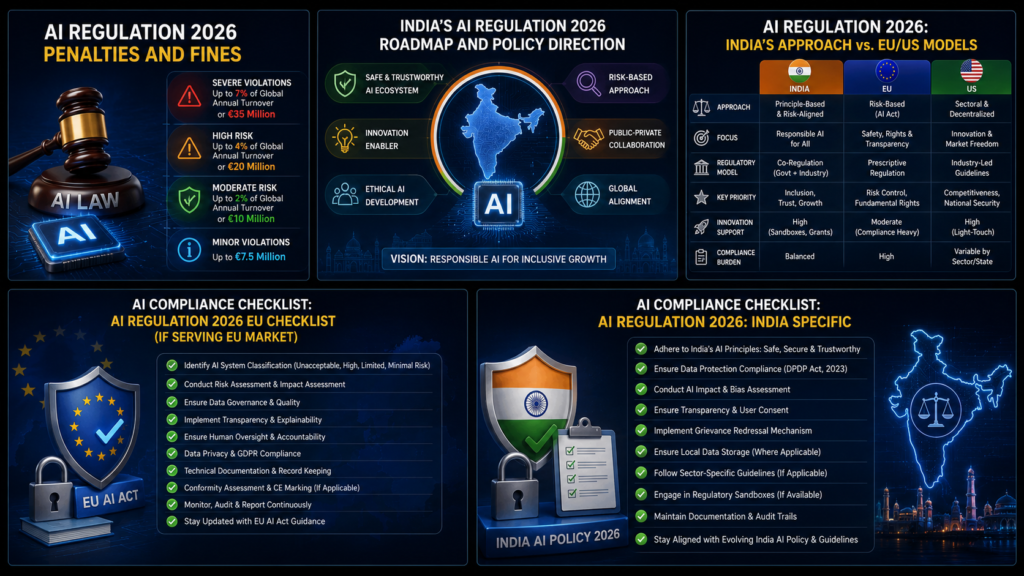
AI Risk Classification System: The 4 Tiers Explained
The EU AI Act categorizes AI systems into four risk levels, each with distinct compliance obligations:
1. Unacceptable Risk: Prohibited
Examples:
• Social scoring systems by governments
• Subliminal techniques to manipulate behavior
• Real-time biometric identification in public spaces (with limited law enforcement exceptions)
• AI exploiting vulnerabilities of specific groups (children, elderly)
• Status: Banned outright. No compliance pathway.
2. High Risk: Strict Requirements
Examples:
• AI in medical devices and healthcare diagnosis
• AI used in hiring, recruitment, and employee evaluation
• AI for credit scoring and loan decisions
• AI in law enforcement (risk assessment, evidence evaluation)
• AI in education and vocational training
• AI in critical infrastructure management
Requirements:
• CE marking before market placement
• Risk management system throughout lifecycle
• Data governance and quality management
• Technical documentation
• Record-keeping and logging
• Transparency and user information
• Human oversight design
• Accuracy, robustness, and cybersecurity
3. Limited Risk: Transparency Obligations
Examples:
• Chatbots and conversational AI
• AI-generated content (deepfakes, synthetic media)
• Emotion recognition systems
Requirements:
• Clear disclosure that users are interacting with AI
• Labeling of AI-generated content
• Notification when emotion recognition is used
4. Minimal Risk: Voluntary Codes
Examples:
• AI-enabled video games
• Spam filters
• Inventory management systems
Requirements:
• No mandatory requirements
• Encouraged to follow voluntary codes of conduct
AI Regulation 2026 Penalties and Fines
| Violation Type | Fine |
| Prohibited AI practices | Up to €35 million or 7% of global annual turnover |
| Non-compliance with high-risk requirements | Up to €15 million or 3% of global annual turnover |
| Providing incorrect information to authorities | Up to €7.5 million or 1% of global annual turnover |
Compliance Timeline for Companies
| Deadline | Requirement |
| August 2, 2025 | Prohibited AI practices banned |
| February 2, 2026 | Codes of practice for general-purpose AI |
| August 2, 2026 | Full enforcement of all provisions |
| August 2, 2027 | High-risk systems already on market must comply |
India’s AI Regulation 2026 Roadmap and Policy Direction
AI regulation India 2026 takes a markedly different approach from the EU and U.S. models. Rather than prescriptive rules, India favors a principles-based, sectoral framework that encourages innovation while building guardrails for high-risk applications.
Current Status (July 2026)
As of mid-2026, India does not have a standalone AI law. Instead, AI governance is addressed through:
• Digital India Act (draft): Under public consultation; proposes light-touch regulation
• IT Rules amendments: Existing IT Act provisions applied to AI platforms
• Sectoral guidelines: RBI for fintech AI, NITI Aayog for healthcare AI
• Self-regulation: Industry-led codes of conduct encouraged
Digital India Act: Key Provisions for AI
India AI regulation through the draft Digital India Act, expected to be tabled in Parliament in late 2026, includes these AI-specific provisions:
• Risk-based categorization similar to EU but with broader “low-risk” exemptions
• Transparency requirements for AI-generated content and algorithmic recommendations
• Data localization for AI training data used in critical sectors
• Grievance redressal mechanisms for AI-related harms
• Sandbox provisions allowing experimental AI deployment with regulatory relief
AI Regulation 2026: India’s Approach vs. EU/US Models
| Aspect | EU AI Act | US (State-led) | India (Proposed) |
| Philosophy | Precautionary | Reactive/fragmented | Innovation-first |
| Scope | Comprehensive | Patchwork | Sectoral |
| Risk Classification | 4 tiers | Varies by state | 3 tiers (minimal, moderate, high) |
| Enforcement | Centralized (EU-wide) | State-by-state | Central + state regulators |
| Penalties | Severe (up to 7% revenue) | Moderate | Moderate (expected) |
| Extraterritorial | Yes | Limited | Yes (for India market) |
| Startup Exemptions | Limited | Varies | Proposed (revenue threshold) |
AI Regulation 2026: What Indian Startups Need to Know
• No immediate compliance burden for most AI applications
• High-risk sectors (healthcare, finance, hiring) should prepare for sectoral rules
• Exporting to the EU/US? You must comply with those jurisdictions regardless of Indian law
• AI-generated content should be labeled proactively (best practice even without mandate)
• Monitor NITI Aayog and MeitY for draft guidelines
AI Regulation 2026 Compliance Checklist for Companies
Use this comprehensive AI regulation 2026 compliance checklist to assess your posture across major jurisdictions as of July 2026.
AI Compliance Checklist: General Requirements (All Jurisdictions)
1.Conduct AI risk assessment and classify your AI systems by risk level
2.Map regulatory applicability: identify which laws apply based on your markets and AI use cases
3.Document AI inventory: maintain a catalog of all AI systems, their purposes, and risk levels
4.Establish an AI risk management framework before deploying high-risk systems
5.Establish AI governance committee with legal, technical, and business stakeholders
6.Create AI use policies for employees and contractors
7.Implement data governance for training data quality, bias detection, and privacy compliance
8.Set up incident reporting and remediation procedures
9.Review third-party AI vendors for compliance certifications
10.Train staff on AI ethics, legal requirements, and responsible use
11.Monitor regulatory updates in all operating jurisdictions
AI Compliance Checklist: AI Regulation 2026 EU Checklist (If Serving EU Market)
12.Determine risk classification for each AI system (minimal, limited, high, unacceptable)
13.Prepare technical documentation for high-risk AI systems
14.Implement risk management system throughout AI lifecycle
15.Design human oversight into high-risk systems
16.Ensure data quality and representativeness for training datasets
17.Apply for CE marking through notified body for high-risk AI
18.Create user instructions and transparency information
19.Establish post-market monitoring system
20.Register high-risk AI in EU database
21.Prepare for conformity assessment (internal or third-party)
AI Compliance Checklist: AI Regulation 2026: US State Law Specific
• Illinois: If revenue >$100M + high-risk AI, prepare for mandatory audits (effective Jan 2027)
• Colorado: If deploying high-risk AI in employment/housing/healthcare/finance, conduct bias audits
• California: Monitor pending bills for safety testing requirements
• New York City: If using AI in hiring, conduct annual bias audits (Local Law 144)
• All states: Implement transparency disclosures for AI-generated content
AI Compliance Checklist: AI Regulation 2026: India Specific
• Monitor Digital India Act progress and sectoral guidelines
• Label AI-generated content proactively
• Prepare data localization plans if operating in critical sectors
• Engage with industry bodies (NASSCOM, iSPIRT) for self-regulation codes
Download the AI compliance checklist PDF
AI Safety Audits Under AI Regulation 2026: Requirements & Process
What Is an AI Safety Audit?
Under current AI regulation 2026 frameworks, an AI safety audit is an independent, systematic evaluation of an AI system’s safety, fairness, robustness, and compliance with regulatory requirements. Unlike traditional software audits, AI audits examine:
•Model behavior across diverse inputs and edge cases
•Training data quality and potential bias sources
•Decision explainability for high-stakes outputs
•Security vulnerabilities specific to AI (adversarial attacks, prompt injection)
•Human oversight mechanisms and their effectiveness
AI Safety Audit Requirements: Who Needs to Conduct AI Audits? (By Jurisdiction)
| Jurisdiction | Who Must Audit | Frequency | Auditor Type |
| EU (High-Risk AI) | All high-risk AI deployers | Before market placement + ongoing | Notified body or internal |
| Illinois (SB 315) | Companies >$100M revenue with high-risk AI | Annual | Third-party certified |
| Colorado | High-risk AI in consequential decisions | Annual | Third-party or internal |
| New York City | AI in hiring/employment | Annual | Independent auditor |
| India | Not yet mandatory | N/A | N/A |
AI Regulation 2026 Safety Audit Process: Step-by-Step Guide
22.Scope Definition: Identify AI systems, risk levels, and applicable regulations
23.Documentation Review: Examine technical docs, training data records, and risk assessments
24.Model Testing: Evaluate performance across demographic groups, edge cases, and adversarial inputs
25.Bias Assessment: Measure disparate impact and fairness metrics
26.Explainability Review: Assess whether decision logic can be explained to affected individuals
27.Security Testing: Test for adversarial vulnerabilities and prompt injection risks
28.Human Oversight Evaluation: Verify oversight mechanisms are effective and accessible
29.Compliance Mapping: Cross-check against regulatory requirements
30.Report Generation: Document findings, risks, and remediation recommendations
31.Remediation Tracking: Monitor fixes and re-test as needed
AI Regulation 2026 Audit Costs and Timeline
| Company Size | Audit Scope | Estimated Cost | Timeline |
| Startup (<50 employees) | 1-2 low-risk AI tools | $10,000–$25,000 | 2–4 weeks |
| Mid-size (50–500 employees) | 3-5 mixed-risk systems | $50,000–$150,000 | 4–8 weeks |
| Enterprise (>500 employees) | 10+ high-risk systems | $200,000–$500,000+ | 8–16 weeks |
Industry-Specific AI Regulation 2026 Requirements
AI regulation 2026 affects different industries with unique compliance challenges based on their risk profiles and existing regulatory frameworks.
AI Regulation 2026: Healthcare Sector
| Regulation | Requirement | AI Impact |
| FDA AI/ML Guidance (US) | Clinical validation for medical AI | AI diagnostic tools need FDA clearance |
| EU MDR (Medical Device Regulation) | CE marking for medical devices | AI medical software classified as device |
| HIPAA (US) | Patient data privacy | Training data must be de-identified |
| ICMR Guidelines (India) | Ethical AI in health research | Biased AI in diagnosis is prohibited |
Key Compliance Focus: Clinical validation, patient safety, data privacy, algorithmic transparency
AI Regulation 2026: Finance Sector
| Regulation | Requirement | AI Impact |
| SEC AI Rules (US) | Algorithmic trading transparency | AI trading systems must be explainable |
| EU MiCA | Crypto asset regulation | AI-powered trading platforms affected |
| Fair Lending Laws (US) | Non-discrimination in credit | AI credit scoring must be bias-tested |
| RBI Guidelines (India) | Digital lending norms | AI loan decisions need human review |
Key Compliance Focus: Algorithmic fairness, explainability, anti-discrimination, audit trails
AI Regulation 2026: Employment / HR Tech
| Regulation | Requirement | AI Impact |
| EEOC Guidance (US) | Anti-discrimination in hiring | AI resume screening must be bias-tested |
| Illinois SB 315 | Mandatory audits for high-risk AI | AI hiring tools need annual audits |
| NYC Local Law 144 | Bias audits for automated hiring tools | Annual independent audits required |
| EU AI Act | High-risk classification for employment AI | CE marking, human oversight required |
Key Compliance Focus: Bias testing, disparate impact analysis, candidate transparency, human review
Education
| Regulation | Requirement | AI Impact |
| FERPA (US) | Student data privacy | AI tutoring systems must protect data |
| EU AI Act | High-risk for education/vocational training | CE marking for AI used in admissions |
| COPPA (US) | Children’s online privacy | AI tools for children need parental consent |
Key Compliance Focus: Age-appropriate AI, data privacy, algorithmic transparency in grading
Autonomous Vehicles
| Regulation | Requirement | AI Impact |
| NHTSA (US) | Vehicle safety standards | Self-driving AI must meet crash standards |
| UNECE Regulations | International vehicle standards | AI driving systems need type approval |
| EU Type Approval | Safety assessment for autonomous features | Extensive testing and documentation |
Key Compliance Focus: Safety testing, liability frameworks, human-machine interaction.
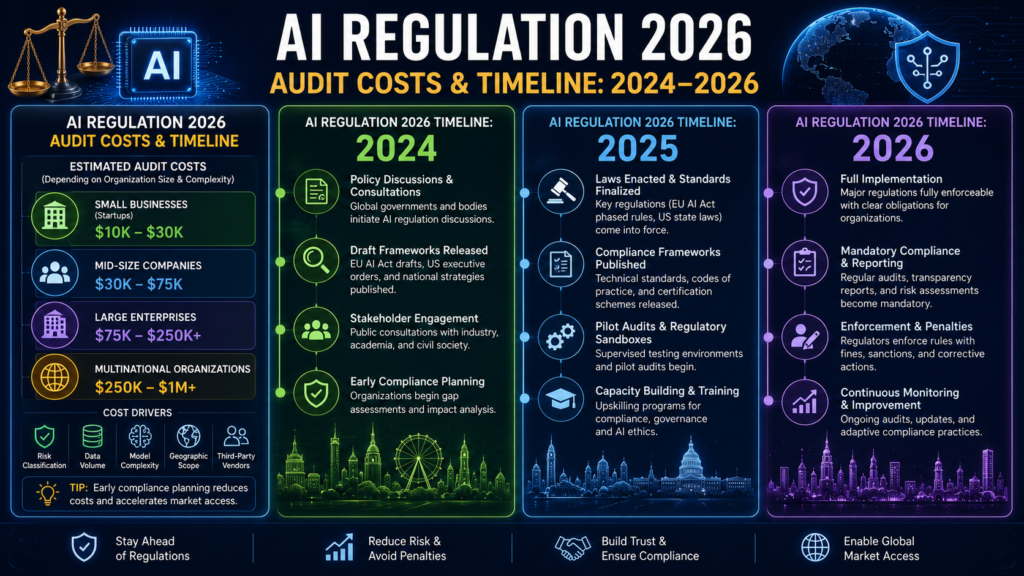
AI Regulation 2026 Timeline: Key Events from 2024–2026
AI Regulation 2026 Timeline: 2024
• March 2024: EU AI Act passed by European Parliament
• May 2024: Biden Administration issues updated AI Executive Order
• August 2024: EU AI Act published in Official Journal; 24-month implementation clock starts
• October 2024: G7 agrees on Hiroshima AI Process guiding principles
• November 2024: Colorado AI law provisions begin phased implementation
AI Regulation 2026 Timeline: 2025
• February 2025: EU AI Act prohibited practices ban takes effect
• June 2025: Colorado AI Law (SB 24-205) fully signed; implementation begins
• August 2025: Illinois SB 315 introduced in state legislature
• September 2025: India releases draft Digital India Act for consultation
• October 2025: UK AI Safety Institute publishes first evaluation results
• December 2025: California introduces SB 1047 (AI safety testing bill)
AI Regulation 2026 Timeline: 2026
• January 2026: EU AI Act high-risk provisions begin applying
• March 2026: Illinois SB 315 passes; OpenAI and Anthropic publicly support
• April 2026: EU publishes first codes of practice for general-purpose AI
• May 2026: India extends Digital India Act consultation period
• June 2026: Colorado bias audit requirements fully enforceable
• July 2026: Illinois finalizes audit certification body requirements
• August 2026: EU AI Act full enforcement begins all provisions active
• September 2026: India expected to table Digital India Act in Parliament (projected)
• October 2026: First Illinois AI audits due for preparation (effective Jan 2027)
AI Regulation 2026: Frequently Asked Questions
AI Regulation 2026: Is there a federal AI law in the United States?
No comprehensive federal AI law in the US as of July 2026. Regulation is state-led (IL, CO, CA leading), with only federal executive orders and guidance. Congressional efforts have stalled.
AI Regulation 2026: What is the EU AI Act risk classification?
EU AI Act risk tiers:
Minimal: Voluntary codes for low-risk uses (e.g. spam filters)
Unacceptable: Banned (e.g. social scoring, manipulative AI)
High: Strict rules (CE marking, risk management, oversight) for healthcare, hiring, law enforcement
Limited: Transparency for chatbots & AI-generated content
AI Regulation 2026: Do Indian companies need to comply with the EU AI Act?
Yes, if offering AI products/services in the EU. The EU AI Act applies extraterritorially to any company serving EU customers, regardless of headquarters. Indian startups targeting Europe should prepare CE marking, risk documentation, and human oversight—even if used indirectly by EU firms.
AI Regulation 2026: How much does an AI safety audit cost?
AI safety audit costs vary by company size: small firms $10K–$30K, mid-size $50K–$150K, enterprises $200K–$500K+. Illinois SB 315 requires annual third-party audits for companies with >$100M revenue using high-risk AI.
AI Regulation 2026: What happens if my company doesn’t comply?
AI regulation penalties in 2026 vary widely by jurisdiction. EU AI Act: up to €35M or 7% of global turnover. US: Illinois SB 315 ($50k per violation); Colorado (injunctive relief + damages). Non-compliance risks bans, market exclusion, reputational damage, and lost government contracts.
AI Regulation 2026: Which AI applications are “high-risk” under the EU AI Act?
High-risk AI under the EU AI Act includes: medical devices/healthcare diagnosis, recruitment/employee evaluation, credit scoring, law enforcement, education admissions, critical infrastructure, and biometric identification.
These require CE marking, risk management, data governance, technical documentation, human oversight, and post-market monitoring.
AI Regulation 2026: When do Illinois AI audit requirements take effect?
Illinois SB 315’s mandatory third-party AI audits take effect January 1, 2027. Companies with >$100M revenue using high-risk AI in Illinois should prepare now for annual certified audits. The Attorney General’s office expects to release certification requirements and approved evaluator lists by late 2026.
AI Regulation 2026: How is India’s AI regulation different from EU and US?
India’s Digital India Act proposes a principles-based, innovation-first AI framework—unlike the EU’s prescriptive risk-based or US’s fragmented models. It favors voluntary sectoral guidelines, stricter oversight for high-risk sectors like healthcare and finance, AI sandboxes, and startup exemptions to balance innovation with safeguards.
AI Regulation 2026: What generative AI legal issues should companies watch in 2026?
Generative AI legal risks include training data copyright, deepfake liability, algorithmic bias, and data scraping consent. Companies should monitor EU, US, and India case law to minimize exposure.
AI Regulation 2026: Does the EU AI Act apply to my small business?
Yes, if your AI is high-risk or serves EU users. The EU AI Act depends on risk level and user location, not company size.
Minimal-risk AI (e.g., spam filters, games) has no requirements. High-risk uses (hiring, credit, healthcare) need full compliance regardless of business size.
AI Regulation 2026: Is ChatGPT banned under the EU AI Act?
No. General-purpose AI models like ChatGPT are not banned. They are “limited risk” and require transparency (disclosure, watermarking, training data summaries). Only specific uses like social scoring and workplace emotion recognition are banned.
AI Regulation 2026: Do I need to label AI-generated content on my website?
Short version:
Under EU AI Act Art. 50 & US rules, clearly disclose AI chatbots and label AI-generated images, video, text, and deepfakes. Fines up to €7.5M or 1% global turnover.
AI Regulation 2026: Who is legally liable when AI makes a mistake?
Liability is shared and evolving. EU AI Act holds both providers and deployers accountable. US applies existing product liability and negligence laws. India has no specific AI law—general tort and consumer protection rules apply.
AI Regulation 2026: How much does EU AI Act compliance cost for a startup?
Shortened version:
Limited-risk: €10k–€50k. High-risk AI: €50k–€200k+ annually (audits, docs, legal, CE marking). GPAI: €5k–€20k (transparency & copyright). Budget 12–18 months.
AI Regulation 2026: What is an AI risk assessment and how do I conduct one?
AI Risk Assessment Map your AI systems to EU AI Act risk tiers.
Steps:
- List all AI tools
- Identify purpose & user impact
- Match to 4-tier classification
- Document data sources & bias checks
- Assign ownership & review frequency
Typically completed in 2–4 weeks by internal teams.
AI Regulation 2026: Does my AI hiring tool need a bias audit?
Short version:
Yes, in NYC (Local Law 144), Colorado (SB 24-205), Illinois (SB 315, >$100M revenue), or EU (high-risk). Audits must measure disparate impact by race, gender, and age. NYC & Illinois require annual independent audits; Colorado and minimal-risk EU allow self-assessments.
AI Regulation 2026: Can I use AI to screen job applicants in Europe?
Yes, high-risk under EU AI Act. Requires CE marking, fundamental rights impact assessment, ongoing bias monitoring, human oversight before adverse decisions, and informing candidates. Fines up to €15M or 3% of global turnover for non-compliance.
AI Regulation 2026: What AI practices are completely banned in 2026?
Short version:
EU AI Act prohibits 8 categories (Aug 2026):
AI-generated non-consensual intimate imagery
Government social scoring
Subliminal manipulation
Exploiting children/elderly vulnerabilities
Real-time public biometric ID (limited LE exceptions)
Untargeted facial recognition scraping
Emotion recognition in workplaces/schools
Profiling-based predictive policing
AI Regulation 2026: Do I need an AI compliance officer?
Shortened:
EU AI Act requires human oversight for high-risk AI. Companies with multiple high-risk systems or >$100M Illinois revenue should designate an AI governance lead to track regulatory updates, manage vendor audits, and maintain risk documentation.
AI Regulation 2026: Are AI chatbots on my website regulated?
Shortened:
Chatbots are limited-risk under the EU AI Act—disclose you’re AI, not human. In the US, CA & CO require disclosure for consequential decisions (no federal law yet). Use a clear “AI assistant” label with human support opt-out.
About This Guide
TechTodays AI Policy Research Team tracks AI regulation 2026 developments across 20+ jurisdictions. This guide is updated monthly to reflect new laws, court decisions, and regulatory guidance.
Sources Consulted:
• European Commission AI Act Official Text
• Illinois General Assembly SB 315
• Colorado Secretary of State SB 24-205
• NITI Aayog India AI Strategy Documents
• Stanford HAI AI Index Report 2026
• Gartner AI Governance Research
• IBM AI Regulation Insights
Last Updated: July 15, 2026