 By
By Quick Answer
India AI regulation for startups in 2026 is innovation-first and principles-based, not one EU-style AI Act. Founders still face real duties under MeitY’s India AI Governance Guidelines, the IT Rules Amendment 2026 on synthetically generated content (SGI), the Digital Personal Data Protection Act (DPDPA), sector rules in health and finance, and the draft Digital India Act. If you build gen-AI, SaaS, or platforms in India or sell into India you need labeling, data controls, grievance paths, and a simple compliance plan. Exporting to the EU or US means those laws apply too.
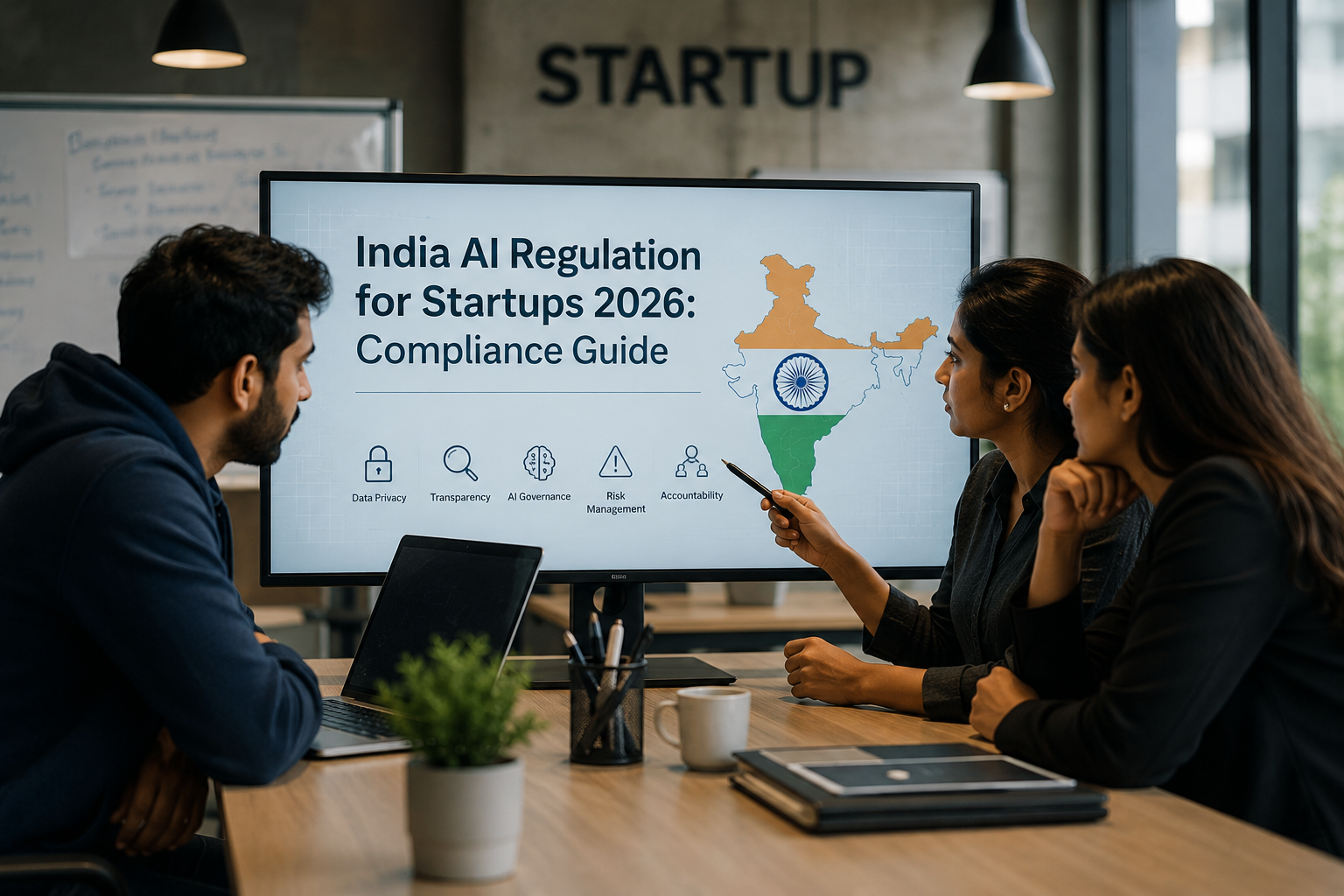
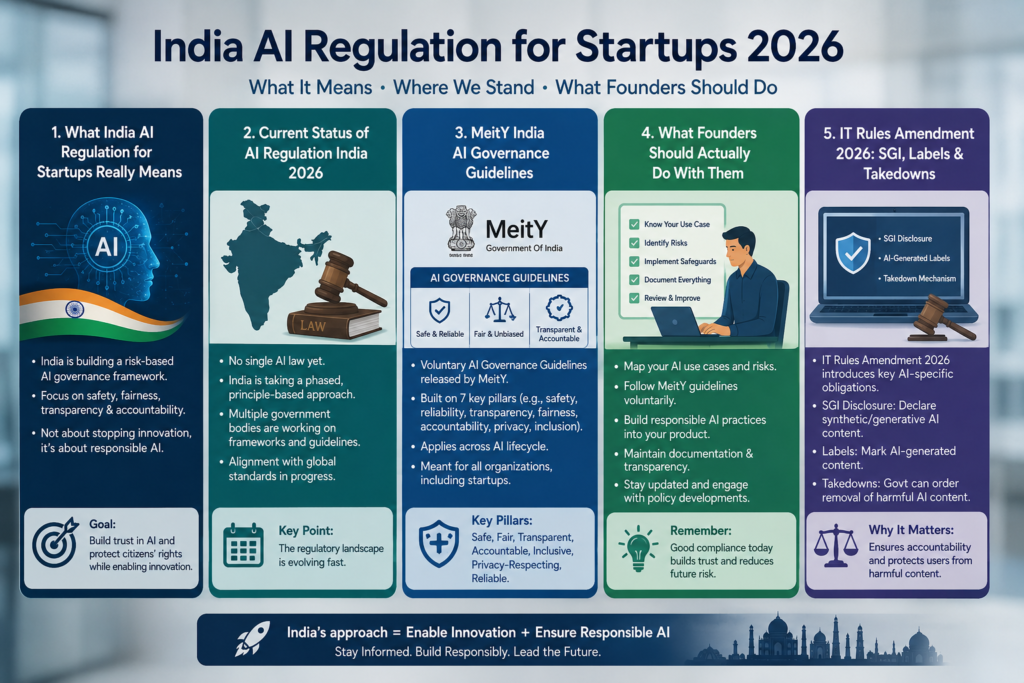
What India AI Regulation for Startups Really Means
When people search India AI regulation for startups, they usually want a plain answer: Do I need a license? Will MeitY block my launch? What must I ship this quarter?
Here is the honest picture. India has not passed a single standalone AI statute that mirrors the EU AI Act 2026. Instead, India AI regulation for startups works like a stack: soft national principles, hard rules for synthetic media and intermediaries, personal data law, and sector regulators. That design is deliberate. Policymakers want AI companies in Bengaluru, Hyderabad, Pune, Gurugram, and Chennai to ship products while still stopping deepfakes, unfair automated decisions, and careless use of personal data.
So if you are seed or Series A, you rarely need a giant compliance department on day one. You do need owners, labels (if you generate media), clean data practices, and paperwork buyers will ask for in security reviews. That is the practical core of India AI regulation for startups in 2026.
Current Status of AI Regulation India 2026
As of July 2026, this is the live map:
| Layer | What it is | Status | Startup impact |
| India AI Governance Guidelines | MeitY principles (techno-legal) | Released 2025; active reference | Trust, transparency, accountability baseline |
| IT Rules Amendment 2026 | Binding rules on SGI / platforms | In force from Feb 2026 | Labels, metadata, fast takedowns |
| DPDPA | Personal data law | Phased rollout | Training data, prompts, vendors |
| Digital India Act | Draft digital / platform law | Under consultation | Future risk tiers, sandboxes |
| Sector rules | RBI, health, etc. | Active | Fintech, lending, care-adjacent AI |
MeitY’s committee line has been clear: India does not need a heavy standalone AI law yet; existing law plus guidelines can carry most of the load if industry acts responsibly. That is good news for speed and a warning not to ignore the pieces that already bind you.
MeitY India AI Governance Guidelines
The India AI Governance Guidelines are the soft backbone of India AI regulation for startups. They are not a licensing portal. They set seven-style guiding ideas that do no harm, fairness, transparency, accountability, inclusivity, privacy, and sustainability and push a “techno-legal” path where code and process share the work with statutes.
What founders should actually do with them
Translate principles into boring, useful artifacts:
- A one-page AI principles note for your team and investors
- Intended use vs prohibited use (no non-consensual deepfakes, no covert scoring of people)
- Human review on high-impact outputs (credit, hiring, health triage)
- A grievance contact users can reach
- Light model notes: purpose, limits, known failure modes
Enterprise buyers treat this pack as table stakes even when hard law is light. In that sense, the guidelines already shape India AI regulation for startups in the market, not only on paper.
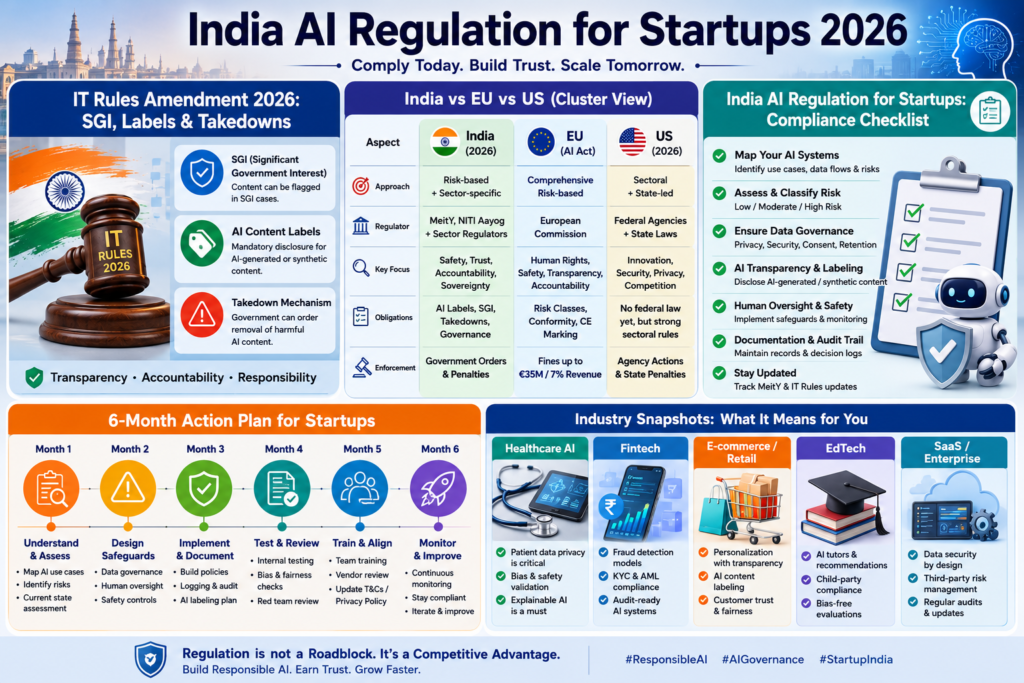
IT Rules Amendment 2026: SGI, Labels & Takedowns
For many consumer and creator tools, the sharpest hard edge of India AI regulation for startups is the IT Rules Amendment 2026 on Synthetically Generated Information (SGI).
What counts as SGI
SGI covers audio, visual, or audio-visual content that is artificially or algorithmically created or altered so it appears as real deepfakes, synthetic clips, and similar media a reasonable person would treat as authentic.
Duties that hit products
- Prominent labeling so users can spot AI-generated
- Metadata / unique identifiers for origin and changes, where required
- User declarations before publish; platforms should verify and can reject non-compliant uploads
- No label stripping intermediaries must not help hide that content is synthetic
- Technical measures to limit unlawful SGI (obscene content, impersonation, child harm, non-consensual intimate imagery)
- Faster enforcement: unlawful SGI can require action within three hours of a court order or reasoned government intimation (far tighter than older 36-hour patterns)
- Grievance clocks: acknowledge faster; resolve on shortened timelines (e.g. acknowledgment in 24 hours and resolution in about seven days under the updated frame)
Miss these and you risk more than a slap on the wrist. Non-compliance can threaten safe harbour under Section 79 of the IT Act and open platform-level liability. That is why every gen-AI media startup should treat SGI controls as core product work, not a legal afterthought, under India AI regulation for startups.
DPDPA and AI: Data You Cannot Hand-Wave
If your system trains on, fine-tunes with, logs, or infers personal data, DPDPA sits inside India AI regulation for startups whether or not you host deepfakes.
Practical checklist:
- Say clearly in your notice that data may power AI features
- Collect only what you need; scrub personal data from long-lived eval sets
- Sign processor terms with cloud hosts, model APIs, and annotation vendors
- Set retention rules for prompts and outputs that contain personal data
- Control access to AI logs; plan for security incidents
- Track cross-border transfers when you call foreign model endpoints
“We only wrap an LLM API” is not a free pass. If you set purposes and handle user content, you still design the compliance path.
Digital India Act: What to Watch Next
The draft Digital India Act is the long-range chapter of India AI regulation for startups. It is still under consultation, with AI-relevant themes often described as light-touch risk framing, transparency for AI content and recommendations, grievance paths, possible data localization in critical sectors, and sandboxes for experiments. Startup-oriented relief has been discussed, but nothing replaces enacted text.
Build modular systems now labeling module, data map, grievance SLA, model card so DIA clauses can plug in without a rewrite.
India vs EU vs US (Cluster View)
| Point | India 2026 | EU AI Act | US (e.g. Illinois path) |
| Style | Principles + IT/DPDP + sectors | Binding risk tiers | State patchwork |
| Startup default burden | Lower for many apps | High if high-risk / EU users | Depends on state + size |
| Content rules | Strong SGI labeling & speed | Transparency duties | Varies |
| Audits | Not general for small startups | Conformity paths for high-risk | Third-party audits above thresholds |
Global rule of thumb: India AI regulation for startups governs your India build; EU AI Act and laws like the Illinois AI Accountability Act govern where you sell. Headquarters in India does not waive EU duties if you serve EU users.
India AI Regulation for Startups: Compliance Checklist
Governance
- Inventory models, APIs, fine-tunes, RAG stores
- Tag each: SGI media / personal data / consequential decision
- Name one compliance owner
- Write a one-page MeitY-aligned principles note
If you generate or host media
- Default AI labels on outputs
- User SGI declaration + verification flow
- Metadata preserved; block label stripping
- Takedown runbook tested on a three-hour clock
- Grievance officer path live
Data
- AI language in privacy notice
- Vendor DPAs
- Minimize personal data in logs
- Retention and deletion rules
Sales trust pack
- Intended / prohibited uses
- Limitations and human oversight points
- Incident log template
This checklist is the shortest useful version of India AI regulation for startups for a working team.
6-Month Action Plan
Month 1: Inventory + gap list + counsel who knows IT Rules and DPDPA.
Month 2: Ship labels, declarations, abuse reporting, updated Terms and Privacy.
Month 3: Vendor contracts, clean training/eval stores, lock down AI logs.
Month 4: Model notes, grievance page, support scripts (“Is this AI?”).
Month 5: Simulate a takedown; fix label gaps; close enterprise questionnaire holes.
Month 6: Quarterly user notices on calendar; monthly metrics; watch DIA and MeitY updates.
Keep it founder-sized. Perfect paperwork loses to working labels and a phone tree that answers.
Industry Snapshots
Healthcare: No unverified diagnosis claims; clinician-in-the-loop; sensitive data design.
Fintech: Human review on adverse lending outcomes; bias checks; audit trails (RBI expectations).
HR tech: Notice to candidates; measure disparate impact; human final say on rejects.
Consumer gen-AI: SGI labeling and deepfake abuse prevention first this is where India AI regulation for startups bites fastest.
Frequently Asked Questions
Is there one AI Act for India AI regulation for startups?
No. You work with guidelines, IT Rules 2026, DPDPA, sector rules, and a draft Digital India Act not one consolidated AI code.
Do early-stage startups face heavy licensing?
Usually not. Burdens rise if you host SGI, process personal data at scale, or operate in health, finance, or hiring or export to the EU/US.
What is SGI?
Synthetically generated information: AI-created or altered media that appears authentic. Labeling, metadata, and fast removal duties apply.
How fast must unlawful AI content come down?
About three hours after a qualifying court order or reasoned government intimation for covered unlawful SGI build runbooks that match.
Are MeitY guidelines mandatory?
They are guidelines, not a license regime, but they set buyer and policy expectations. Operationalize them early.
Does DPDPA cover model training?
Yes when personal data is involved in training, fine-tuning, logging, or inference. Minimize and contract carefully.
Must Indian companies follow the EU AI Act?
Yes if they offer AI in the EU market. See our EU AI Act 2026 guide.
What is the best first week step under India AI regulation for startups?
Finish an AI inventory, assign an owner, and ship default AI labels if you output media.
Does India AI regulation for startups apply if we only wrap OpenAI or Gemini APIs?
Yes. Under India AI regulation for startups, you still handle user notices, DPDPA duties on prompts/logs, and SGI labeling if you output or host synthetic media even when the model is foreign.
Do AI chatbots need labels under India AI regulation for startups?
Chat replies need clear “you’re talking to AI” style disclosure as best practice; IT Rules 2026 SGI labels hit hardest for AI images, audio, and video that look real not every plain text answer.
Is a DPO or DPIA mandatory for India AI regulation for startups?
Not for every seed team. A DPO / DPIA-style review matters more if you are a Significant Data Fiduciary or run high-volume/sensitive AI (health, kids, credit) under DPDPA.
Can Indian AI startups train models on scraped web data legally?
India AI regulation for startups does not give a free scrape pass. Personal data needs a DPDPA basis; copyright and terms-of-use still apply—document sources and avoid sensitive or login-walled data.
How much does India AI regulation for startups compliance cost at seed stage?
Many lean teams spend roughly ₹50,000–₹3 lakh early (counsel, labels, privacy updates)—far less than EU high-risk builds—unless you host deepfakes-prone media or process sensitive data at scale.