 By
By A heart attack is a race against time. Every minute of delay in acute myocardial infarction treatment costs living heart muscle, which is why understanding how doctors diagnose, stabilize, and treat this emergency can help patients and families act faster and ask the right questions. This guide walks through the full pathway of acute myocardial infarction treatment from the ambulance to the cardiac catheterization lab to the medicines you’ll take for years afterward with a special focus on one of the most talked-about first-response drugs: aspirin for heart attack. Understanding acute myocardial infarction treatment early helps doctors restore blood flow quickly and reduce permanent heart muscle damage.
Whether you are researching heart attack treatment for a family member, studying for a medical exam, or simply want to understand what happens during acute myocardial infarction treatment, this article covers the emergency steps, hospital-based care, and long-term follow-up that together make up modern heart attack treatment.
Medical Disclaimer: This article is for general educational and informational purposes only and does not replace professional medical advice, diagnosis, or treatment.
Heart attack symptoms require immediate emergency medical attention and should never be managed solely using information from this article.
Medication names and doses, including aspirin, vary according to individual health conditions, allergies, bleeding risk, and medical history.
Do not start, stop, or change any heart medication without consulting a qualified healthcare professional.
Always follow the advice of your cardiologist or emergency medical team for diagnosis and treatment.
If you or someone else may be having a heart attack, seek emergency medical care immediately.
Rad more: Angina Pectoris Drugs | 3 Stents in Heart | Heart Attack Treatment and Management
What Is Acute Myocardial Infarction?
Acute myocardial infarction (AMI), commonly called a heart attack, happens when blood flow to part of the heart muscle is suddenly blocked, usually by a clot forming over a ruptured cholesterol plaque inside a coronary artery. Without oxygen, heart muscle cells begin to die within minutes, which is why myocardial infarction diagnosis must happen quickly. Doctors classify a heart attack as either an ST-elevation myocardial infarction (STEMI) or a non-ST-elevation myocardial infarction (NSTEMI) based on the ECG pattern, and this classification directly decides the treatment pathway that follows.
Recognizing symptoms early chest pain or pressure, pain radiating to the arm or jaw, breathlessness, sweating, and nausea and calling emergency services immediately is the single biggest factor in survival. Most people who die from a heart attack do so in the first hour, often before reaching a hospital, which makes prehospital care just as important as anything done inside a cardiac unit. This is precisely why acute myocardial infarction treatment begins long before a patient reaches the cardiology ward it starts the moment someone recognizes the warning signs.
Once the diagnosis is confirmed, doctors select from a well-studied list of myocardial infarction drugs to stabilize the patient, relieve pain, and prevent further clot formation, with the exact combination guided by the type and severity of the event.
Emergency Management of Myocardial Infarction
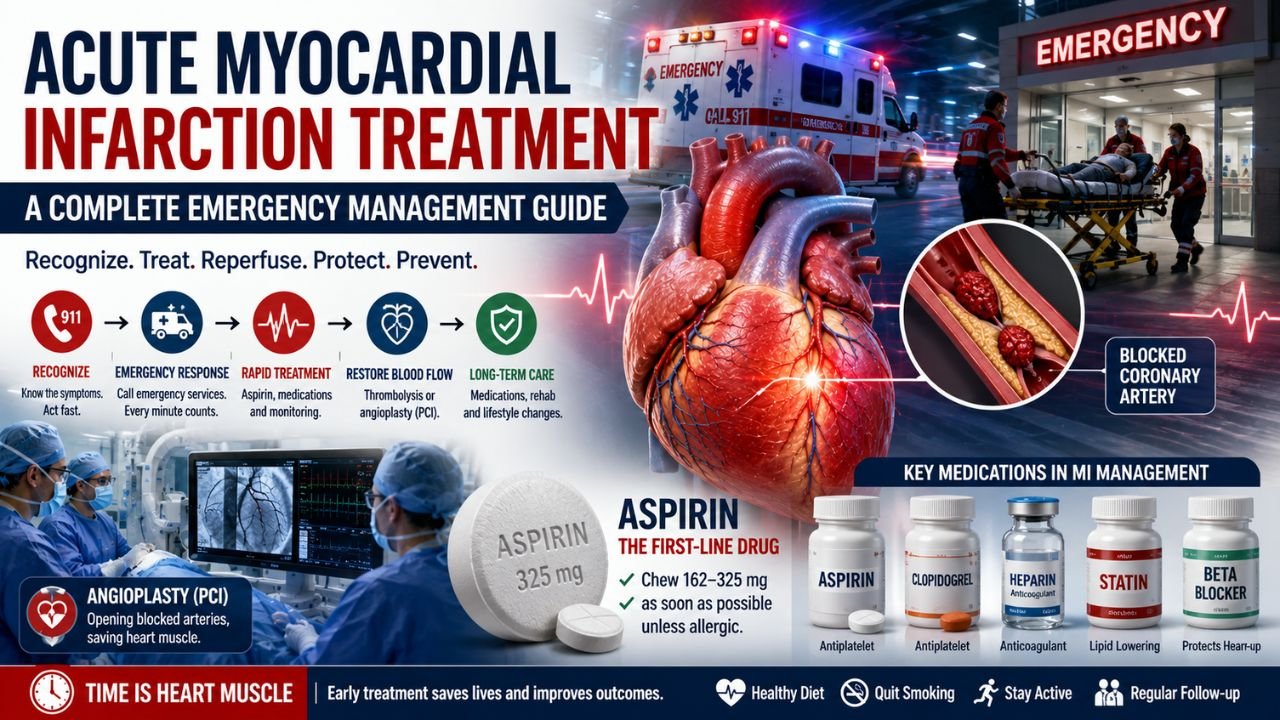
The emergency management of myocardial infarction begins the moment paramedics or emergency staff make contact with the patient. Standard mi protocol in the ambulance or emergency department includes:
- Oxygen support if oxygen saturation is low
- Continuous ECG monitoring to watch for dangerous rhythm changes
- Intravenous access for medications
- Pain relief, usually with nitroglycerin and, if needed, morphine
- Immediate chewable aspirin, unless there is a known allergy
This rapid-response sequence is the backbone of every myocardial infarction protocol used in emergency departments worldwide, and it forms the first stage of any complete acute myocardial infarction treatment plan. The goal is to confirm the diagnosis, decide whether the patient needs clot-busting drugs or an emergency angioplasty, and start treatment within minutes rather than hours. A well-run mi management protocol aims for a “door-to-drug” time of 30 minutes and a “door-to-balloon” time of 90 minutes for patients heading to angioplasty, both benchmarks that directly predict survival. Emergency teams handling mi management in emergency settings are trained to work through this sequence without waiting for every lab result, because in heart attack treatment, time saved is heart muscle saved. Early acute myocardial infarction treatment during the emergency phase greatly improves survival and reduces complications.
Aspirin for Heart Attack: Why It’s the First Drug Given
If there is one medicine almost everyone associates with heart attack care, it’s aspirin. Aspirin for heart attack management works by blocking platelets from clumping together, which slows or halts the clot that is choking off blood flow to the heart muscle. This is why aspirin during heart attack care is given as early as possible ideally by the patient themselves at home while waiting for the ambulance, chewed rather than swallowed whole so it absorbs faster.
Because aspirin for heart attack treatment is inexpensive, widely available, and backed by decades of trial evidence, it remains one of the few medicines a bystander can safely offer before paramedics arrive. Every major acute myocardial infarction treatment guideline, from the American Heart Association to India’s cardiology societies, lists aspirin as a first-line, non-negotiable step in heart attack treatment unless a true allergy is documented.
Aspirin in myocardial infarction treatment is typically given as a loading dose of 162–325 mg, chewed immediately, followed by a lower daily maintenance dose once the patient is stabilized. Clinical trials have repeatedly shown that aspirin for MI reduces mortality significantly when combined with other therapies like clot-dissolving drugs or angioplasty. Because of this strong evidence base, aspirin remains a Class I recommendation in nearly every major cardiology guideline for suspected heart attacks.
A common question patients ask is: can aspirin prevent heart attack events from happening in the first place? For people with known cardiovascular risk factors, low-dose aspirin (75–150 mg daily) is sometimes prescribed for primary prevention, though this decision is individualized and must always be made with a doctor, since aspirin also raises bleeding risk. For someone already having a heart attack, though, aspirin’s role shifts from prevention to active, aspirin for heart attack life-saving treatment.
The correct loading dose for heart attack aspirin therapy is one of the most frequently searched questions among patients and caregivers, and the answer is consistent across most guidelines: 162–325 mg, chewed, as soon as a heart attack is suspected, followed by ongoing low-dose aspirin for heart attack prevention once the acute phase has passed.
Loading Dose Protocols in MI Management
Understanding the loading dose for MI is central to emergency cardiac care. A loading dose is a larger-than-usual first dose given to rapidly reach a therapeutic drug level in the blood, rather than waiting for a standard daily dose to build up slowly. The most important loading dose for MI patient management includes:
- Aspirin loading dose for MI: 162–325 mg chewed at first contact
- Clopidogrel (an antiplatelet agent): a 300 mg or 600 mg loading dose depending on whether the patient is headed for angioplasty
- Statins: a high-intensity loading dose is often started in-hospital regardless of baseline cholesterol
- Anticoagulants such as heparin or enoxaparin, dosed by weight and kidney function
This combined approach is sometimes referred to as cardiac loading dose therapy, and it’s designed to hit the clotting cascade from multiple angles at once. The exact loading dose for cardiac patient care can vary slightly by hospital protocol, patient age, kidney function, and bleeding risk, so treatment is always individualized rather than one-size-fits-all.
In India, emergency departments generally follow ACC/AHA-adapted protocols for loading dose for MI India cases, with aspirin and clopidogrel loading doses considered standard of care alongside oxygen, nitrates, and pain control. The loading dose for heart attack India approach is broadly consistent with international guidelines, though drug availability and cost sometimes influence whether clopidogrel or a newer agent like ticagrelor is chosen as the loading dose for MI drugs of choice. Medical students and junior doctors preparing for exams or ward rounds often look for a loading dose for chest pain reference sheet as a general framework, immediate aspirin, sublingual nitroglycerin (if blood pressure allows), and antiplatelet loading form the foundation, with the exact loading dose medicines list and sequencing determined by whether the patient is having a STEMI or NSTEMI. A carefully planned acute myocardial infarction treatment strategy always includes appropriate loading doses based on the patient’s condition.
In practice, clinicians often refer to this rapid, high-dose approach simply as the stat dose for MI, a stat order meaning “give immediately,” reflecting how urgently these mi drugs need to reach the bloodstream. The specific loading dose medicine for heart attack and loading dose tablets for heart attack used can vary by hospital formulary, but aspirin, clopidogrel, and a statin remain the near-universal starting point. When patients or caregivers ask about loading dose tablets name options, the honest answer is that only a treating physician can confirm the right choice and dose for that specific patient.
Medical Management of Myocardial Infarction
Beyond the first hour, the medical management of myocardial infarction shifts toward stabilizing the heart, preventing complications, and deciding on reperfusion strategy. The core drug classes used in MI management include:
- Antiplatelet agents (aspirin, clopidogrel, ticagrelor) to prevent further clotting
- Anticoagulants (heparin, enoxaparin) to stop existing clots from growing
- Beta-blockers to reduce the heart’s oxygen demand and lower arrhythmia risk
- ACE inhibitors or ARBs to protect heart function, especially when there’s reduced pumping capacity
- High-intensity statins to stabilize plaque and lower cardiovascular risk long-term
- Nitrates for ongoing chest pain, used cautiously due to blood pressure effects
These form the backbone of nearly every myocardial infarction treatment drugs list used in modern cardiology, and they are drawn directly from current myocardial infarction guidelines published by cardiology societies worldwide. The exact combination and sequencing depend on whether the patient has STEMI or NSTEMI, kidney function, bleeding risk, and whether they’re headed for angioplasty or bypass surgery. This is also where the management of mi patient care becomes highly individualized. Two patients with the same diagnosis may receive different drug combinations based on their overall health profile, even though the underlying acute myocardial infarction treatment guidelines are the same. Long-term acute myocardial infarction treatment also focuses on preventing another heart attack through medications and lifestyle modification.
Reperfusion: Thrombolysis and Angioplasty
The definitive acute myocardial infarction treatment for a STEMI is restoring blood flow as fast as possible, through one of two routes:
Thrombolysis (clot-busting drugs): Medicines such as tenecteplase or streptokinase are given intravenously to dissolve the clot. This is most effective when given within the first few hours of symptom onset and is often used when a cardiac catheterization lab isn’t immediately available.
Primary percutaneous coronary intervention (PCI): Also called angioplasty, this is generally the preferred drug of choice in acute myocardial infarction care whenever it can be performed quickly, because it physically opens the blocked artery with a balloon and usually a stent, restoring blood flow more reliably than medication alone. Current myocardial infarction treatment guidelines recommend primary PCI within 90 minutes of first medical contact whenever a capable facility is accessible.
The choice between these two approaches, along with drugs like aspirin, clopidogrel, and anticoagulants given alongside them, makes up the standard mi treatment protocol followed in most major hospitals today. Rapid reperfusion is considered the most important component of acute myocardial infarction treatment for STEMI patients.
Inferior Wall Myocardial Infarction: A Special Case
Inferior myocardial infarction treatment requires a few important adjustments compared to other heart attack locations. Because the inferior wall is often supplied by the right coronary artery, which also frequently supplies the right ventricle, patients can develop right ventricular involvement. This changes management significantly: nitrates and other blood-pressure-lowering drugs must be used cautiously or avoided, since these patients depend heavily on adequate fluid volume to maintain blood pressure. Inferior wall myocardial infarction treatment typically involves careful IV fluid support, avoiding preload-reducing medications, and close monitoring for slow heart rhythms, which are more common in this type of heart attack. Although management varies slightly, acute myocardial infarction treatment principles remain focused on restoring circulation and preventing complications.
Laboratory Investigation of Myocardial Infarction
Alongside the ECG, laboratory investigation of myocardial infarction relies heavily on cardiac biomarkers proteins released into the blood when heart muscle is damaged. Troponin I or T is the gold standard, detectable within a few hours of injury and remaining elevated for days, which helps confirm diagnosis and estimate the extent of damage. Additional blood work typically includes kidney function, electrolytes, complete blood count, and lipid profile, all of which guide medication dosing and long-term risk management. Laboratory testing supports acute myocardial infarction treatment by confirming diagnosis and guiding medication choices.
Is Heart Attack Curable?
A common and understandable question is: is heart attack curable? A heart attack itself is an acute event, not an ongoing disease, so the immediate emergency can be successfully treated and survived with fast, appropriate care. However, the underlying coronary artery disease that caused it is a chronic condition that requires lifelong management. So while doctors can effectively treat the event and often restore near-normal heart function, especially with early intervention, the honest answer to how to cure heart attack questions is that treatment focuses on stopping the current attack, preventing another one, and managing risk factors for life rather than a one-time “cure.” Successful acute myocardial infarction treatment depends on rapid diagnosis, timely intervention, and long-term secondary prevention.
Knowing how to treat a heart attack in the moment can save a life: call emergency services immediately, keep the person calm and seated, and if aspirin is available and there’s no known allergy, having them chew a tablet while waiting for help can begin protecting the heart muscle before medical teams even arrive.
Life After a Heart Attack: Long-Term Care
Recovery doesn’t end at hospital discharge. Long-term management of myocardial infarction includes cardiac rehabilitation, lifestyle changes such as quitting smoking and adopting a heart-healthy diet, and continuing medications like aspirin, statins, and beta-blockers, often for life. Regular follow-up with a cardiologist helps track heart function, adjust medications, and catch complications early. This ongoing phase of acute myocardial infarction treatment is just as important as the emergency response, since most future risk is determined by how well these long-term steps are followed. Continuing acute myocardial infarction treatment after discharge is essential for reducing the risk of future cardiovascular events.
Patients and caregivers preparing for consultations, or medical students revising the topic, often look for a concise management of myocardial infarction PPT or summary sheet. While formal teaching slides such as a myocardial infarction treatment PPT, an acute MI PPT, or a myocardial infarction ECG PPT are best sourced from certified medical education platforms rather than general web content, the framework covered in this article recognize, treat, reperfuse, protect, prevent reflects the same core clinical logic found in most myocardial infarction PPT free download teaching resources and lecture notes used in cardiology training. Following current acute myocardial infarction treatment guidelines gives patients the best chance of recovery and long-term heart health.
Conclusion
Acute myocardial infarction treatment is a race against time, and early action can make the difference between full recovery and permanent heart damage. Prompt diagnosis, immediate administration of aspirin for heart attack when appropriate, and rapid reperfusion through angioplasty or thrombolytic therapy are the cornerstones of successful treatment. However, recovery does not end at hospital discharge. Long-term medications, cardiac rehabilitation, healthy lifestyle changes, and regular follow-up with a cardiologist are essential to reduce the risk of future heart attacks. By understanding the complete treatment process and seeking emergency medical care without delay, patients can improve both survival and long-term heart health.
Also read: 7 Day Diet to Lower Triglycerides | Low Blood Pressure Symptoms In Women | 7 Day Diet Plan for Weight Loss (Indian)
Frequently Asked Questions
Q1: What is the first treatment for a heart attack?
Emergency care usually starts with rapid assessment, ECG monitoring, aspirin when appropriate, and treatment to restore blood flow.
Q2: How does aspirin help during a heart attack?
Aspirin reduces platelet clotting and can help prevent the blockage from becoming larger.
Q3: Can aspirin alone treat a heart attack?
No. Aspirin is an emergency treatment, but many heart attacks also require angioplasty or other medical treatment.
Q4: What is the difference between STEMI and NSTEMI?
STEMI usually involves a complete coronary artery blockage and requires urgent reperfusion, while NSTEMI is managed according to its risk and clinical findings.
Q5: How quickly should a heart attack be treated?
Treatment should begin as soon as possible because delays can lead to more permanent heart muscle damage.
Q6: Is a heart attack completely curable?
The acute event can often be treated successfully, but the underlying coronary artery disease requires long-term management.
Q7: What medicines are commonly used after a heart attack?
Doctors may prescribe antiplatelets, statins, beta-blockers, ACE inhibitors or ARBs, depending on the patient’s condition.
Q8: What should I do if I suspect a heart attack?
Call emergency medical services immediately and follow their instructions. Do not delay professional care while trying home remedies.
A Note for Students and Caregivers
If you’re compiling notes or a loading dose for MI PPT for a class or ward presentation, remember that guidelines are updated periodically, so always cross-check dosing against the latest published cardiology guidance rather than older slide decks. And if you’re a family member trying to remember just one thing from this entire guide, let it be this: aspirin for heart attack symptoms, given immediately and followed by an emergency call, is one of the simplest and most effective actions available before professional help arrives a small step that consistently makes aspirin for heart attack care one of the highest-impact interventions in all of emergency cardiology.