
 By
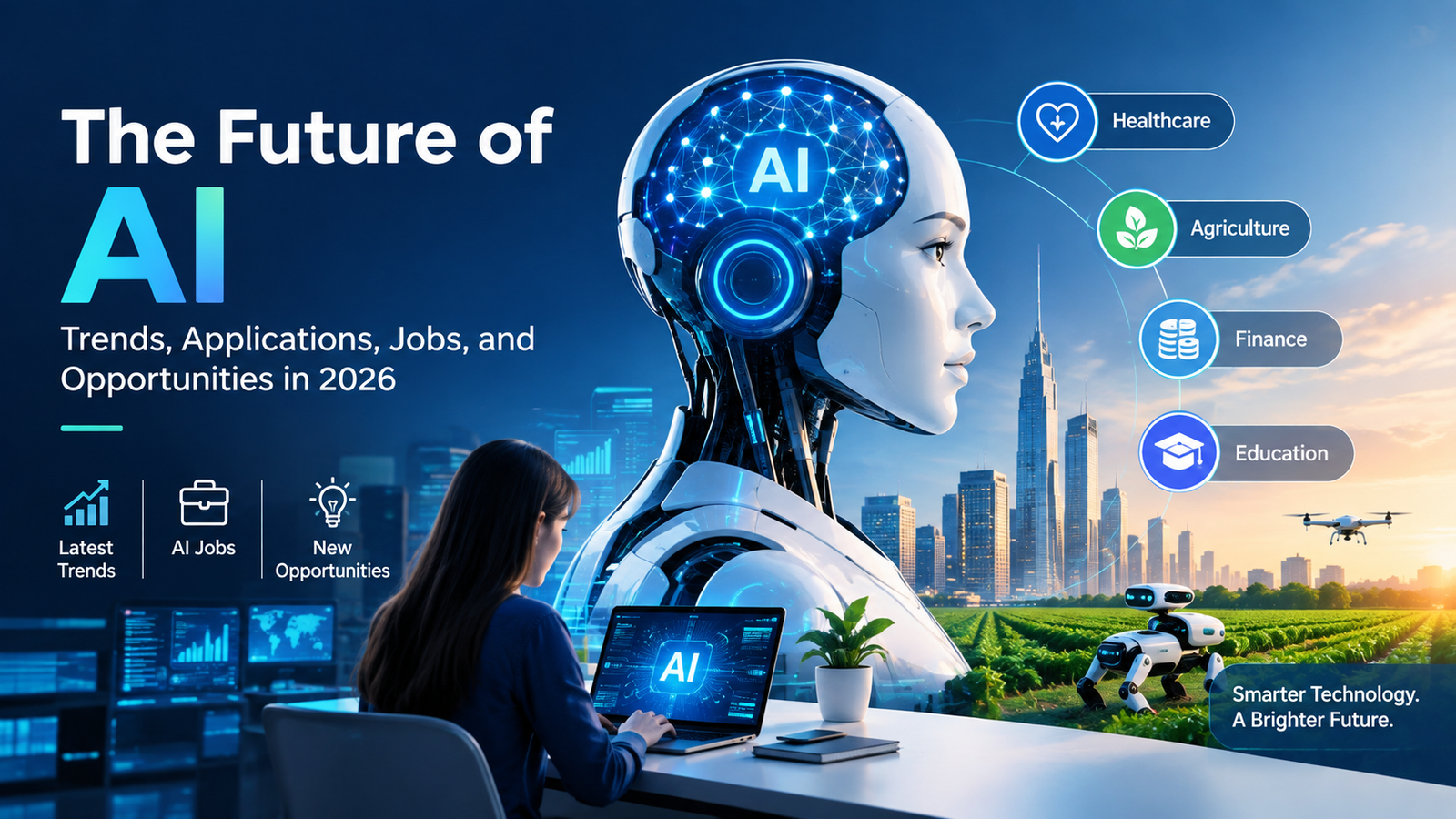
By The future of AI is transforming how people work, learn, communicate, and use technology in 2026. Artificial intelligence is becoming an important part of modern life, from smart assistants and AI-powered search tools to autonomous robots and business automation. artificial intelligence is changing how people work, learn, communicate, and solve problems.
The future of AI is not limited to chatbots that answer questions. It includes AI agents that can perform multiple tasks, generative AI models that create content, intelligent robots that interact with the physical world, and specialised systems that support industries such as healthcare, agriculture, finance, and education.
AI can provide opportunities for productivity, innovation, and new career paths. However, it also creates challenges related to privacy, cybersecurity, misinformation, job changes, and responsible technology development. Understanding these opportunities and risks can help individuals and businesses make informed decisions.
This article explains the future of AI, including emerging trends, business applications, AI jobs, smart assistants, robotics, investment banking, agriculture, and the skills people may need to develop.
What Is future of AI Artificial Intelligence?
Artificial intelligence is a field of computer science focused on developing systems that can perform tasks associated with human intelligence. These tasks may include recognising patterns, understanding language, analysing information, making predictions, generating content, and supporting decisions. The full form of AI in computer technology is Artificial Intelligence.
AI does not necessarily mean that a machine thinks exactly like a human. Different AI systems are designed for different purposes. Some systems identify objects in images, while others generate text, translate languages, recommend products, or detect unusual activity.
Applications future of AI
| Industry | AI Application | Benefits |
| Healthcare | Medical data analysis and virtual assistants | Supports healthcare professionals and improves service efficiency |
| Education | Personalized learning and automated feedback | Helps students learn at their own pace |
| Finance | Fraud detection and financial analysis | Identifies suspicious transactions |
| Marketing | Content creation and customer segmentation | Supports targeted marketing campaigns |
| E-commerce | Product recommendations and chatbots | Improves customer experience |
| Manufacturing | Predictive maintenance and quality inspection | Helps reduce equipment downtime |
| Transportation | Route optimization and autonomous technology | Supports efficient transportation |
| Agriculture | Crop monitoring and smart farming | Helps improve resource management |
| Customer Service | AI chatbots and automated responses | Helps identify security risks |
Read more : iPhone 18 Pro | OpenAI News Today | AI Gemini Photo | iPhone 18 Pro vs. iPhone 17 Pro
Many modern AI applications use machine learning. Machine learning systems identify patterns in data and use those patterns to produce predictions or outputs. Generative AI models can create new content based on patterns learned during training. A smart assistant can respond to voice or text commands.
How Does future of AI Work?
The quality of an AI system depends on factors such as its training data, model design, instructions, testing, and operating environment.
Why Is the Future of AI Important?
The future of AI matters because artificial intelligence is moving from individual applications into wider business and professional workflows. Organisations are exploring how AI can improve customer service, automate repetitive work, analyse data, and support employees.
Several factors are contributing to AI adoption:
1. Increased Digital Data
Businesses and individuals generate large amounts of data through websites, applications, transactions, sensors, and online interactions. AI can help process this information and identify patterns that may be difficult to recognise manually.
2. Better Computing Infrastructure
Cloud computing, specialised processors, and improved AI infrastructure allow organisations to train and operate increasingly complex systems. The cost, availability, and energy requirements of this infrastructure remain important considerations.
3. Demand for Automation
Businesses want to reduce repetitive work and improve operational efficiency. AI may help with document processing, customer support, research, reporting, and workflow coordination.
4. Wider Access to future of AI Tools
Many AI services are available through websites, mobile applications, and software integrations. This makes it easier for students, marketers, entrepreneurs, and professionals to use AI without developing a complete AI model themselves.
Major Trends Shaping the Future of AI
The future of AI will be influenced by several technologies that are developing rapidly. The following trends are relevant to consumers, businesses, and technology professionals.
1. Future of AI Agents and Autonomous Workflows
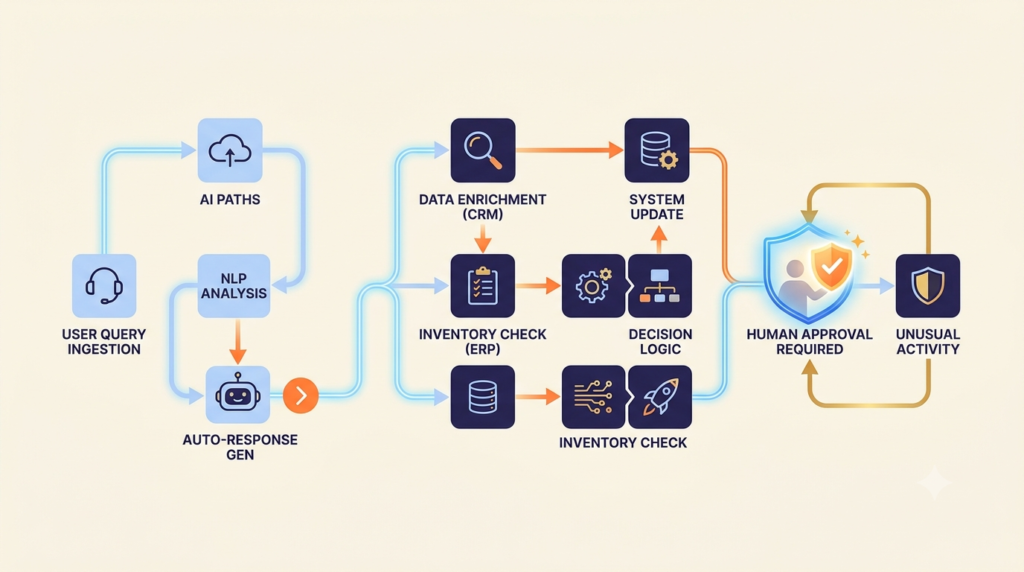
AI agents are software systems designed to complete tasks using information, tools, and defined objectives. A basic chatbot may answer a question, while an AI agent can potentially perform a sequence of actions within a controlled workflow.
AI agents must be given appropriate permissions and monitored carefully. An agent that can access sensitive systems may create security risks if its permissions are too broad.
Google Cloud’s 2026 AI agent report describes the use of agents for productivity, multi-step workflows, customer experience, security operations, and workforce training. These are reported industry trends and not guarantees that every organisation will experience the same results.
Benefits of future AI Agents
- Automating repetitive workflows.
- Supporting customer service teams.
- Helping employees organise information.
- Connecting multiple software applications.
- Reducing manual data processing.
Risks of future AI Agents
- Incorrect actions.
- Unauthorised access.
- Data leakage.
- Poor decision-making.
- Difficulty tracking automated activities.
Businesses should begin with limited use cases, establish access controls, and require human approval for sensitive actions.
2. Generative Future of AI Models
Generative AI models can create text, images, audio, video, and computer code. They are used in education, content creation, software development, marketing, and research.
If someone asks, “Choose the generative AI models for language from the following,” the correct approach is to identify models designed to process and generate language. Examples include large language models such as GPT-based models, Gemini language models, Claude, and other comparable systems. The exact correct choice in a multiple-choice question depends on the options provided.
Generative AI can help with:
- Blog outlines.
- Content drafts.
- Email writing.
- Translation.
- Code generation.
- Research summaries.
- Brainstorming.
However, AI-generated information should be reviewed. AI models can produce incorrect statements, outdated information, invented references, and biased outputs.
For professional content, human review is important for factual accuracy, originality, brand voice, and audience relevance.
3. Smart Assistants
A smart assistant
is a software application that uses technologies such as natural language processing, speech recognition, and machine learning to respond to user requests.
Examples of smart assistant activities include:
- Answering questions.
- Setting reminders.
- Managing calendars..
In the future, smart assistants
may become more integrated with applications and business systems. Instead of simply responding to questions, they may help users complete tasks across multiple services.
For example, a business assistant could help an employee find a company policy, prepare a report, and organize a meeting request. Such functions require appropriate permissions and protection of personal or confidential data.
4.Future AI and Robotics
What Is an future of AI Robot?
An AI robot combines physical hardware with software that can process information and respond to its environment. Robots may use cameras, sensors, machine learning, and control systems to perform tasks.
A robot model may be designed for a particular purpose, such as manufacturing, warehouse movement, inspection, or research. Not all robot models use the same type of AI, and some robots operate mainly through predefined instructions.
Applications of Future AI Robots
- Industrial manufacturing.
- Warehouse automation.
- Agricultural monitoring.
- Medical research support.
- Dangerous-task assistance.
- Delivery and logistics.
- Educational robotics.
Robots need more than intelligent software. They also require reliable hardware, safety testing, environmental awareness, and appropriate human supervision.
The development of physical AI is connected to broader trends in robotics, intelligent machines, and industrial automation. The practical usefulness of a robot depends on its operating environment, cost, safety, and task-specific performance.
5. Future AI in Investment Banking
AI investment banking applications are being explored in areas such as financial research, document analysis, risk assessment, customer support, and workflow automation.
Potential applications include:
- Summarising financial documents.
- Organising company information.
- Supporting market research.
- Reviewing large datasets.
- Automating routine reporting.
- Identifying unusual transaction patterns.
Financial services require strong controls because incorrect information can result in financial loss, compliance problems, or poor decisions. AI systems should not independently make high-impact financial decisions without appropriate oversight.
The use of AI in investment banking also raises questions about data confidentiality, model reliability, regulatory requirements, and accountability. Financial professionals must verify AI-generated analysis and use approved data sources.
6. Future of AI Jobs and Career Opportunities
The growth of AI is creating demand for people who can develop, implement, operate, evaluate, and manage AI systems. AI jobs are not limited to machine learning researchers. Many roles focus on connecting AI technology with real business needs.
Examples of AI-Related Jobs
- AI engineer.
- Machine learning engineer.
- Data scientist.
In India, reporting on AI hiring in 2026 has described growing demand for roles related to agentic AI development, enterprise integration, workflow orchestration, AI operations, and governance. The exact hiring demand varies by company, location, experience level, and technical specialization.
Skills Required for future of AI Careers
People interested in AI jobs can develop a combination of technical and professional skills:
- Programming fundamentals.
- Data analysis.
- AI and machine learning concepts.
- Prompt design and evaluation.
- Cloud and API integration.
- Cybersecurity awareness.
- Communication and problem-solving.
- Industry-specific knowledge.
Not every AI-related role requires advanced programming. For example, AI content specialists, AI trainers, product professionals, and business analysts may need different skills from AI researchers or machine learning engineers.
7.Future of AI Artificial Intelligence in Agriculture
The Role of Artificial Intelligence in Agriculture
Artificial intelligence in agriculture can support farmers and agricultural organisations by analysing information, monitoring crops, and assisting with operational planning.
8. Importance of AI in Business
The importance of AI in business is connected to its potential to support productivity, improve information processing, and automate selected tasks.
Benefits of Artificial Intelligence
Artificial intelligence can provide several potential benefits when it is designed and used responsibly.
1. Improved Productivity
AI may help employees complete repetitive activities more efficiently. Productivity improvements depend on the quality of implementation and whether employees can review and correct AI outputs.
2. Faster Information Processing
AI systems can analyse large amounts of data and help users identify patterns, summarise documents, or organise information.
3. Better Customer Experiences
AI tools can provide support outside normal working hours, answer routine questions, and direct complex issues to human representatives.
4. Support for Innovation
Researchers and businesses can use AI to explore ideas, create prototypes, test possibilities, and analyse information.
5. Personalized Learning
AI tools can provide explanations and practice exercises adapted to a user’s questions and learning goals. Teachers and learners should still check accuracy and maintain academic integrity.
Cost and Infrastructure
Advanced AI systems can require computing resources, data infrastructure, maintenance, and ongoing evaluation. Businesses should assess total costs instead of focusing only on initial software pricing.
How to Prepare for the Future of AI
Individuals and businesses can take practical steps to prepare for AI development.
For Students
- Learn basic AI concepts.
- Practice using AI tools responsibly.
- Develop communication and research skills.
- Understand data privacy.
- Build practical projects.
- Learn AI applications in a chosen career.
For Businesses
- Identify a specific problem.
- Start with a small pilot project.
- Use approved data sources.
- Limit AI permissions.
- Measure performance.
- Train employees.
- Review the system regularly.
- Read more about :- Clean Computer Screen Safely| gemini ai photo creation |AI agent replace job
Conclusion
The future of AI will influence many areas of technology, including smart assistants, generative AI, robotics, agriculture, investment banking, education, cybersecurity, and business automation. Artificial intelligence can help people process information, improve workflows, and develop new solutions, but it also creates challenges involving privacy, accuracy, security, and employment.
The most effective approach is to use AI with clear goals, appropriate human oversight, and continuous evaluation. Students can prepare by developing AI literacy and professional skills, while businesses can begin with carefully selected use cases and responsible governance.
Frequently Asked Questions About the Future of AI
1. Which statement is true regarding artificial intelligence?
A correct statement is that artificial intelligence enables computer systems to perform tasks such as pattern recognition, language processing, prediction, and content generation. AI does not guarantee human-like thinking or perfectly accurate results. Its capabilities depend on its design, training, data, and operating environment.
2. What is the future of AI?
The future of AI includes possible growth in AI agents, generative AI, robotics, smart assistants, business automation, healthcare applications, education tools, and cybersecurity. The pace and impact of development will depend on technical progress, costs, regulation, and responsible implementation.
3.Can future of AI replace human jobs?
AI can automate certain tasks and change job responsibilities, but its impact differs across occupations. Some roles may require new technical skills, while other tasks will continue to need human communication, judgment, creativity, and professional expertise.
4. What are generative future of AI models used for?
Generative AI models are used to produce content such as text, images, audio, video, and code. They can support drafting, research, brainstorming, education, and software development. Their outputs should be reviewed for accuracy and suitability.
5. What is an future of AI robot?
An AI robot is a physical machine that uses software and, in some cases, AI technologies to sense its environment, process information, and perform tasks. Different robots have different capabilities, and not every robot uses advanced AI.
6. Why is future of AI important for businesses?
AI may help businesses automate repetitive work, analyse information, support customers, improve workflows, and explore new products or services. Businesses should assess security, cost, accuracy, and measurable value before adopting an AI solution.
7. How is artificial intelligence used in agriculture?
Artificial intelligence in agriculture is used for crop monitoring, pest detection, weather analysis, yield prediction, irrigation support, and agricultural automation.
8. How do you choose generative future of AI models for language?
To choose generative AI models for language, evaluate accuracy, language support, context length, privacy, integration options, performance, and cost.
9. How future of AI Will Shape the Future Computer
The future computer may become more intelligent, personalised, and connected. The development of the future computer will depend on processor performance, privacy protections, software design, and energy efficiency.
10. What is an future AI robot used for?
An AI robot can be used for tasks such as industrial automation, warehouse operations, agricultural monitoring, inspection, and research.




1 Comment