
 By
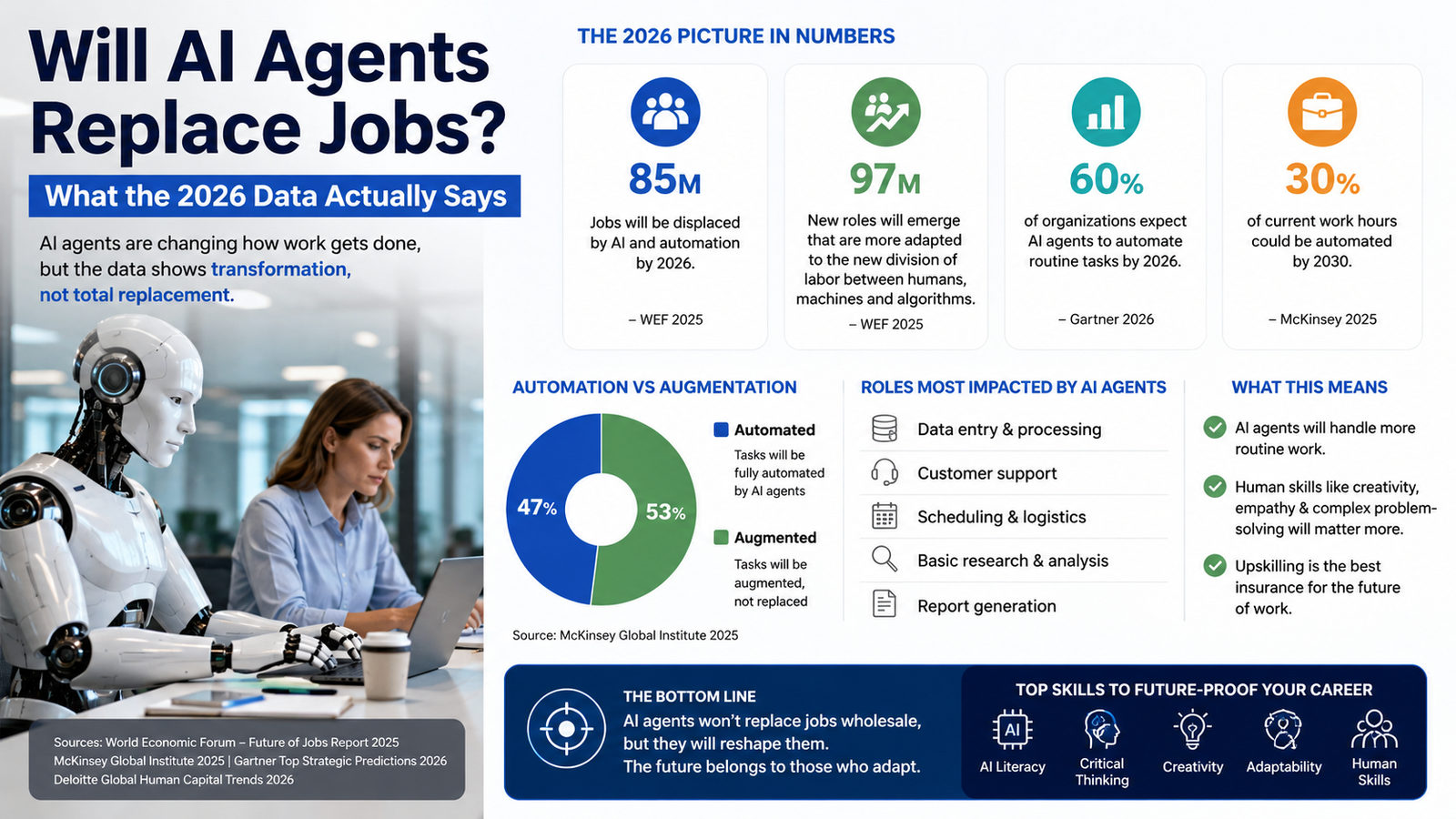
By Will AI agents replace jobs in 2026? The data says no – not at scale. BCG’s latest analysis of 165 million US roles shows 50–55% will be reshaped within 2–3 years, but only 10–15% face elimination over 4–5 years. Meanwhile, the UK expects ~100,000 AI agents in workforces by end-2026, creating a two-speed market: surging demand for AI-skilled staff alongside cuts in routine, automatable roles.
Will AI agents really replace human jobs?
AI agents are restructuring work, not erasing it. Most roles will change faster than they disappear.
To understand why these systems can perform work with limited human input, see our guide to what agentic AI is and how it works.
The 2026 headline numbers often sound scarier than the underlying data. BCG Henderson Institute’s June–July 2026 research, covering 1,500 occupations and ~165 million US jobs, finds that 50–55% of jobs will be reshaped in the next two to three years, while only 10–15% could be eliminated over a longer four- to five-year horizon.
That’s a transformation story, not a mass-unemployment story. In practice, companies are using agents to absorb routine tasks (data entry, FAQ responses, basic coding, document sorting), then redeploying people to higher-judgment work supervision, exception handling, client relationships, and strategy.
These applications are part of a much broader range of agentic AI use cases across customer service, finance, healthcare, IT, sales, and other industries.
Even in tech, where AI-attributed layoffs hit >185,000 roles in 2026, roughly half of those cuts are expected to be rehired offshore or at lower salaries more a labour repricing than pure reduction. And across the US and UK, aggregate employment data still shows no economy-wide AI displacement shock as of mid-2026.
Related reads:
- What is Agentic AI? Complete 2026 Guide
- Agentic AI Use Cases: Real Business Examples
- Agentic AI Risks: Job Displacement, Bias & Compliance
Which jobs are most at risk from AI agents?
Roles heavy in routine, text-based, rule-driven tasks face the highest exposure especially entry-level white-collar work.
BCG’s six-segment framework (July 2026) puts 43% of US jobs above a 40% task-automation threshold, with the “Substituted” segment at ~12% and “Rebalanced/Amplified” roles making up much of the rest. McKinsey’s 2026 workforce report similarly flags 300,000–500,000 corporate white-collar roles globally facing direct displacement or restructuring as firms move from pilots to production.
Highest-exposure roles (2026 data)
| Role / Function | Why it’s exposed | 2026 stat / note |
|---|---|---|
| Office & admin support | Data entry, scheduling, document sorting | McKinsey: ~46% of admin tasks already fully automatable |
| Customer support / call centers | Routine queries, ticket triage | Up to 80% of routine CS queries moving to AI agents |
| Content writers & copywriters | Drafting, rewriting, basic SEO content | Writers/authors: 57% vulnerable over 2–5 years |
| Computer programmers (junior) | Boilerplate code, tests, simple features | Programmers: 55% vulnerable; juniors most compressed |
| Web/digital interface designers | Template-based UI, basic layouts | 55% vulnerable over 2–5 years |
| Data entry & records clerks | Structured input, form processing | Among first roles cited in AI-linked layoffs |
Stanford’s 2026 “canary” analysis finds a 2.7% employment hit for 22–25-year-olds since ChatGPT’s rollout, rising to 12.8% in the most AI-exposed sectors (finance, software, creative). That’s the entry-level squeeze in action: one senior + AI agents can replace teams of 3–5 juniors on routine work.
Which jobs are safe from agentic AI?
Jobs requiring physical presence, licensed human accountability, or complex interpersonal trust remain the safest in 2026.
AI agents still struggle with unpredictable physical environments, regulated clinical judgment, and deep emotional work. That’s why “safe zones” cluster around hands-on trades, healthcare, and high-stakes human roles.
Lowest-exposure roles (2026 data)
| Category | Example roles | Why protected |
|---|---|---|
| Skilled physical trades | Electricians, plumbers, HVAC, mechanics, construction leads | Moravec’s Paradox: real-world navigation and dexterity remain hard for robots |
| Clinical healthcare & therapy | Surgeons, bedside nurses, physician assistants, physical/occupational therapists, mental health professionals | Requires physical presence, empathy, and regulated human judgment |
| Licensed, high-accountability roles | Pilots, lawyers (complex litigation), professional engineers | Legal/ethical accountability and complex, non-routine judgment |
| Emergency & field services | Paramedics, firefighters, field technicians | Unstructured environments, safety-critical decisions |
| Specialized manufacturing & maintenance | CNC operators, industrial maintenance, specialized assembly | Hands-on skill, variability, and safety constraints |
In short: if your work is mostly screen-based, text-heavy, and rule-driven, you’re in the “compression zone.” If it’s hands-on, people-centric, or legally regulated, you’re in the “safe zone” for now.
What new jobs will agentic AI create?
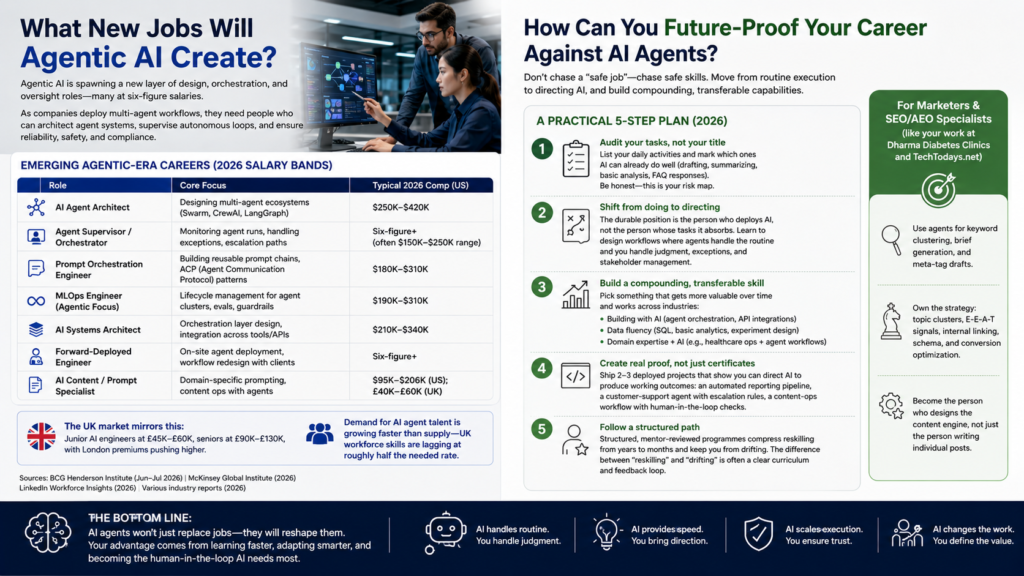
Agentic AI is spawning a new layer of design, orchestration, and oversight roles many at six-figure salaries.
As companies deploy multi-agent workflows, they need people who can architect agent systems, supervise autonomous loops, and ensure reliability, safety, and compliance.
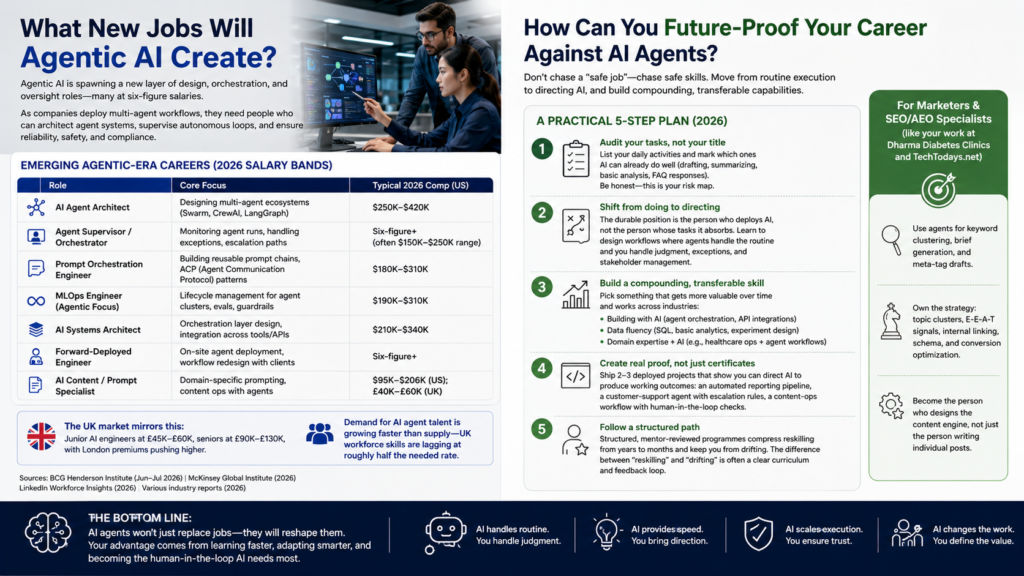
Emerging agentic-era careers (2026 salary bands)
| Role | Core focus | Typical 2026 comp (US) |
|---|---|---|
| AI Agent Architect | Designing multi-agent ecosystems (Swarm, CrewAI, LangGraph) | $250K–$420K |
| Agent Supervisor / Orchestrator | Monitoring agent runs, handling exceptions, escalation paths | Six-figure+ (often $150K–$250K range) |
| Prompt Orchestration Engineer | Building reusable prompt chains, ACP (Agent Communication Protocol) patterns | $180K–$310K |
| MLOps Engineer (Agentic Focus) | Lifecycle management for agent clusters, evals, guardrails | $190K–$310K |
| AI Systems Architect | Orchestration layer design, integration across tools/APIs | $210K–$340K |
| Forward-Deployed Engineer | On-site agent deployment, workflow redesign with clients | Six-figure+ |
| AI Content / Prompt Specialist | Domain-specific prompting, content ops with agents | $95K–$206K (US); £40K–£60K (UK) |
The UK market mirrors this: junior AI engineers at £45K–£60K, seniors at £90K–£130K, with London premiums pushing higher. Meanwhile, demand for AI agent talent is growing faster than supply UK workforce skills are lagging at roughly half the needed rate.
How can you future-proof your career against AI agents?
Don’t chase a “safe job” chase safe skills. Move from routine execution to directing AI, and build compounding, transferable capabilities.
A practical 5-step plan (2026)
- Audit your tasks, not your title
List your daily activities and mark which ones AI can already do well (drafting, summarizing, basic analysis, FAQ responses). Be honest this is your risk map. - Shift from doing to directing
The durable position is the person who deploys AI, not the person whose tasks it absorbs. Learn to design workflows where agents handle the routine and you handle judgment, exceptions, and stakeholder management. - Build a compounding, transferable skill
Pick something that gets more valuable over time and works across industries:- Building with AI (agent orchestration, API integrations)
- Data fluency (SQL, basic analytics, experiment design)
- Domain expertise + AI (e.g., healthcare ops + agent workflows)
- Create real proof, not just certificates
Ship 2–3 deployed projects that show you can direct AI to produce working outcomes: an automated reporting pipeline, a customer-support agent with escalation rules, a content-ops workflow with human-in-the-loop checks. - Follow a structured path
Structured, mentor-reviewed programmes compress reskilling from years to months and keep you from drifting. The difference between “reskilling” and “drifting” is often a clear curriculum and feedback loop.
For marketers and SEO/AEO specialists (like your work at Dharma Diabetes Clinics and TechTodays.net), this means:
- Use agents for keyword clustering, brief generation, and meta-tag drafts.
- Own the strategy: topic clusters, E-E-A-T signals, internal linking, schema, and conversion optimization.
- Become the person who designs the content engine, not just the person writing individual posts.
FAQ: Core questions people ask about AI agents and jobs
Will AI agents replace jobs in 2026?
Not at scale. In 2026, AI agents are reshaping 50–55% of US jobs but eliminating only 10–15% over a longer horizon. Most roles are being redesigned, not removed.
What does BCG say about AI and jobs in 2026?
BCG Henderson Institute’s 2026 analysis of 165 million US jobs finds 50–55% will be reshaped in 2–3 years, with 10–15% potentially eliminated over 4–5 years. They map six AI-disruption segments, with 43% of roles above a 40% task-automation threshold.
How many jobs will AI agents eliminate vs reshape?
Current 2026 data shows roughly 50–55% reshaped vs 10–15% eliminated in the US. Globally, WEF projects 170 million roles created and 92 million displaced by 2030 a net gain of 78 million.
Which jobs are most at risk from AI agents?
Routine, text-heavy, rule-driven roles admin support, customer service, junior coding, content writing, data entry. Writers/authors (57%), programmers (55%), and web designers (55%) are flagged as highly vulnerable over 2–5 years.
Which jobs are safe from AI in 2026?
Skilled trades, clinical healthcare, licensed/high-accountability roles, and emergency services. These require physical presence, empathy, or regulated human judgment that agents can’t replicate yet.
What new jobs will AI agents create?
AI Agent Architect, Agent Supervisor, Prompt Orchestrator, MLOps (agentic), AI Systems Architect, and AI Content/Prompt Specialist. Many pay $180K–$420K in the US as of 2026.
How can I future-proof my career against AI agents?
Audit your tasks, shift from doing to directing AI, build compounding skills (AI orchestration, data, domain + AI), ship real projects, and follow a structured reskilling path. The goal is to become the person who designs and oversees agent workflows.
Is AI causing layoffs or just changing hiring?
Both. AI is cited in >185,000 tech layoffs in 2026, but aggregate data shows no economy-wide displacement yet. Hiring is shifting toward AI-skilled staff while routine roles shrink.
What skills should I learn to work with AI agents?
Agent orchestration (Swarm, CrewAI, LangGraph), prompt engineering, API integrations, basic data/SQL, and domain-specific workflow design. Pair these with soft skills: stakeholder management, exception handling, and quality control.
AI agents vs traditional automation: what’s different for jobs?
Traditional automation handles fixed, rule-based tasks. AI agents can plan, reason, call tools, and adapt to new situations so they reshape entire workflows, not just single tasks. That’s why 50–55% of jobs are being redesigned, not just partially automated.
How do AI agents change marketing and SEO jobs?
Agents handle keyword research, briefs, meta tags, and first drafts; humans own strategy, E-E-A-T, internal linking, schema, and conversion optimization. The role shifts from “writer” to “content engine designer.”
How to use AI agents without losing my job?
Map your tasks, automate the routine, and reposition yourself as the person who designs, supervises, and improves those agent workflows. Build proof via deployed projects, not just courses.
How to transition from content writer to AI content strategist?
Learn prompt orchestration, topic-cluster strategy, internal linking, schema markup, and analytics. Use agents for drafting and optimization; focus your time on strategy, quality control, and conversion.
How to become an AI Agent Architect or Prompt Orchestrator?
Study multi-agent frameworks (Swarm, CrewAI, LangGraph), build 2–3 real agent workflows, and learn evaluation/guardrails. Target roles like AI Systems Architect or MLOps (agentic) as stepping stones.
Sources & further reading
- BCG Henderson Institute: AI’s impact on US jobs (reshape vs eliminate) – BCG analysis summaryfuturefeed+2
- Stanford Digital Economy Lab: AI and entry-level employment (“canary” research) – Stanford AI & jobs 2026
- World Economic Forum: Future of Jobs Report 2025 (170M created, 92M displaced by 2030) – WEF Future of Jobs
- UK AI agent talent demand (Consultancy.uk / Malt) – UK AI agent skills gap


1 Comment