 By
By Who Owns AI? Understanding AI Ownership, Companies, Models, and Control
This past year, the public became more interested in artificial intelligence (AI), particularly after its integration into consumer technology. With the growing reliance on and value of AI, people have begun to ponder, who owns AI? While the question has increased in popularity, the opposite is true of its answer.
With regard to AI, there are many open-ended questions. Who owns ChatGPT? Who developed Claude? Who owns the AI chip and cloud computing infrastructure used by these applications? Who Owns AI ?,Who determines the legal rights of AI-generated content? Each question is independent from the others.
A more constructive method of addressing who owns AI is to analyze the AI ecosystem and nearby neighboring ecosystems. These include (but are not limited to) research ecosystems, intellectual property ecosystems, and services. Within these, different companies can own or control these ecosystems in their entirety or in part and Who Owns AI.
Understanding these ecosystems provides insight to who owns AI.
What Does “Who Owns AI” Actually Mean?
The term who owns AI creates confusion around several different financial and legal concepts. These should be distin―gued from one another.
No single entity controls all aspects of artificial intelligence (AI). It takes significant financial and human resources to develop AI applications. Therefore, numerous public and private organizations from universities to large tech companies as well as startups have developed aspects of current AI systems.
Comparing AI to the Internet is apt. Similar to the Internet, there is no single entity that controls AI. Parts of AI systems and applications may be owned and/or controlled by specific companies.
The crux of the matter is: when someone asks, ‘who owns AI?’ which AI technology are they referring to?
Who Owns AI If we break it down this far, we can make definitive statements about the companies that own aspects of AI.
Read more about: The Future of AI | AI Gemini Photo | 10 Best Agentic AI Tools | Agentic AI Risks
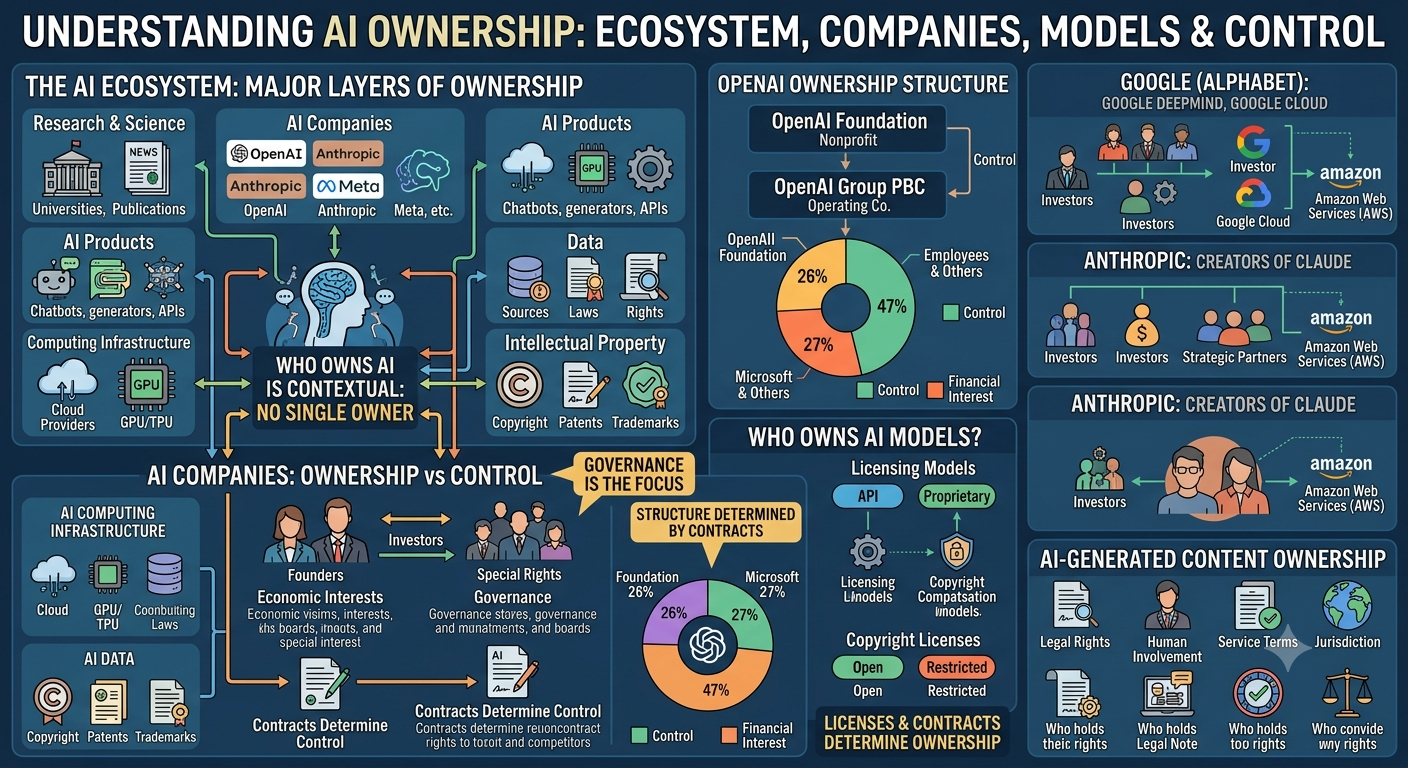
The Major Layers of AI Ownership
Research and science
Universities and research institutions innovate tech like algorithms, training methods, assessment procedures, etc. Scientific discoveries are published as research and may be licensed to industry or published freely.
AI companies
Companies that focus on AI, such as OpenAI and Anthropic, build AI models and related services. Other technology companies build AI as one of many services they offer.
AI products
Companies can buy different sorts of AI, such as chatbots, coding assistants, image generators, search and recommendation engines, and AGI.
Computing infrastructure
“Large models require a lot of computing power to train,” acknowledges a 2017 Nature article. Cloud providers and semiconductor companies are thus strategically situated in the AI ecosystem.
Data
AI systems work by ingesting data to be trained and/or tested, to retrieve information to operate on, and to be generally functional. Legal frameworks for datasets differ based on their sources and the laws that govern their use.
Intellectual property
AI technology raises numerous legal questions, e.g. the acquisition of software, trademarks, patents, trade secrets, contracts and licenses may affect the ownership of AI.
These issues encompass more than single founders, CEOs, investors, or companies.
These issues are, to a large extent, a function of structure of companies or the agreement of the parties.
Who Owns AI Companies?
With many owners, including employees, founders, investors, strategic partners and more, AI companies can be opaque about ownership.
Public companies must disclose their owners, but many AI companies are private. Employees and founders of private AI companies can hold economic interests that differ from ownership and control.
It is a misnomer to think the owner of an AI company is the same entity that controls the AI system. There are various reasons for this, such as bankruptcy, but ultimately the governance and control of the system are the focus.
The ownership of AI systems is often obfuscated.
Governance is the focus, and the owners are often investors.
OpenAI and Its Ownership Structure
Though there are many companies involved in the development of artificial intelligence (AI), including both its applications and its underlying technologies, OpenAI has gained notable attention for ChatGPT and other related products, and is thus included in discussions around who owns AI.
OpenAI was established in 2015 as a nonprofit company and, in 2019, formed a for-profit company. In 2025, the company updated its structure to what it is currently.
According to the company, the nonprofit was renamed the OpenAI Foundation, and the operating company was established as OpenAI Group PBC. Although the nonprofit controls the operating company, OpenAI states the Foundation holds a 26% interest in the company, Microsoft holds 27%, and the remaining 47% is held by employees and other parties.
Although an investor may own a portion of a company, that investor is usually not in control of the company. Through the establishment of special rights, a controlling party of a company may give an investor control of the company.
Factors which influence the ownership of AI are called model rights.
Does Microsoft Own OpenAI?
Microsoft is a strategic partner and invested shareholder of OpenAI. In 2019, Microsoft invested in OpenAI and since then has expanded its partnership to use OpenAI’s technology for cloud computing and other services.
It is important to note, however, that Microsoft does not own OpenAI. OpenAI claims that the Foundation controls OpenAI Group. So, when people ask “who owns AI?” and use OpenAI as an example to answer the question, people should differentiate Foundation’s control from financial interest.
In general, control of a company is determined by contracts.
Does Google Own AI?
Google, as a company, doesn’t monopolize AI. It is primarily considered as one of many companies in the AI field.
Some of Google’s projects are located outside the main company, such as Google DeepMind, Google Cloud, and other AI projects and programs.
Alphabet is the publicly traded company, and Google is one of its subsidiaries.
There are many fields and services in which AI can be applied. Google can have intellectual property rights for certain AI services. However, there may be other companies with different AI services.
Competition in the market determines which companies have AI services.
Does Microsoft Own AI?
Microsoft is definitely one of the major players when it comes to applying AI in various products. They are also heavily investing in AI research, products and partnerships.
Azure and Microsoft 365 are examples of AI products, and Microsoft has a major partnership with OpenAI. Their cloud computing services offer customers the opportunity to run various AI workloads.
There are situations where a company owns the AI model and rents out the computing power to run it. In such scenarios, owning the computing infrastructure is essential.
Ultimately, ownership of AI is determined by the products produced.
Who Owns Claude and Anthropic?
An independent AI company called Anthropic has created an AI product named Claude. Investors have played a key role in building Anthropic and strategic partners have helped the company rapidly develop its products and services.
An example of a strategic partner for Anthropic has been Amazon Web Services (AWS). In April 2022, Anthropic disclosed that Amazon would provide up to 5 gigawatts of cloud computing capacity to develop and deploy Claude. Anthropic also disclosed that Amazon would provide Anthropic with significant access to Amazon’s Trainium chips.
Anthropic has raised funds from a long list of investors. The company’s public statements in 2022 showed that Anthropic does not have a single owner.
Who Owns AI so, when asked who owns Claude AI, the response should disclose that Claude is produced by Anthropic, and then provide information about Anthropic’s investors and partners.
To disclose who actually owns artificial intelligence, one would have to look through Anthropic’s corporate records.
What About Meta AI?
Meta uses its AI to develop a variety of products including apps with built-in AI assistants, computer vision products, generative AI, and products that incorporate recommendation systems and large language models.
Meta is a publicly traded company, which means it has to distribute its economic ownership to shareholders. As such, many shareholders can own a part of AI products and services developed by Meta’s AI research unit.
It follows then, that the question of who owns AI is contextual. Meta is, of course, governed by a board of directors who ultimately make the major decisions.
In truth, the ownership of AI is defined by contracts.
Who Owns AI Models?
Licensing for AI models encompasses a range of possible scenarios. A model may be a proprietary asset of its developer. Access may then be granted through an API.
On the other hand, a model may be released under a more liberal copyright license. In this case, a model may be freely redistributed, altered, or improved by others.
Just as with any copyrighted work, the extent of rights and restrictions are determined on a case-to-case basis. For example, just because a work is released under a liberal copyright license does not necessarily mean that the copyright is totally waived. Similarly, a copyright work may be released under a liberal license but the rights may still be totally restricted.
Ultimately, the most accurate way to determine ownership of AI is to analyze the applicable licenses. While there are legitimate cases to support that a particular entity owns AI, in most cases, assumptions should not be made about ownership based on a model’s name. Equity agreements and voting rights largely determine Who Owns AI.
Who Owns AI-Generated Content?
Who do the rights to AI-generated content belong to?
How the law applies to a given situation will depend on several factors including the jurisdiction in which the content is created, the nature of the content, the AI service used, and the level of human involvement.
In a given situation, a lawyer may use an AI service to generate a first draft of a legal document and then extensively edit the document. In a different situation, a user of the same AI service may generate a document with very little, if any, human involvement. The law may apply differently to the two situations.
The terms of the AI service may address these situations. In addition, the terms may address how the service will treat other inputs and outputs. A given user may retain control over how AI is used.
The law also applies to the differences between an AI service’s outputs and the underlying AI service. A user may commission an AI service to generate a document and not own the AI service that generates the document. The user may not own the software, hardware or other components that comprise the AI Service.
Boards of directors may limit ownership of AI.
Licenses may affect ownership of AI.
The Difference Between AI Ownership and AI Control
There’s a difference between ownership and control.
An entity may own a stake in an AI company and not control it governance-wise. For instance, an investment may be made by an entity different from the one controlling the company, say, by having the board and/or voting power.
Likewise, company A may own an AI model and Company B may own the cloud on which the model is run. Company C may build an app to access the model through an API.
These contracts may be a combination of licensing and/or hosting agreements, as well as contracts covering IP, distribution, data processing, and other commercial interests.
When considering who owns AI, the following questions become pertinent: Who owns the company? Who controls the company? Who owns the AI model/ technology? Who is allowed to use and/or monetize the AI model/ technology?
Who Owns AI and The ownership of AI is reflected in company filings.
Service terms shape who owns AI.
Who Are the Owners of AI?
Owners of AI is a phrase that can be used to describe several groups of people.
1. Institutions Focused on AI Research
Algorithms and data are usually published in academic journals or conferences.
2. Large Tech Companies
AI is used in other kinds of mainstream software and hardware developed by large tech companies.
3. AI-Focused Companies
AI is used to create other kinds of software and hardware.
4. Cloud and Chip Companies
AI requires large amounts of computing power to train and use.
5. Financial Companies
Financial companies invest in AI companies.
6. Scientific Community
Models and frameworks can be published with open access.
There are many owners of AI because of the ways it can be published, protected, and transferred.
Who owns use.ai?
The phrase “who owns use.ai” is often used to determine ownership of specific AI services. It is not used to determine ownership of services within the broader AI ecosystem.
At the time this document was created, use.ai offered a number of different AI services. Information about ownership of these services is available in the terms of service. Terms of service are subject to change and service ownership may change as well.
Ownership of a service is different from the models offered by the service. A service may provide models offered by other services.
It is common to believe that a company which provides access to AI models through a service also develops the models.
The ownership of AI models is often determined by data, not you owning the models.
What is an AI Owner?
An AI owner can mean something different to a business. Here, an AI owner can refer to a business that controls or manages AI systems used in its business processes.
A business can develop a bespoke, internal AI system using its own data and documents, and in accordance with its own process, security, and infrastructure policies, without creating a foundational model.
- A business can do any or all of the following:
- Connect one or more AI systems to its internal databases.
- Implement policies for employee access and use of AI systems.
- Create AI systems to perform specific business functions.
- Create and implement policies and standards to manage AI systems used in the business.
- Integrate AI systems to business software and/or services.
- Monitor the performance of AI systems and take corrective actions.
- Rights and interests held by investors and other capital providers define ownership of AI.
- Rights and interests held by investors define ownership of AI.
Who Can legally Claim Ownership of Artificial Intelligence?
Artificial Intelligence encompasses numerous disciplines in computer science. Therefore, no entity can lay claim to a monopoly in this area of research.
Some elements of Artificial Intelligence can be sheltered by intellectual property laws. Programs can be protected by authorship. Other innovations can be protected by patents. Closely held innovations can be protected by mer restricted property. Names and architectures of products can be protected by trademarks. Further restrictions can be created by contracts and licenses.
In light of the above, it is correct to state that no single entity can lay claim to a monopoly in Artificial Intelligence.
A firm can own a product or software based on Artificial Intelligence without owning the principles underlying the product. Similarly, a given product or software can be made available to the public without restricting its use.
Most often, the answer to the question who owns Artificial Intelligence, is determined by the terms of a product or software license.
Does One Company Control the AI Industry?
The AI industry contains multiple competing layers and participants. Competition exists among foundation-model developers, cloud providers, chip manufacturers, enterprise software companies, consumer AI platforms, robotics companies, and open-source projects.
Some companies may have strong positions in particular parts of the ecosystem, but that does not mean they own AI as a whole.
This matters because the answer to who owns AI can change depending on whether the discussion concerns models, chips, cloud computing, applications, research, data, or intellectual property.
Specific assets matter when asking who owns AI.
Legal documents help answer who owns AI.
Why AI Ownership Matters
Understanding ownership matters to consumers, developers, and businesses.
Data Privacy
AI services may process prompts, documents, files, and other information. Users should understand the provider’s data practices before submitting sensitive information.
Licensing
Developers should review whether a model permits commercial use, modification, redistribution, or deployment. The specific license matters more than general labels such as open or closed.
Intellectual Property
Businesses should understand how their contracts, local law, and AI-provider terms affect content, software, designs, and other AI-assisted work.
Vendor Lock-In
Depending heavily on one provider can create operational risks if pricing, availability, features, or terms change.
Security
Organizations using private or controlled AI environments may have different options for protecting sensitive information than organizations using public services.
Long-Term Strategy
Companies deciding whether to build, buy, or integrate AI should understand which parts of the technology they own and which parts depend on third parties.
- Current disclosures clarify who owns AI.
- Corporate governance explains who owns AI.
- Licensing terms clarify who owns AI.
- Ownership and control affect who owns AI.
What Does “AI to Own Words” Mean?
The phrase ai to own words can relate to questions about AI-assisted writing and ownership of written material.
The important questions are not limited to whether AI generated the words. Businesses and creators should consider who supplied the source material, which model was used, what the provider’s terms say, how much human editing occurred, and which copyright rules apply.
Human review remains valuable for factual accuracy, originality, quality, and brand standards. AI-assisted content should also be checked for accidental similarities, unsupported claims, and material that may require permission.
Jurisdictions can change who owns AI.
Specific facts determine who owns AI.
How AI Ownership Could Change
AI is developing quickly, and corporate structures can change through investment rounds, acquisitions, partnerships, licensing agreements, and new business models.
Models may also become more open or more restricted over time. Cloud providers can expand their infrastructure partnerships, while AI companies can diversify their computing suppliers.
These changes mean the answer to who owns AI should be treated as a question that requires current information rather than a permanent fact.
A practical approach is to identify the specific company or product first. Then examine its corporate structure, investors, governance, model license, intellectual-property terms, infrastructure relationships, and user agreement.
Read more about: Yashvir Singh | The Last Dance of Cristiano Ronald | IND vs AUS | FIFA World Cup 2026
Final Answer: Who Owns AI?
The clearest answer is that no single person or company owns artificial intelligence as a whole. AI is a broad ecosystem made up of research, models, software, data, infrastructure, services, and intellectual property.
When someone asks who owns AI, the answer depends on what they are actually trying to identify. OpenAI controls and operates its own AI business under a structure in which the OpenAI Foundation controls OpenAI Group. Microsoft has a substantial equity interest, while employees and investors hold the remaining interests described by OpenAI. Google develops AI through Alphabet, Anthropic develops Claude, Meta develops its own AI systems, and numerous other organizations contribute to the field.
The most reliable way to understand who owns AI is therefore to examine the specific asset or service. Ask who developed it, who owns the relevant company, who controls its governance, who owns the intellectual property, who provides the infrastructure, and what the applicable license permits.
Ultimately, AI ownership is distributed across a large network of researchers, companies, investors, infrastructure providers, open-source developers, and users. That structure is likely to keep changing as AI technology and business models evolve.
FAQs
1. Who owns AI?
No single entity owns artificial intelligence as a whole. Different organizations own or control individual AI models, applications, research, infrastructure, and intellectual-property assets.
2. Who owns OpenAI?
OpenAI’s current structure includes the nonprofit OpenAI Foundation and OpenAI Group PBC. OpenAI states that the Foundation controls OpenAI Group and holds 26% of its equity. Microsoft holds roughly 27%, while current and former employees and investors hold the remaining 47%.
3. Does Microsoft own OpenAI?
Microsoft has a major investment and strategic relationship with OpenAI, but OpenAI states that the OpenAI Foundation controls OpenAI Group through special governance and voting rights.
4. Who owns ChatGPT?
ChatGPT is developed and operated by OpenAI. Questions about its corporate ownership are therefore connected to OpenAI’s current corporate and governance structure.
5. Who owns Claude?
Claude is developed by Anthropic. Anthropic has multiple investors and major infrastructure partnerships, including a significant relationship with Amazon.
6. Who owns Gemini?
Gemini is developed by Google and is part of Google’s broader AI portfolio within Alphabet.
7. Who owns Use AI?
Use AI is a separate AI service. The company and its terms should be checked directly for the latest information about its ownership, operation, technology, and licensing arrangements.
8. Do users own AI-generated content?
Ownership and copyright treatment depend on the applicable law, the user’s creative contribution, and the terms of the AI service. Users should review the relevant terms and legal requirements before assuming that an AI-generated work is exclusively theirs.