
 By
By Shoulder pain can affect almost every part of daily life. Reaching for something on a shelf, getting dressed, sleeping comfortably, exercising, lifting an object, or working at a desk can become difficult when the shoulder is painful or stiff. Finding effective shoulder pain relief depends on understanding why the pain is occurring and choosing an approach that matches the underlying problem.
Shoulder Pain Relief discomfort can develop because of muscle strain, repetitive movement, tendon irritation, bursitis, arthritis, frozen shoulder, rotator cuff problems, nerve irritation, injuries, or referred pain from another area. The intensity can range from a mild ache to severe pain that limits movement.
Understanding the shoulder pain symptoms you experience can provide useful information about whether the problem may involve muscles, tendons, joints, nerves, or another part of the body. However, symptoms alone cannot establish a diagnosis.
This guide explains common causes, shoulder pain symptoms, home-care options, exercises, professional shoulder pain treatments, prevention strategies, and when medical evaluation may be necessary.
Important: This article provides general health information and is not a diagnosis. If shoulder or arm pain occurs with chest pressure, trouble breathing, sweating, fainting, nausea, or pain spreading to the arm, back, neck, or jaw, seek emergency medical help instead of relying on home remedies.
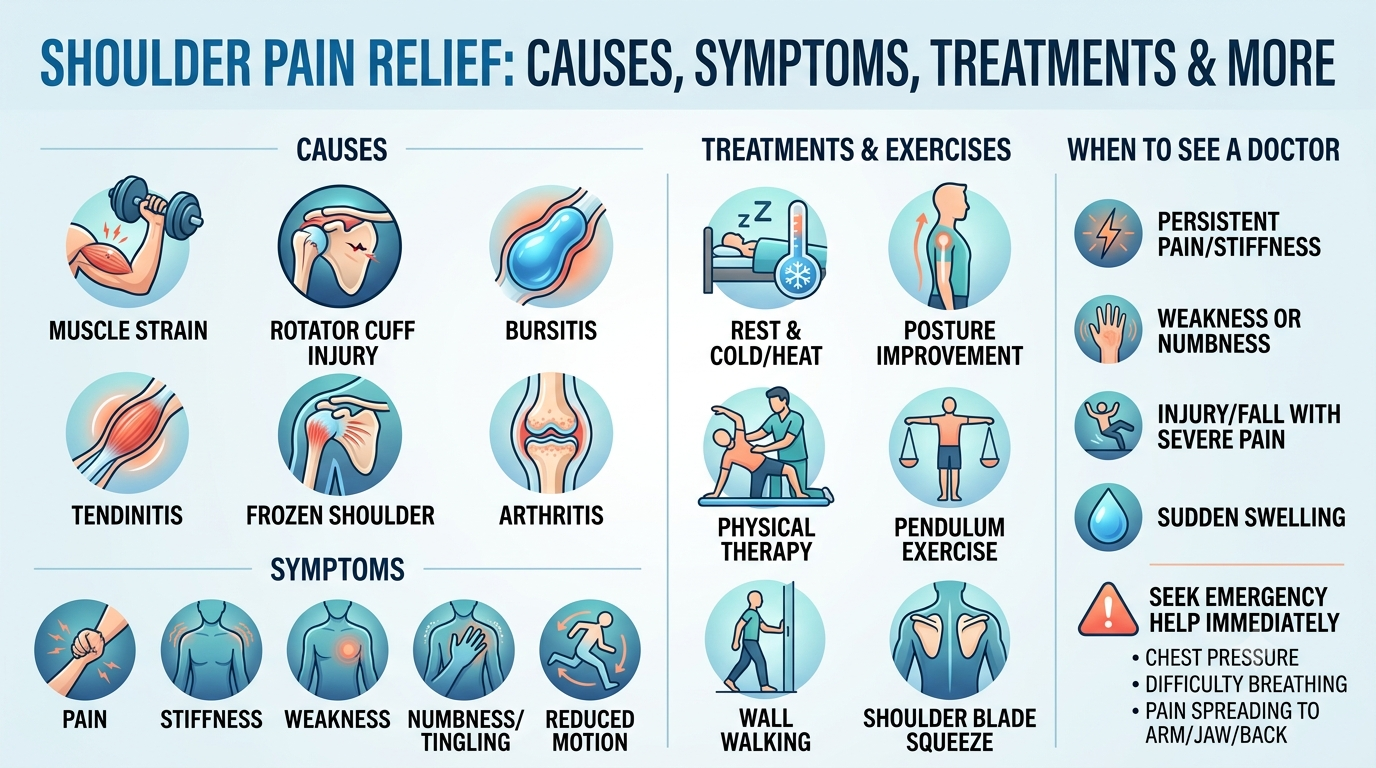
What Causes Shoulder Pain?
The Shoulder Pain Relief is a complex joint that allows a wide range of movement. It includes bones, muscles, tendons, ligaments, cartilage, and bursae. Because the shoulder is used for many everyday movements, it can be affected by both sudden injuries and gradual overuse.
Understanding the cause is an important first step toward shoulder pain relief.
1. Muscle Strain
Muscle strain can happen after lifting heavy objects, exercising without proper technique, carrying a heavy bag, or performing repetitive movements.
Mild muscle soreness may improve when you temporarily reduce activities that aggravate the shoulder. Gentle movement can help prevent excessive stiffness, but painful activities should be avoided until symptoms improve.
2. Rotator Cuff Problems
The rotator cuff is a group of muscles and tendons that helps stabilize and move the shoulder. Repeated overhead activity, sports, aging-related changes, or an injury can affect these structures.
Symptoms may include pain while lifting the arm, weakness, difficulty reaching overhead, or discomfort at night.
The appropriate approach to shoulder pain relief depends on whether the rotator cuff problem involves irritation, inflammation, or a more significant injury.
3. Bursitis
Bursae are small fluid-filled sacs that help reduce friction between tissues. When a bursa becomes irritated or inflamed, the shoulder can become painful and tender.
Pain may become more noticeable during movement or when pressure is placed on the affected shoulder.
4. Tendinitis
Tendinitis involves irritation or inflammation of a tendon. Repetitive movements can increase stress on tendons around the shoulder.
People who frequently perform overhead activities may experience pain when raising or rotating the arm.
Activity modification and rehabilitation may be part of a treatment plan for shoulder pain relief.
5. Frozen Shoulder
Frozen Shoulder Pain Relief, also called adhesive capsulitis, can cause pain and progressive stiffness. People may have difficulty raising the arm, reaching behind the back, or performing routine activities.
Frozen Shoulder Pain Relief often develops gradually and may take considerable time to improve. Physical therapy and range-of-motion exercises are commonly used as part of treatment.
6. Arthritis
Arthritis can affect the shoulder joint and cause pain, stiffness, and reduced mobility. Osteoarthritis may become more common with age, while other forms of arthritis can have different causes.
Treatment depends on the type and severity of arthritis. Long-term management may be necessary for ongoing shoulder pain relief.
7. Nerve-Related Pain
A problem involving a nerve in the neck or upper spine can sometimes produce pain that travels into the shoulder and arm.
Nerve-related problems may also cause:
- Tingling
- Numbness
- Burning sensations
- Weakness
- Changes in sensation
When these symptoms occur, simply treating the Shoulder Pain Relief may not address the underlying problem. Evaluation of the neck and nerves may be necessary.
8. Injury or Dislocation
Falls, sports injuries, accidents, or direct blows can damage the shoulder. A dislocation, fracture, tendon injury, or other traumatic problem can produce significant pain.
Severe pain, visible deformity, sudden swelling, or an inability to move the arm normally requires prompt medical assessment rather than attempting home shoulder pain relief.
Read more about: Left Shoulder Pain Symptoms | 7 Day Diet to Lower Triglycerides | Low Blood Pressure Symptoms In Women | 7 Day Diet Plan for Weight Loss (Indian)
Shoulder Pain Symptoms You Should Know
Recognizing shoulder pain symptoms can help you describe the problem more accurately to a healthcare professional.
Common symptoms include:
- Dull or aching shoulder pain
- Sharp pain during movement
- Shoulder stiffness
- Difficulty raising the arm
- Weakness
- Swelling
- Tenderness
- Pain while sleeping
- Pain that spreads into the upper arm
- Numbness or tingling
- Clicking or popping during movement
- Reduced range of motion
The location and behavior of the pain can also provide useful clues.
For example, pain that appears primarily during overhead movement may have a different cause from pain associated with neck movement and tingling in the hand.
Although identifying shoulder pain symptoms is useful, self-diagnosis is not always reliable. A professional examination may be needed when symptoms persist or worsen.
Shoulder Pain Relief: What Can You Try at Home?
For mild shoulder discomfort that is not associated with a serious injury, several conservative approaches may provide shoulder pain relief.
The most appropriate method depends on the cause and severity of the problem. so do exercise for Shoulder Pain Relief
Rest From Painful Activities
Rest does not necessarily mean keeping the shoulder completely still.
Instead, temporarily reduce activities that clearly make the pain worse. Avoid repeated overhead movements, heavy lifting, or exercises that increase discomfort.
Maintaining comfortable, gentle movement may help prevent stiffness.
Try Cold Therapy
An ice pack wrapped in a towel can be applied to a painful area for short periods.
Cold therapy may be useful after certain minor injuries or when swelling and inflammation are present.
Never place ice directly against your skin.
Consider Heat for Stiffness
Heat can feel comfortable when stiffness or muscle tightness is the main concern. A warm shower or heating pad may help some people relax tight muscles before gentle movement.
However, heat is not automatically appropriate for every situation, particularly immediately after an acute injury with significant swelling.
Choosing between heat and cold should depend on your symptoms and the suspected cause.
Improve Your Posture
Poor posture can contribute to tension around the neck, upper back, and shoulders.
If you work at a desk, keep your screen at a comfortable height, support your arms when appropriate, and avoid holding your shoulders raised for long periods.
Regular movement breaks can support long-term shoulder pain relief.
Use Medication Carefully
Over-the-counter pain medicines may help some people, but they are not suitable for everyone.
Some medications can interact with other medicines or may be inappropriate for people with certain medical conditions.
If you are unsure what to use for Shoulder Pain Relief, speak with a doctor or pharmacist before choosing medication.
Pain Relief for Shoulder: Which Approach Is Best?
There is no single solution that provides pain relief for shoulder problems in every person.
The appropriate approach depends on the underlying cause, severity, duration, age, activity level, and general health.
For example, someone experiencing mild muscle soreness after exercise may need temporary activity modification and gentle movement. Someone with frozen shoulder may benefit from structured physical therapy, while someone who has suffered a traumatic injury may require imaging and orthopedic evaluation.
This is why effective shoulder pain relief should focus on the cause rather than simply masking symptoms.
Shoulder Arm Pain Relief: Why Does Pain Travel Down the Arm?
Shoulder pain does not always remain in the shoulder. Discomfort can extend into the upper arm because muscles, tendons, joints, and nerves work together throughout this region.
Shoulder Pain Relief may require determining whether the pain originates in the shoulder, neck, upper back, or another structure.
Pay attention to associated symptoms such as:
- Numbness
- Tingling
- Arm weakness
- Neck pain
- Loss of grip strength
- Reduced shoulder movement
- Swelling
- Pain following an injury
Arm pain can have many possible causes, including overuse, injuries, nerve irritation, arthritis, tendon problems, and referred pain.
If arm discomfort occurs with chest pressure or breathing difficulty, emergency medical evaluation is important.
Gentle Exercises That May Help Shoulder Pain
Exercise can be helpful for some Shoulder Pain Relief conditions, but the correct exercises depend on the diagnosis.
The purpose of gentle exercises is usually to maintain or gradually improve mobility and strength without aggravating the underlying problem.
If an exercise causes sharp or increasing pain, stop and seek professional guidance.
Pendulum Exercise
Lean forward while supporting yourself with the unaffected arm. Allow the affected arm to hang comfortably.
Gently move the arm in small circles or back-and-forth movements.
The movement should be relaxed rather than forced.
Pendulum exercises may be included in rehabilitation programs for certain shoulder conditions.
Wall Walking
Stand facing a wall and place your fingers against it.
Slowly walk your fingers upward until you reach a comfortable range.
Do not force the shoulder through severe pain.
Gradually improving movement may contribute to shoulder pain relief when stiffness is the primary limitation.
Shoulder Blade Movement
Gently draw your shoulder blades backward and slightly downward without shrugging your Shoulder Pain Relief.
Hold briefly and relax.
This simple movement can help improve awareness of shoulder positioning and posture.
Gentle Stretching
Gentle stretching can help maintain flexibility, but aggressive stretching is not appropriate for every shoulder problem.
If you recently experienced trauma, significant weakness, severe pain, or a possible dislocation, obtain professional advice before starting an exercise program.
Shoulder Pain Treatments Used by Healthcare Professionals
When home care does not provide sufficient improvement, a healthcare professional can evaluate the shoulder and recommend appropriate Shoulder Pain Relief treatments.
Treatment depends on the suspected diagnosis.
Physical Therapy
Physical therapy is commonly used for many shoulder problems.
A physical therapist may assess:
- Range of motion
- Muscle strength
- Posture
- Movement patterns
- Flexibility
- Functional limitations
A rehabilitation program may include:
- Mobility exercises
- Strengthening
- Stretching
- Postural training
- Activity modification
- Manual techniques
- Home exercises
For frozen shoulder, restoring range of motion is an important part of treatment.
Medication
Depending on the cause, a healthcare professional may recommend pain-relieving or anti-inflammatory medication.
Medication should be selected according to your medical history, allergies, other medicines, and individual risk factors.
Medication can support shoulder pain relief, but it does not necessarily correct the underlying cause.
Injections
Certain shoulder conditions may sometimes be treated with injections when conservative treatment has not provided enough improvement.
For example, corticosteroid injections may be considered for selected inflammatory shoulder conditions or frozen shoulder.
A qualified clinician should determine whether an injection is appropriate.
Imaging
A healthcare professional may recommend an X-ray, ultrasound, MRI, or another investigation depending on the symptoms and examination.
Imaging is not required for every case of shoulder pain.
The purpose is to investigate a suspected structural problem when the clinical situation warrants it.
Surgery
Surgery may be considered when a specific structural problem requires surgical correction or when appropriate non-surgical treatment has not provided adequate improvement.
Some significant tendon injuries, fractures, dislocations, or advanced joint problems may require surgical assessment.
However, many shoulder problems can be managed with non-surgical care.
Shoulder Pain Treatment: When Is Professional Care Necessary?
A professional Shoulder Pain Relief treatment plan may be appropriate if discomfort persists, repeatedly returns, becomes worse, or interferes with normal activities.
Consider medical evaluation if you experience:
- Persistent shoulder stiffness
- Progressive weakness
- Repeated episodes of pain
- Numbness or tingling
- Significant swelling
- Redness or warmth around the joint
- Difficulty raising the arm
- Pain that does not improve with reasonable home care
- Pain following a fall or accident
Severe pain, sudden swelling, visible deformity, or an inability to move the arm after an injury requires prompt evaluation.
Relief for Shoulder Pain: How Long Does It Take?
Recovery time depends heavily on the underlying cause.
A mild strain may improve relatively quickly, while tendon problems, arthritis, frozen shoulder, or significant injuries may require longer rehabilitation.
Instead of focusing only on how quickly you can obtain relief for Shoulder Pain Relief, monitor whether your overall function is improving.
Useful signs of improvement include:
- Lower pain intensity
- Better range of motion
- Improved strength
- Better sleep
- Greater ability to perform daily activities
- Less pain during movement
If symptoms continue to worsen rather than improve, professional evaluation is more appropriate than repeatedly trying home remedies.
What Helps Shoulder Pain at Night?
Nighttime shoulder pain can interfere with sleep and recovery.
Some people find the following strategies helpful:
- Sleep on the opposite side
- Use a pillow to support the affected arm
- Keep the shoulder in a comfortable position
- Avoid sleeping with the arm overhead
- Use heat or cold when appropriate
- Follow gentle mobility exercises recommended by a professional
If nighttime pain continues for several weeks or repeatedly wakes you, speak with a healthcare professional.
Persistent nighttime discomfort can be associated with several shoulder conditions and should not automatically be dismissed as simple muscle soreness.
What to Use for Shoulder Pain?
If you are searching for what to use for shoulder pain, remember that no cream, medicine, brace, or exercise is universally effective.
Depending on the cause, options may include:
- Ice
- Heat
- Topical pain-relief products
- Appropriate over-the-counter medication
- Gentle mobility exercises
- Physical therapy
- Activity modification
- Ergonomic improvements
The right approach to shoulder pain relief should be based on the symptoms and suspected cause.
If pain is persistent, severe, or associated with weakness or numbness, identifying the underlying problem is more important than continually trying different products.
Can Shoulder Pain Be Caused by a Heart Problem?
Yes. Shoulder pain can sometimes be referred from the heart, although many cases of shoulder pain have musculoskeletal causes.
This distinction is especially important when shoulder discomfort occurs alongside chest symptoms.
Seek emergency medical help if shoulder or arm pain occurs with:
- Chest pressure or tightness
- Shortness of breath
- Cold sweating
- Nausea
- Fainting
- Severe dizziness
- Pain spreading to the jaw
- Pain spreading to the neck
- Pain spreading to the back
- Pain spreading to an arm
Heart attack symptoms can vary between people. Not everyone experiences dramatic chest pain.
If these warning signs occur, do not attempt to achieve shoulder pain relief with home treatment before seeking urgent medical attention.
Burning Sensation in the Chest and Shoulder Pain
A burning sensation in the chest should not automatically be attributed to a shoulder muscle problem.
Heartburn caused by acid reflux can create a burning feeling behind the breastbone. However, heart-related conditions can also cause chest discomfort that may spread to the shoulder or arm.
If Shoulder Pain Relief, unexplained, severe, persistent, or accompanied by breathing difficulty, sweating, dizziness, nausea, or pain spreading to the shoulder or arm, seek urgent medical evaluation.
Do not assume that chest burning is simply acid reflux because it feels like heartburn.
When chest symptoms and shoulder symptoms appear together, safety should take priority over attempting home shoulder pain relief.
Can You Prevent Shoulder Pain?
Some shoulder problems cannot be completely prevented, but several habits can reduce unnecessary strain.
Maintain Good Posture
Keep your head, neck, and shoulders in a comfortable position while working.
Avoid staying in the same posture for prolonged periods.
Increase Exercise Gradually
Do not suddenly increase weights, repetitions, or overhead exercises.
Gradual progression allows the body to adapt to increasing workloads.
Warm Up Before Exercise
Gentle warm-up movements can prepare muscles and joints for activity.
Use Proper Lifting Technique
Keep objects close to your body when lifting.
Avoid sudden twisting or lifting heavy objects in awkward positions.
Take Regular Breaks
If your work involves repetitive arm movements, take regular breaks and change positions.
This may reduce repetitive stress and support long-term shoulder pain relief.
Strengthen Supporting Muscles
A properly designed strengthening program can improve shoulder function.
A physical therapist or qualified exercise professional can help select exercises appropriate for your condition.
What Is the Cure for Shoulder Pain?
People often search for a cure for shoulder pain, but there is no universal cure because shoulder pain is a symptom rather than one single disease.
The appropriate solution depends on the underlying condition.
For example:
- A minor strain may improve with conservative care.
- Tendon irritation may require activity modification and rehabilitation.
- Frozen shoulder may require prolonged mobility work.
- Arthritis may require long-term management.
- A serious injury may require orthopedic treatment.
- Nerve-related pain may require evaluation of the neck or spine.
The goal of shoulder pain relief should therefore be to identify the underlying cause and select an appropriate treatment plan.
Pain Relief for Shoulder Joint Problems
The shoulder joint is designed for extensive movement, but its mobility also means it can be vulnerable to injury, inflammation, and degenerative changes.
For pain relief for shoulder joint problems, healthcare professionals may recommend a combination of activity modification, physical therapy, medication, exercises, injections, or other treatments depending on the diagnosis.
If the shoulder becomes increasingly stiff or movement becomes restricted, avoid repeatedly forcing it through painful exercises.
A proper assessment can help determine whether the problem involves the joint, tendons, muscles, nerves, or another structure.
When Should You See a Doctor?
Consider scheduling an appointment if:
- Shoulder pain lasts longer than expected
- Symptoms interfere with sleep
- You cannot perform normal activities
- Pain repeatedly returns
- Your range of motion is decreasing
- You notice weakness or numbness
- The shoulder becomes swollen, red, or warm
- Pain follows an accident or fall
- Your symptoms continue despite reasonable home care
A healthcare professional can examine the shoulder, review your medical history, and determine whether additional testing is appropriate.
Prompt evaluation is particularly important after an injury involving severe pain, sudden swelling, visible deformity, or inability to use the arm normally.
Frequently Asked Questions
1. What is the fastest way to get shoulder pain relief?
The fastest appropriate approach depends on the cause. For mild overuse-related discomfort, temporarily avoiding aggravating activities, using cold therapy when appropriate, and maintaining comfortable movement may help. Severe, persistent, or unexplained pain should be medically evaluated rather than repeatedly treated at home.
2. What are the most common shoulder pain symptoms?
Common shoulder pain symptoms include aching, sharp pain, stiffness, weakness, tenderness, reduced range of motion, pain while sleeping, swelling, clicking, numbness, or tingling. The combination and severity of symptoms can vary depending on the underlying cause.
3. What is good pain relief for shoulder problems?
Appropriate pain relief for shoulder problems can include activity modification, ice or heat, suitable medication, and physical therapy. The most appropriate option depends on whether the problem involves muscles, tendons, joints, nerves, or another structure.
4. What causes shoulder arm pain?
Shoulder arm pain relief depends on identifying the source. Causes can include muscle strain, rotator cuff problems, arthritis, nerve irritation, injuries, tendon problems, and referred pain from the neck or other parts of the body.
5. What are the most common shoulder pain treatments?
Common shoulder pain treatments include physical therapy, activity modification, appropriate pain medication, exercises, and, in selected cases, injections or surgery. Treatment should be matched to the underlying condition rather than based only on the intensity of pain.
6. What should I use for shoulder pain at home?
If you are wondering what to use for shoulder pain, options may include an ice pack, heat, topical pain-relief products, or suitable over-the-counter medication. However, the appropriate choice depends on your symptoms and health circumstances. Persistent or severe pain should be assessed professionally.
7. Is there a cure for shoulder pain?
A cure for shoulder pain depends on its cause. Some minor injuries can resolve with conservative care, while chronic conditions may require ongoing management. There is no single treatment that works for every shoulder condition.
8. What helps shoulder pain while sleeping?
If you are asking what helps shoulder pain at night, try avoiding direct pressure on the painful shoulder and supporting the affected arm with a pillow. Keeping the Shoulder Pain Relief in a comfortable position may reduce nighttime discomfort. Persistent nighttime pain deserves medical evaluation.
Read more about: Different Kinds of Lifestyle | 10 Simple Healthy Lifestyle Habits | Healthy Lifestyle | Benefits of Walking Daily
Final Thoughts
Effective shoulder pain relief starts with understanding why the shoulder hurts. Mild problems caused by overuse may improve with appropriate activity modification, cold or heat, and gradual movement. Other conditions may require physical therapy, medication, injections, imaging, or specialist care.
The goal should not simply be to hide pain temporarily. Identifying the underlying cause can help guide a more appropriate treatment strategy and reduce the risk of repeatedly aggravating the problem.
Pay attention to your shoulder pain symptoms, especially weakness, numbness, restricted movement, swelling, or pain after an injury. Persistent symptoms should be discussed with a qualified healthcare professional.
Most importantly, shoulder or arm pain accompanied by unexplained chest discomfort, chest pressure, breathing difficulty, sweating, dizziness, nausea, fainting, or pain spreading to the jaw, back, neck, or arm should be treated as a potential emergency.
For general shoulder discomfort, understanding the cause is the foundation of Shoulder Pain Relief. When symptoms are persistent, severe, or unusual, professional assessment is the safest way to determine the appropriate shoulder pain treatment for Shoulder Pain Relief.