 By
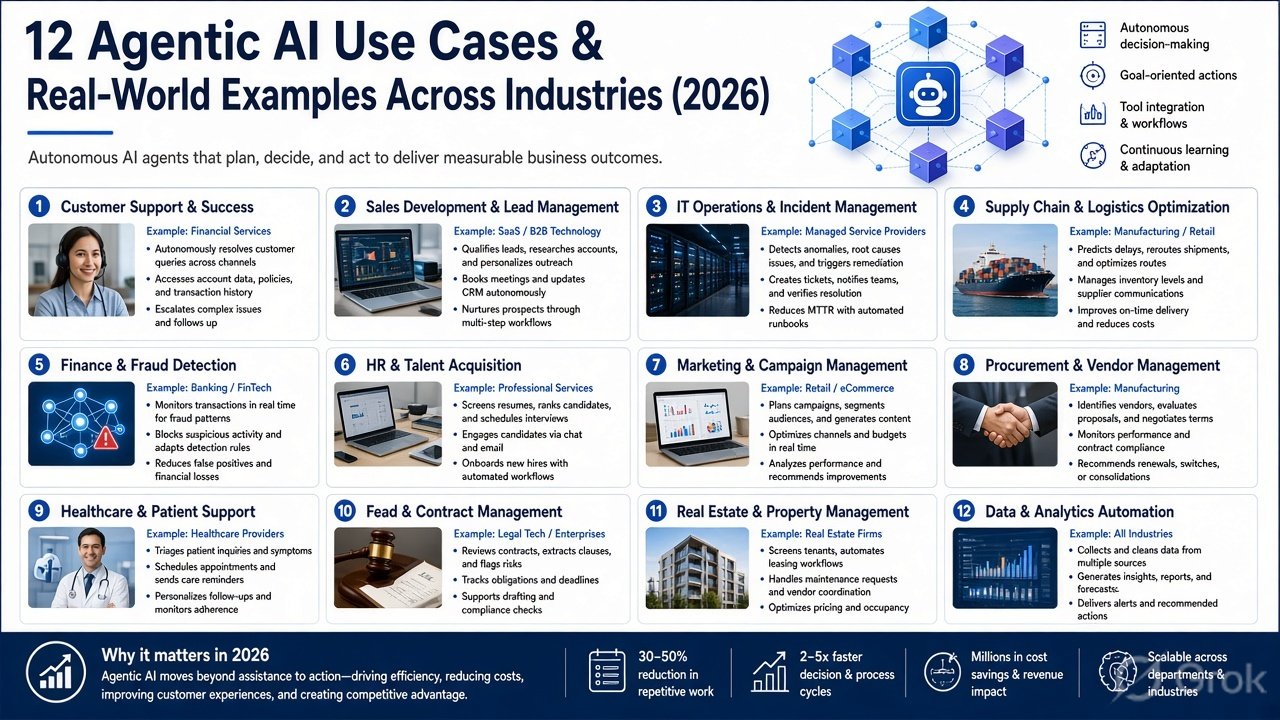
By The most common agentic AI use cases in 2026 are customer service automation, drug discovery, fraud detection, predictive maintenance, and supply chain management. Companies like Genentech, Ford, Klarna, and Oxford University Hospitals already run AI agents that plan, decide, and complete multi-step work with limited human oversight and they’ve published the results.
This guide walks through 12 real agentic AI use cases by department and industry, with the actual numbers behind each one.If you’re still getting clear on the basics, start with our plain-English guide to what agentic AI and if you’re weighing it against traditional AI, our agentic AI vs generative AI breakdown clears that up first.
What are the most common agentic AI use cases?
The most common agentic AI use cases are customer support resolution, document and back-office processing, IT automation, fraud detection, predictive maintenance, and sales lead management. They share one pattern: a repetitive, multi-step workflow where an AI agent reads data, decides the next step, and acts across connected systems without waiting for a human prompt.
Here’s the landscape at a glance before we go deep:
| Department | What the agent does | Who’s doing it |
| Customer service | Resolves tickets end to end, escalates edge cases | Klarna |
| Healthcare | Searches research, drafts treatment plans, monitors patients | Genentech, Oxford University Hospitals |
| Finance | Detects fraud, runs KYC checks, processes invoices | JPMorgan Chase |
| Manufacturing | Predicts equipment failure, adapts production lines | Ford, GM |
| Supply chain | Spots disruptions, reroutes shipments | Walmart |
| Sales & marketing | Qualifies leads, preps meetings, follows up | Startups and SMBs |
| IT & operations | Triages incidents, executes runbooks | Enterprise IT teams |
| HR | Screens candidates, runs onboarding | Enterprise HR teams |
Below are the 12 use cases that matter most right now, with names and numbers attached.
How is agentic AI used in healthcare?
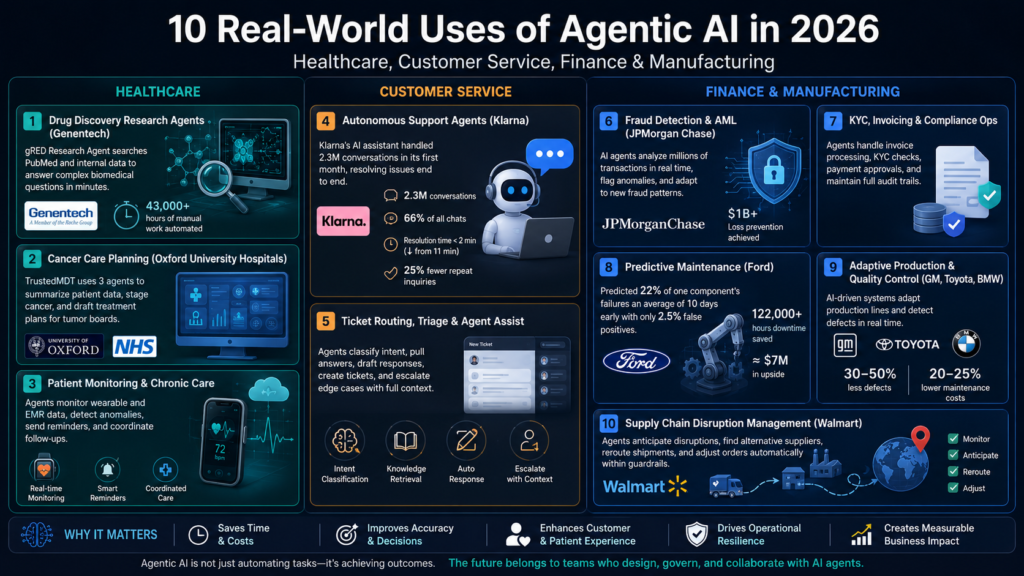
Healthcare uses agentic AI for drug discovery, clinical decision support, patient monitoring, and hospital operations. The two best-documented 2026 examples are Genentech’s gRED Research Agent, which compresses weeks of manual research into minutes, and Oxford’s TrustedMDT, a three-agent system that prepares cancer treatment plans for tumor board review.
Use case 1: Drug discovery research agents (Genentech). Genentech built its gRED Research Agent with AWS, running Anthropic’s Claude Sonnet 3.5 inside Amazon Bedrock Agents. Scientists ask complex questions say, which cell surface receptors are enriched in a specific disease and the agent searches PubMed and internal repositories at once, then returns synthesized findings with citations. Work that took weeks now takes minutes, and Genentech expects it to automate more than 43,000 hours of manual biomarker validation.
Use case 2: Cancer care planning (Oxford University Hospitals). The University of Oxford’s oncology department, working with Microsoft, built TrustedMDT three AI agents that work in concert inside Microsoft Teams. A Clinical Summarisation Agent condenses each patient’s records, a Cancer Staging Agent applies AJCC/UICC international standards, and a Treatment Planning Agent drafts guideline-compliant recommendations for human tumor boards to review. It’s now in an approved pilot at Oxford University Hospitals NHS Foundation Trust one of the earliest agentic AI deployments in a clinically realistic cancer care setting.
Use case 3: Patient monitoring and chronic care. Agents watch data from wearables and electronic medical records, flag deviations from a patient’s baseline, send medication reminders, and coordinate follow-ups. For chronic conditions like diabetes and hypertension, that means continuous oversight between appointments instead of a snapshot every few months.
How is agentic AI used in customer service?
Customer service is the most mature agentic AI use case. Klarna’s AI assistant handled 2.3 million conversations in its first month two-thirds of all its service chats doing work equivalent to roughly 700 full-time agents. Resolution time dropped from 11 minutes to under 2, and repeat inquiries fell 25%.
Use case 4: Autonomous support agents (Klarna). The Klarna assistant doesn’t just answer FAQs. It resolves refunds, returns, and payment issues end to end, with customer satisfaction scores on par with human agents. Here’s the honest part, though: after pushing automation hard, Klarna later rehired human agents for complex, high-empathy cases. The lesson isn’t “replace your team” it’s “let agents take the repetitive two-thirds so humans can handle the rest.” Getting that split wrong is one of the real risks and challenges of agentic AI worth understanding before you deploy.
Use case 5: Ticket routing, triage, and agent assist. Behind the scenes, agents classify intent, pull answers from knowledge bases and CRM records, draft responses, create and update tickets, and escalate edge cases with full context attached. Telecom, banking, and retail companies now run these workflows end to end the agent resolves routine requests independently and hands only the genuinely hard cases to people.
How is agentic AI used in finance and manufacturing?
In finance, agentic AI runs fraud detection, KYC/AML checks, and invoice processing. In manufacturing, it predicts equipment failures, adapts production lines, and controls quality. JPMorgan Chase runs AI agents that spot fraud across millions of transactions, while Ford’s agents predicted 22% of one component’s failures an average of 10 days in advance.
Use case 6: Fraud detection and AML (JPMorgan Chase). JPMorgan has more than 450 AI use cases in production. Its fraud agents analyze millions of transactions in real time, flag behavior that doesn’t match a customer’s history, and keep adapting to new fraud patterns without manual rule updates. Humans still make the final call on flagged cases and the bank reports loss prevention in excess of $1 billion.
Use case 7: KYC, invoicing, and compliance operations. Finance teams deploy agents for invoice processing, expense reconciliation, payment approvals, and KYC verification work that’s rule-heavy but judgment-light. The agents maintain full audit trails as they go, which is why compliance teams tend to love them.
Use case 8: Predictive maintenance (Ford). Ford’s commercial vehicle division applied AI to connected-vehicle data and predicted 22% of one component’s failures an average of 10 days early, with a false-positive rate of just 2.5%. That single use case saved an estimated 122,000 hours of downtime across the Transit fleet roughly $7 million in upside. On the factory side, operations using AI-driven maintenance report up to 40% less unplanned downtime and 20–25% lower maintenance costs.
Use case 9: Adaptive production and quality control (GM, Toyota, BMW). GM uses AI-powered robotics that adapt to production schedule changes without downtime. Toyota’s in-vehicle agents handle voice commands, and BMW is building driver assistance systems on cloud-based AI. AI quality agents on production lines have cut defect rates by 30–50% by correcting process deviations in real time instead of waiting for human inspection.
Use case 10: Supply chain disruption management (Walmart). Walmart has confirmed deploying an agentic end-to-end supply chain workflow that anticipates disruptions rather than reacting to them. These agents monitor supply signals continuously, identify alternative suppliers, reroute shipments, and adjust procurement orders inside pre-set guardrails. Analysts at Deloitte and SAP both describe 2026 as the year supply chain AI stops showing dashboards and starts triggering corrective actions on its own.
Which companies are using agentic AI in 2026?
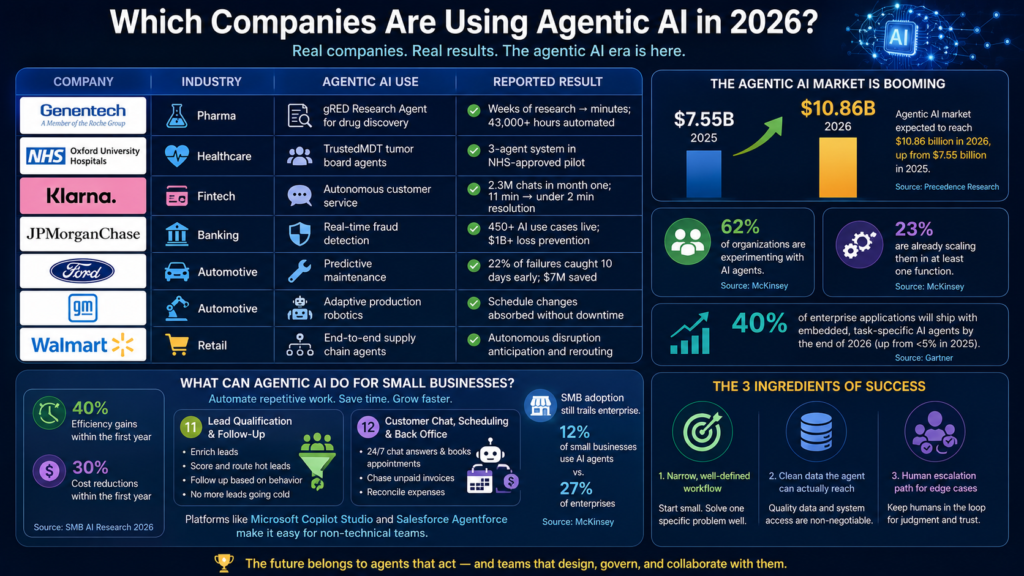
Named enterprise adopters include Genentech (drug discovery), Oxford University Hospitals (oncology planning), Klarna (customer service), JPMorgan Chase (fraud detection), Ford and GM (manufacturing), and Walmart (supply chain). Gartner predicts 40% of enterprise applications will ship with embedded task-specific AI agents by the end of 2026 up from under 5% in 2025.
| Company | Industry | Agentic AI use | Reported result |
| Genentech | Pharma | gRED Research Agent for drug discovery | Weeks of research → minutes; 43,000+ hours automated |
| Oxford University Hospitals | Healthcare | TrustedMDT tumor board agents | 3-agent system in NHS-approved pilot |
| Klarna | Fintech | Autonomous customer service | 2.3M chats in month one; 11 min → under 2 min resolution |
| JPMorgan Chase | Banking | Real-time fraud detection | 450+ AI use cases live; $1B+ loss prevention |
| Ford | Automotive | Predictive maintenance | 22% of failures caught 10 days early; $7M saved |
| GM | Automotive | Adaptive production robotics | Schedule changes absorbed without downtime |
| Walmart | Retail | End-to-end supply chain agents | Autonomous disruption anticipation and rerouting |
The money follows the deployments: the agentic AI market is expected to hit $10.86 billion in 2026, up from $7.55 billion in 2025 (Precedence Research). McKinsey finds 62% of organizations are now experimenting with AI agents, and 23% are already scaling them in at least one function.
What all 12 use cases have in common. Read across every example above and the same three ingredients show up: a narrow, well-defined workflow; clean data the agent can actually reach; and a human escalation path for edge cases. Every public failure we’ve seen skipped at least one of the three.
What can agentic AI do for small businesses?
For small businesses, agentic AI handles lead follow-up, customer chat, appointment scheduling, invoicing, and marketing execution the repetitive workflows that eat an owner’s week. SMBs using AI agents report efficiency gains around 40% and cost reductions near 30% within the first year. You don’t need an enterprise budget; you need one painful workflow and a 90-day metric.
Use case 11: Lead qualification and follow-up. An agent enriches incoming leads, scores them, routes the hot ones to you, and follows up with the rest based on how they behave. No more leads going cold because you were on a job site.
Use case 12: Customer chat, scheduling, and back office. A chat agent answers common questions and books appointments around the clock, while a second agent chases unpaid invoices and reconciles expenses. Platforms like Microsoft Copilot Studio and Salesforce Agentforce now package this for non-technical teams.
SMB adoption still trails enterprise in healthcare, for example, 12% of small businesses run AI agents versus 27% of enterprises which means early movers in local markets face little competition. Start with one workflow, set a 90-day target (time saved, cost cut, or revenue added), and scale only what proves out. And if you’re wondering what this means for your team’s roles, we break down what agentic AI means for jobs and careers separately.
Agentic AI use cases: FAQs
What is an example of agentic AI use cases in real life?
Klarna’s AI assistant resolves refunds, returns & payment disputes end-to-end acting across systems, not just answering. It handled ⅔ of service chats in month one, matching human satisfaction scores.
What industries have the most agentic AI use cases in 2026?
Customer service, healthcare, finance, manufacturing & supply chain lead agentic AI use cases in 2026 each offers repeatable processes agents can plug into without full workflow redesign.
Are agentic AI use cases only for big companies like JPMorgan and Walmart?
No. Genentech, Ford, JPMorgan Chase & Walmart are frontier agentic AI deployers with large data & engineering teams. Small businesses already run narrower versions today mainly lead follow-up, scheduling & customer chat.
What’s the difference between agentic AI use cases and regular automation?
Regular automation follows a fixed script and stalls on the unexpected. In every case above fraud review, maintenance scheduling, ticket resolution—the agentic AI reasons about changes and acts independently, without waiting for human approval at each step.
What are the risks of deploying agentic AI use cases like these?
The main risks are compounding errors, cost overruns from agents that loop or retry, and unclear accountability when an agent gets something wrong. We cover each one, plus mitigation steps, in our guide to agentic AI risks.
Which agentic AI use case should a business start with?
Start with the highest-volume, lowest-risk workflow usually customer support triage, lead follow-up, or invoice processing. Pick one painful process, set a 90-day metric (time saved or cost cut), and scale only after it proves out.