 By
By Generative AI creates. Agentic AI completes. That’s the simplest way into the agentic AI vs generative AI question. One waits for your instruction and produces something new a paragraph, an image, a snippet of code. The other takes a single goal and finishes the whole job without you guiding every step. This guide breaks down 7 key differences, with plain examples and quick tables, so you know exactly which one you need.
What is generative AI?
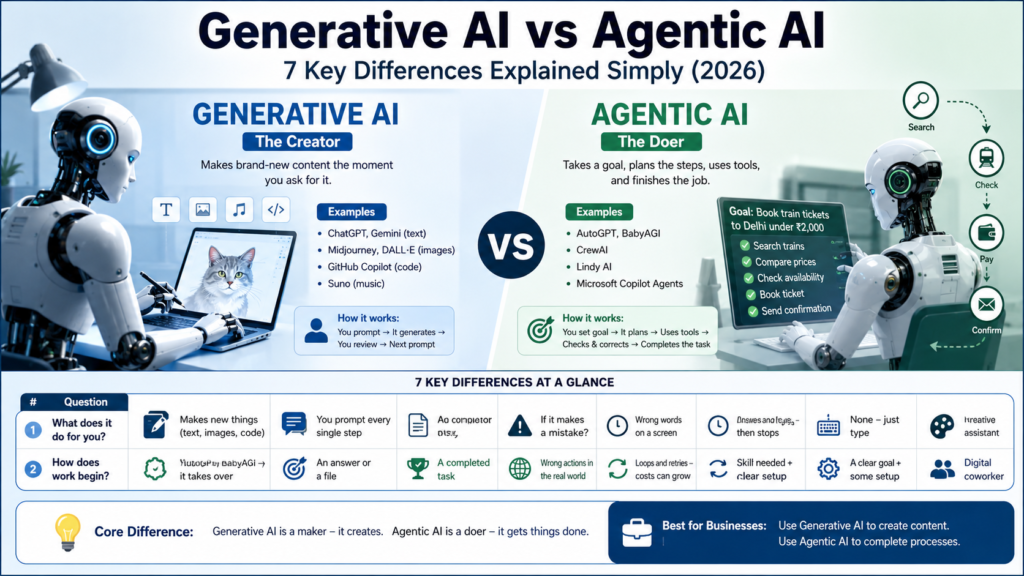
Generative AI makes brand-new content the moment you ask for it. You type a prompt, and it hands back a paragraph, a picture, a song, or a piece of code. Then it stops and waits for your next instruction.
Picture it as a talented artist sitting at a desk. Say “draw me a cat,” and you get a cat. Say “write a birthday message,” and you get one. The artist never starts a new project alone you’re directing every step.
Familiar examples: ChatGPT and Gemini answer questions and write text. Midjourney and DALL-E create images. GitHub Copilot drafts code. The word “generative” simply means it generates building fresh output from patterns learned during training. That’s the one job it’s built for, and it does that job well.
What is agentic AI?
Agentic AI finishes a whole job on its own. Instead of feeding it prompts one at a time, you hand it a single goal say, “book my train tickets to Delhi under ₹2,000” and it plans the steps, uses tools, checks its own work, and keeps going until the task is done.
Think of it as a robot assistant rather than an artist. You don’t spell out every move; you state the outcome you want. It works out the “how” comparing prices, checking trains, completing the booking and only comes back to you when a real decision needs a human.
On our Agency Spectrum (a simple 5-level scale for AI tools), content-generating systems sit at Level 0–1: they answer and assist. Goal-completing systems sit at Level 2 and above: they finish outcomes.
New to this idea? Our beginner’s guide explains what agentic AI is and how it works, step by step.
What’s the core difference?
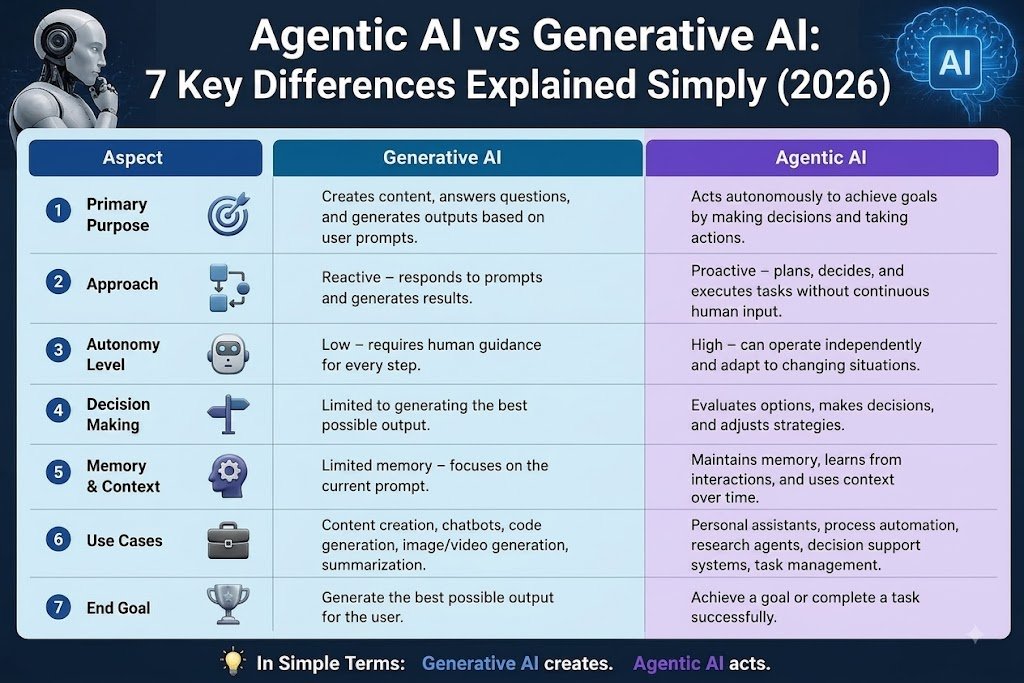
The core of the agentic AI vs generative AI comparison is this: one is a maker, the other is a doer. Generative AI produces something new each time you ask, then stops. A goal-completing system takes one instruction and keeps working alone planning, using tools, and correcting its own mistakes until the job is actually finished.
All 7 differences at a glance:
| # | Question | Generative AI | Agentic AI |
|---|---|---|---|
| 1 | What does it do for you? | Makes new things (text, images, code) | Finishes whole jobs |
| 2 | How does work begin? | You prompt every single step | You give one goal it takes over |
| 3 | What do you get back? | An answer or a file | A completed task |
| 4 | If it makes a mistake? | Wrong words on a screen | Wrong actions in the real world |
| 5 | How does it spend? | Answers once, then stops | Loops and retries costs can grow |
| 6 | Skill needed to start | None just type | A clear goal + some setup |
| 7 | Its best role | Creative assistant | Digital coworker |
Difference #1 sits at the center of everything: one builds things, the other gets things done.
Difference #4 is the one people miss most, and it matters. A typo in a poem costs nothing. A wrong bank transfer costs real money. When AI only talks, mistakes stay on a screen. When it acts, mistakes land in your email, your files, and your accounts which is why task-completing systems need guardrails like spending limits and approval steps. Our guide to agentic AI risks explains them in plain language.
Can the two work together?
Yes, one can’t function without the other. Every agentic AI system has generative AI inside it doing the actual thinking and writing. The agent layer adds the doing: the plan, the memory, the tools.
Picture it this way. Generative AI is a talented writer. The agent framework is the manager who hires that writer. When your travel-booking assistant needs to send a polished confirmation email, it hands the writing job to its internal model. The manager decides what happens next; the writer handles the words.
Or put simply: agentic AI is generative AI given hands (tools), a notebook (memory), and a to-do list (planning). As one online commenter put it, every agentic system has generative AI inside it, but not every generative tool is agentic.
Which is better for businesses?
Neither is “better” on its own they solve different problems. If your work is about producing content blogs, ads, designs generative AI is enough. If your work is about finishing processes support tickets, invoices, follow-ups you need agentic AI. Most growing businesses in 2026 use both.
| If your business needs… | Choose… |
|---|---|
| Blog posts, ads, social media content | A content-generating tool |
| Code help and design drafts | A content-generating tool |
| Customer support that resolves tickets alone | A goal-completing system |
| Invoice processing and data entry | A goal-completing system |
| Sales follow-ups and lead qualification | A goal-completing system |
| A full workflow, start to finish | Both, working together |
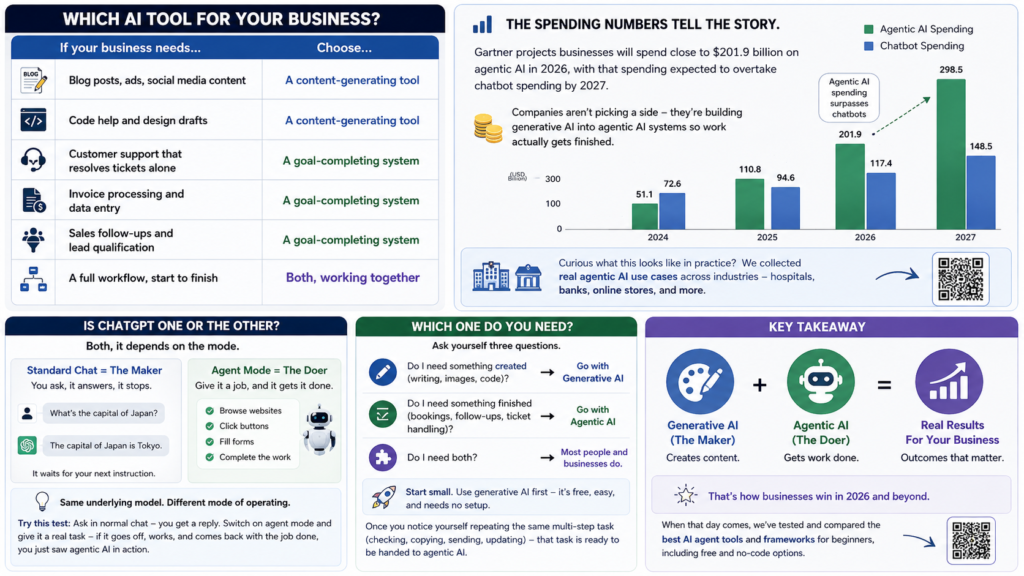
The spending numbers tell the story. Gartner projects businesses will spend close to $201.9 billion on agentic AI in 2026, with that spending expected to overtake chatbot spending by 2027. Companies aren’t picking a side they’re building generative AI into agentic AI systems so work actually gets finished.
Curious what this looks like in practice? We collected real agentic AI use cases across industries hospitals, banks, online stores, and more.
Is ChatGPT one or the other?
Both, it depends on the mode. Standard chat is the maker: you ask, it answers, it stops. Agent mode is the doer: give it a job, and it browses websites, clicks buttons, and finishes the work while you watch.
Try this test yourself. Ask a question in normal chat you get a reply, and it waits. That’s the generative side. Now switch on agent mode and say: “Find me the cheapest flight to Goa next Friday and fill in the booking form.” If it goes off, navigates sites, and comes back with the job done you just watched the agentic side at work.
Same underlying model. Different mode of operating.
Which one do you need?
Ask yourself three questions. Do I need something created writing, images, code? Go with generative AI. Do I need something finished bookings, follow-ups, ticket handling? Go with agentic AI. Do I need both? Most people and businesses do, because real work always mixes creating and doing.
Start small. Use generative AI first it’s free, easy, and needs no setup. Once you notice yourself repeating the same multi-step task checking, copying, sending, updating that task is ready to be handed to agentic AI.
When that day comes, we’ve tested and compared the best AI agent tools and frameworks for beginners, including free and no-code options.
FAQs
Is generative AI a part of agentic AI?
Yes. The underlying model is like the engine; the agent is the whole car. The engine produces power. The car wheels, steering, brakes actually takes you somewhere. Planning, memory, and tools are the wheels and steering.
Which is easier for beginners?
Generative AI. You type a question and get an answer no setup, no cost. The task-completing kind needs a clear goal, connected tools, and a few safety rules before it can work alone.
Which should I learn first generative AI or agentic AI?
Start with Generative AI to learn prompts, LLMs, and AI basics. Then progress to AI tools → APIs → your first AI agent. Master the basics before building Agentic AI systems.
Is agentic AI more expensive to run?
Usually, yes. Generative AI answers once and stops. A goal-completing system loops plan, try, check, retry calling the model many times for one task. Good platforms let you set spending limits so costs don’t run away.
Will one replace the other?
No, they’re partners, not rivals. An agent needs a language model inside it to think and write, and a language model alone can’t take real-world actions. The future is generative intelligence built inside agentic systems, working together.
Is Siri or Alexa agentic AI or generative AI?
Old Siri and Alexa followed fixed voice commands. New versions are evolving with Generative AI and Agentic AI, moving from simple assistants toward smarter AI agents.
Bottom line: the agentic AI vs generative AI question isn’t a competition it’s a partnership. One is the artist. The other is the manager turning that artist’s work into finished results. Learn to use both, and you’re ready for how work will actually happen in 2026 and beyond.