
 By
By If you’ve been searching for the latest on the dbrand Casetify lawsuit, you’re not alone. What started as a Twitter callout in late 2023 has turned into one of the most closely watched intellectual-property disputes in the phone accessory industry and it’s still working its way through a U.S. federal court. This guide breaks down exactly what this case is about, how it has evolved, and where things stand right now, so you don’t have to dig through court dockets yourself. The Dbrand Casetify Lawsuit has continued to attract attention because it involves allegations of copied product designs and an ongoing federal copyright dispute.
Dbrand and Casetify: Who Are the Two Companies Involved?
Before diving into the case itself, it helps to know who’s actually fighting. dbrand is a Canadian gadget-accessory brand best known for precision-cut device skins and cases, built around a design-first identity. Casetify (legally Casetagram Limited) is a much larger, globally distributed phone case company known for artist collaborations and mass-market retail partnerships, including placement at Best Buy and other major retailers. That size gap is part of why the Casetify dbrand dispute drew so much attention a smaller, design-focused brand accusing a much bigger competitor of lifting its work is a classic David-versus-Goliath narrative, and it’s one reason the story spread quickly once dbrand went public with its claims.
Also read: Red Tint on Monitor | Perplexity Comet | Artifacting on Screen | Bug in Monitor
What Is the Dbrand Casetify Lawsuit About?
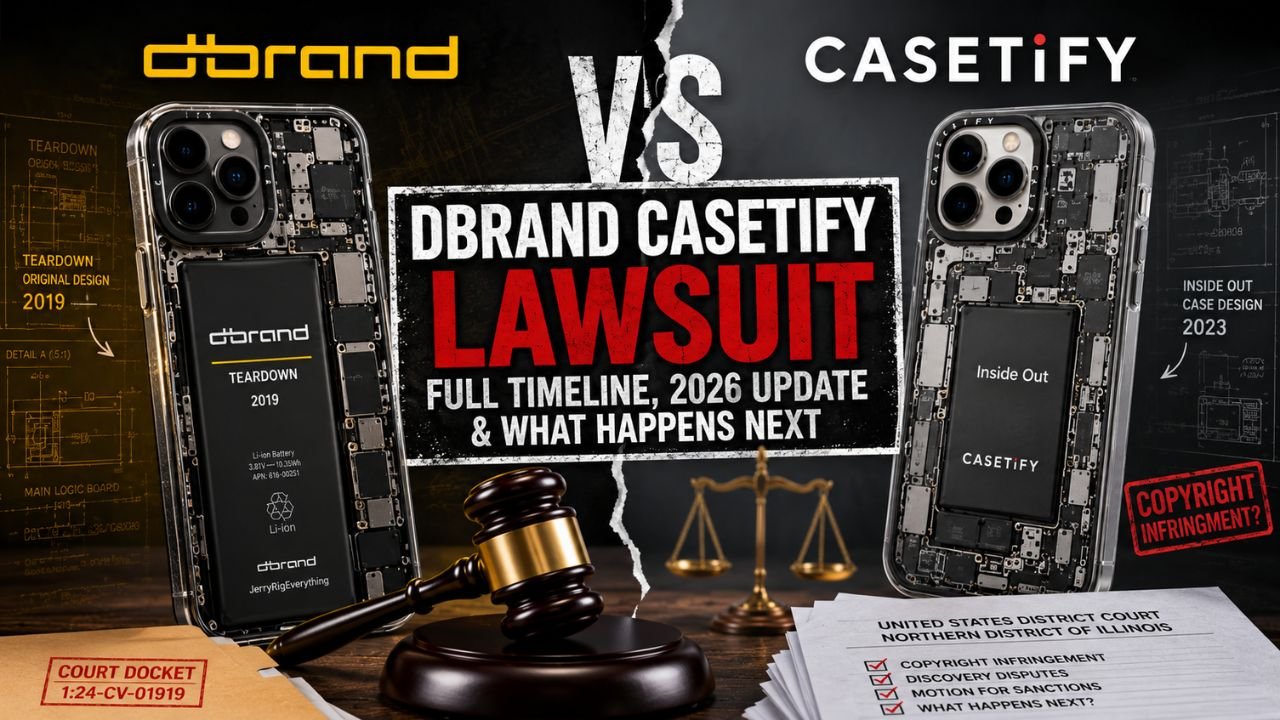
This dispute centers on a product line called “Teardown,” which dbrand created in 2019 in partnership with YouTuber Zack Nelson, better known as JerryRigEverything. Teardown skins and cases were designed to look like the exposed internals of a phone or laptop batteries, circuit boards, and all rendered at high resolution from real device scans. The line became a signature product for dbrand and helped define its identity as a company built around precision and originality.
In November 2023, dbrand publicly accused Casetify (legally known as Casetagram Limited) of copying the Teardown design almost wholesale for a new Casetify line called “Inside Out.” dbrand and Nelson said they’d found small, deliberately placed details from the original Teardown artwork effectively hidden “easter eggs” reproduced in Casetify’s supposedly independent design. That discovery is what pushed the dispute from a design disagreement into a full Casetify copyright lawsuit, filed as a multi-million-dollar infringement claim against Casetify.
Casetify responded publicly at the time, calling itself a “bastion of originality,” pulling the disputed products from sale, and saying it would investigate the allegations. That response did little to slow the case down, and by early 2024 the dispute had moved into federal court. The Dbrand Casetify Lawsuit focuses on the similarities between dbrand’s Teardown designs and Casetify’s Inside Out products.
Timeline: dbrand vs Casetify Lawsuit Update, Year by Year
Anyone tracking the dbrand Casetify lawsuit update cycle or searching for a dbrand v Casetify timeline will notice the case has moved in distinct phases. The following timeline explains the major stages of the Dbrand Casetify Lawsuit from 2023 through 2026:
- November 2023: Dbrand and Nelson go public with side-by-side comparisons of Teardown and Casetify’s “Inside Out” cases, and confirm a lawsuit has been filed in a Canadian court.
- March 2024: Dbrand formally files a federal copyright infringement lawsuit against Casetagram Limited (Casetify) in the U.S. District Court for the Northern District of Illinois, docketed as Case No. 1:24-cv-01919, with a jury demand attached. This filing marked a major legal escalation in the Dbrand Casetify Lawsuit.
- Mid-2024: The court refers the case to Magistrate Judge Maria Valdez for discovery supervision and scheduling. Casetify files an answer, and both sides begin exchanging motions, including a motion for judgment on the pleadings and a motion to stay discovery, the latter of which the court denies, meaning the case keeps moving on schedule.
- Late 2024 into 2025: The parties file amended pleadings and counterclaims, followed by a motion from Casetify to withdraw certain counterclaims and affirmative defenses, narrowing the scope of what’s being contested.
- 2025 into 2026: Discovery disputes intensify. dbrand files a motion for sanctions and a motion to compel against Casetify, and the defendants request extra time and page allowances to respond. As of the most recent docket update in July 2026, those motions were still being actively litigated before Judge Valdez. These discovery disputes have become an important part of the Dbrand Casetify Lawsuit in 2026.
This is the most accurate dbrand Casetify lawsuit update 2026 available from public court records and it’s a meaningful shift from the dbrand Casetify lawsuit update 2025 picture, when the case was still working through amended pleadings and counterclaims. As of the latest filings, the case has not gone to trial, and no settlement or final ruling has been publicly reported.
Dbrand vs Casetify Lawsuit Update 2026: Where Things Stand Now
So what’s the real dbrand lawsuit update as of today?
The short version: this is still very much an open case, and the dbrand lawsuit latest update doesn’t include a resolution. Rather than resolving quickly, the case has settled into the kind of prolonged discovery fight that’s common in copyright litigation involving design files, sales data, and internal communications.
The current phase revolves around discovery meaning both sides are compelled to hand over internal documents, communications, and product data that could prove or disprove the copying allegations. dbrand’s motion to compel suggests it believes Casetify hasn’t fully complied with earlier discovery requests, while the motion for sanctions indicates dbrand’s legal team believes Casetify’s conduct during this process has crossed a line significant enough to ask the court to intervene. Casetify, for its part, has asked for more time and more room in its filings to respond to those claims a request the court partially granted.
None of this determines who’s right on the underlying copyright claim. But it does tell you that both sides are still actively fighting rather than settling behind closed doors, which is a meaningful signal for anyone following the dbrand Casetify lawsuit update closely and it means the dbrand vs Casetify lawsuit update cycle is likely to keep producing fresh procedural news before it produces a final answer. Many readers following the Dbrand Casetify Lawsuit are primarily interested in whether either company has officially won.
Did dbrand Win the Lawsuit Against Casetify?
This is the single most searched question tied to this case, so let’s answer it directly: did dbrand win the lawsuit against Casetify? As of the latest available court records, no because there is no final verdict, judgment, or public settlement yet. The case is still in the discovery and pre-trial motion phase in the Northern District of Illinois. Reports claiming a definitive win for either side should be treated with caution unless they cite an actual court filing, since the docket itself shows ongoing procedural battles rather than a resolution. At this stage, the Dbrand Casetify Lawsuit has not produced a final judgment for either side.
It’s worth noting that most copyright disputes of this size and complexity are eventually resolved through settlement rather than a jury trial, simply because litigation costs and business risk tend to push both sides toward a negotiated outcome. That remains a realistic possibility here, but as of now, nothing has been finalized publicly.
Dbrand vs Casetify Quality: Why the Comparison Matters
Part of what fueled this dispute in the first place is a genuine dbrand vs Casetify quality debate among consumers. dbrand built its reputation on precision-cut skins, tight tolerances, and a design process rooted in actual device teardown photography the Teardown line wasn’t just a visual style, it was a documented process. When Casetify’s “Inside Out” cases appeared, early buyers and reviewers pointed out inconsistencies: print quality that some described as noticeably softer than the originals, and in at least one widely shared example, a product listing that mismatched the internal imagery to the wrong phone model entirely.
That quality gap became part of the public case dbrand made before the lawsuit was even filed. It’s also why this dispute resonates beyond legal circles for buyers comparing skins and cases, this dispute isn’t just a corporate matter it’s a reminder to look closely at sourcing and originality before buying a design-driven accessory.
What Happened to dbrand Casetify Lawsuit? Key Legal Developments Explained
If you’re wondering what happened to dbrand Casetify lawsuit proceedings after the initial headlines faded, the honest answer is: it kept going, just out of the public eye. Copyright cases rarely stay in the news cycle once the viral moment passes, but that doesn’t mean they’ve been dropped. In this instance, the case moved from a public social media dispute into the far slower, document-heavy world of federal litigation.
Key developments worth knowing:
- Jurisdiction shifted: What began as a claim referenced in a Canadian court became a federal copyright case filed in the Northern District of Illinois, the venue where it remains active today.
- Counterclaims were filed and later narrowed: Casetify initially pushed back with its own counterclaims and defenses, some of which were later withdrawn, suggesting the legal battlefield has been shrinking to the core copyright question.
- Discovery became the real fight: Much of 2025 and 2026 has been consumed by disputes over what documents each side must produce, culminating in dbrand’s motion for sanctions.
- No trial date has been widely reported: Given the current focus on discovery disputes, a trial if the case doesn’t settle first likely remains some way off.
The history of the Dbrand Casetify Lawsuit shows how quickly a public design dispute can develop into complex federal litigation.
Why This Case Matters for Designers and Brands
Beyond the back-and-forth between two case makers, this legal dispute has become something of a bellwether for the broader accessory and design industry. Independent designers and smaller brands are watching closely because the outcome could shape how aggressively larger companies protect (or copy) niche design concepts. The broader significance of the Dbrand Casetify Lawsuit extends beyond phone cases and accessories.
If dbrand ultimately prevails, it could reinforce that a distinctive execution of an idea not just the underlying concept is protectable under copyright law, giving smaller studios more confidence to challenge copycats. If the case settles quietly or Casetify prevails, it may reinforce how difficult it is to win these disputes without airtight documentation of originality, which is exactly why dbrand’s public case leaned so heavily on the “easter egg” evidence and its documented 2019 creation process with Nelson.
Either way, the case is a useful real-world example of how copyright protection actually plays out for product design slowly, through discovery motions and procedural rulings, rather than through viral social media posts alone.
Final Thoughts
The Dbrand Casetify Lawsuit remains an important case to watch for developments involving copyright, product design, and intellectual property. The dbrand Casetify lawsuit is far from over, and that’s the single most important thing to understand if you’re following this story. What started as a viral accusation over copied phone case designs in late 2023 has turned into a genuine test of how copyright law applies to product design, and it’s now playing out through discovery motions in a federal courtroom rather than social media posts. As of the most recent docket update, both dbrand and Casetify are still contesting sanctions motions and document requests, which means the case is nowhere near a jury verdict or a public settlement announcement. If you’re searching for a clean answer to “did dbrand win the lawsuit against Casetify,” the honest one is that no verdict exists yet, and anyone claiming otherwise isn’t citing the actual court record. The smarter move is to check back periodically rather than assume the story ended when the headlines faded months ago. A ruling on the sanctions motion, a negotiated settlement, or a confirmed trial date would all count as meaningful next steps worth watching for.
Read more about: India AI Regulation for Startups 2026 | What is Manus AI? | Context7 AI | X Android App Rebuilt in 2026
Frequently Asked Questions About the dbrand Casetify Lawsuit
These frequently asked questions address the most common searches surrounding the Dbrand Casetify Lawsuit.
Q1: Did dbrand win the lawsuit against Casetify?
Not yet. As of the latest public court records, the case remains in the discovery phase with no verdict or settlement announced.
Q2: What is the latest dbrand Casetify lawsuit update?
As of mid-2026, the parties are litigating discovery disputes, including a motion for sanctions and a motion to compel filed by dbrand, with the court granting Casetify additional time and page allowance to respond.The latest Dbrand Casetify Lawsuit developments remain focused on discovery and related court motions.
Q3: What was the dbrand vs Casetify lawsuit about?
dbrand accused Casetify of copying its “Teardown” skin and case designs created with YouTuber JerryRigEverything for Casetify’s “Inside Out” product line, down to hidden design details.
Q4: Is the dbrand vs Casetify case still ongoing?
Yes. It’s an active federal case (No. 1:24-cv-01919) in the Northern District of Illinois, currently in pre-trial discovery.
Q5: When did the dispute between the two brands start?
The dispute became public in November 2023, and dbrand filed the formal federal lawsuit in March 2024.
Q6: What court is handling the case?
The case is in the U.S. District Court for the Northern District of Illinois, with discovery matters overseen by Magistrate Judge Maria Valdez.
Q7: Has Casetify responded to the copyright allegations?
Yes. Casetify publicly denied wrongdoing, removed the disputed products, and has filed formal answers and (later narrowed) counterclaims in court.
Q8: Will the case go to trial?
It’s possible, but no trial date has been publicly reported. Many copyright disputes of this scale settle before reaching trial, though that hasn’t happened here yet.


1 Comment