 By
By Hearing that you need 3 stents in heart can feel overwhelming, especially if you’re not sure what the procedure involves or what life looks like on the other side of it. This guide walks through everything patients typically search for: what a stent is, how to put stent in heart during the procedure, what a heart stent before and after really looks like, recovery timelines, risks, and the answers to the most common questions people ask their cardiologist. Patients diagnosed with 3 Stents in Heart often have many questions about treatment, recovery, and long-term heart health.
Whether you’ve just been told you need 3 stents in heart, or you’re researching how to put stent in heart ahead of a scheduled procedure, this article covers the full picture from the heart stent operation itself to what heart stent before and after genuinely feels like week by week.
Medical Disclaimer: This article about 3 Stents in Heart is for general educational purposes and does not replace professional medical advice, diagnosis, or treatment.
Heart stent procedures, medications, recovery, and risks vary depending on each patient’s condition and coronary artery health.
Do not start, stop, or change any medication without consulting your cardiologist.
If you experience severe chest pain, breathing difficulty, fainting, or other emergency symptoms, seek immediate medical attention.
Always consult a qualified cardiologist for personalized advice regarding angioplasty, stent placement, recovery, and follow-up care. This guide was last fact-checked in August 2026.
What Is a Stent? Understanding the Basics
In simple terms, a stent is a small, expandable mesh tube usually made of metal alloy, sometimes coated with medication that’s placed inside a narrowed or blocked artery to hold it open and restore normal blood flow. That’s the stent medical definition your doctor is working from when they recommend one. Understanding 3 Stents in Heart begins with knowing how coronary stents work and why cardiologists recommend them.
What are stents made of?
Most modern heart stents are made from cobalt-chromium or stainless steel alloys, often coated with a polymer that slowly releases medication to prevent the artery from re-narrowing. This coated version is called a drug-eluting stent, and it’s the most commonly used type of vascular stent in coronary procedures today. This technology is commonly used in 3 Stents in Heart procedures.
What is a stent used for?
Stents are used to treat coronary artery disease when plaque buildup narrows the arteries supplying blood to your heart muscle, restricting flow and causing chest pain or, in severe cases, a heart attack. Many patients requiring 3 Stents in Heart are treated because multiple coronary arteries have become narrowed.
To define stent in one line: it’s a permanent, expandable scaffold that keeps a treated artery open after angioplasty. Understanding what is a stent this way makes the rest of the procedure much easier to follow. Every step from here is really about getting that scaffold safely into place and keeping it working long-term.
What Is Angioplasty? Angioplasty Meaning Explained
Angioplasty medically called percutaneous coronary intervention (PCI) is the procedure used to open a blocked or narrowed coronary artery, typically followed by stent placement to keep it open. The angioplasty meaning, at its core, is “reshaping the vessel”: a thin catheter with a small balloon is guided to the blockage, inflated to widen the artery, and a stent is deployed to hold that width in place. Most patients requiring 3 Stents in Heart undergo angioplasty as part of their treatment plan.
If you’ve searched what angioplasty is and landed here confused by the medical jargon, think of it this way: angioplasty meaning, in plain language, is a minimally invasive way to fix a plumbing problem in your heart’s blood supply without open surgery.
Why angioplasty is done: It’s performed when a coronary artery is significantly narrowed usually more than 70% blocked and is limiting blood flow enough to cause symptoms or put you at risk of a heart attack. This concept is important for understanding 3 Stents in Heart treatment.
How to Put Stent in Heart: The Step-by-Step Procedure
Understanding how to put stent in heart helps demystify what can otherwise feel like a frightening unknown. This stent placement procedure is one of the most refined techniques in modern cardiology, and knowing how stent is placed in heart step-by-step including the fact that the stent material itself (usually cobalt-chromium) is biocompatible and designed to stay in place permanently helps most patients feel far calmer walking into the cath lab. Here’s how the procedure actually unfolds. This is one of the most common reasons doctors recommend 3 Stents in Heart treatment.
Step 1: Access: The cardiologist numbs a small area, usually at the wrist (radial access) or occasionally the groin (femoral access), and inserts a thin catheter into the artery. This is the first stage of every 3 Stents in Heart procedure.
Step 2: Navigation: Using live X-ray imaging (fluoroscopy) and contrast dye, the doctor guides the catheter through your blood vessels to the blocked section of the coronary artery. This is essentially how is a stent inserted through your existing vascular network, not through open surgery. Accurate catheter placement is essential during 3 Stents in Heart treatment.
Step 3: Balloon angioplasty: A tiny balloon at the catheter’s tip is inflated at the blockage site, compressing the plaque against the artery wall and widening the passage. This step is repeated whenever 3 Stents in Heart are required.
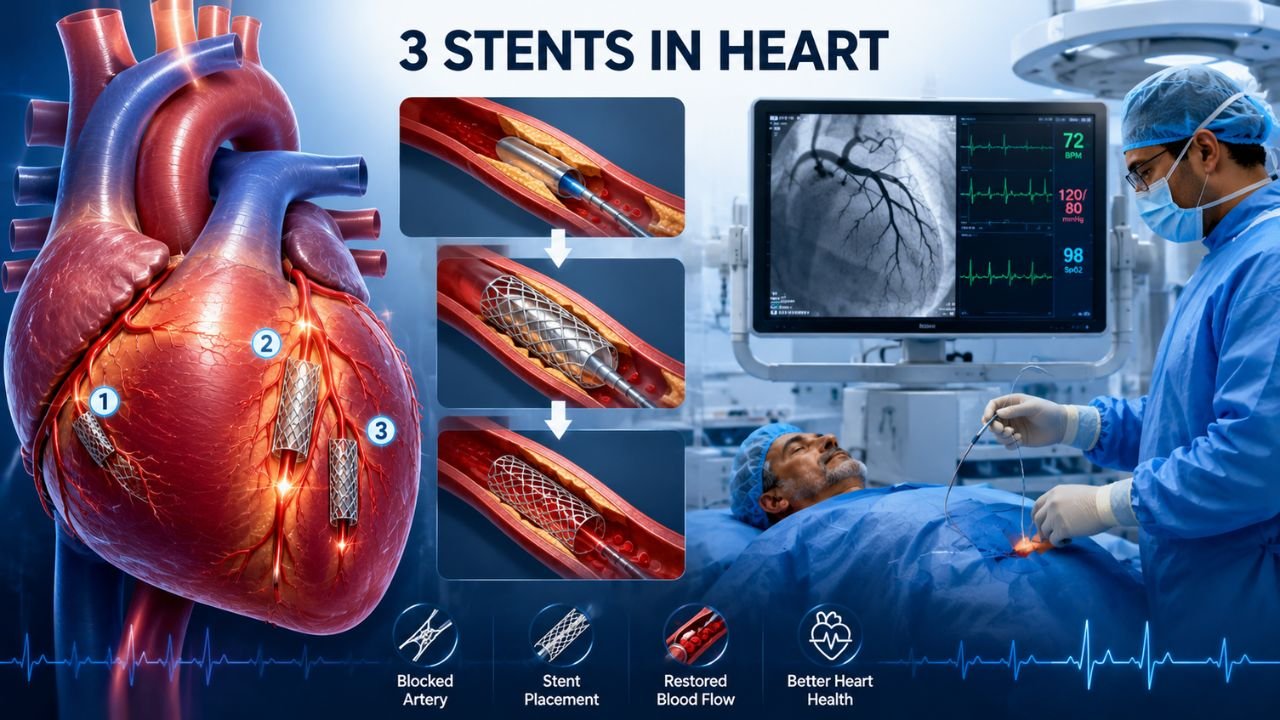
Step 4: Stent deployment: This is the heart of how to put stents in heart procedures: a collapsed stent, mounted on the balloon, is positioned at the narrowed spot. When the balloon inflates, the stent expands and locks into place against the artery wall, acting as a permanent scaffold. This step is repeated at each site during a heart stent operation involving multiple blockages.
Step 5: Confirmation and closure: The balloon and catheter are withdrawn, leaving the stent in place. The access site is closed, often with a closure device for faster healing. Successful placement completes the 3 Stents in Heart procedure.
This is also how to insert a stent in heart when three separate blockages are present the same steps are repeated at each site, either in one sitting or, for complex cases, staged across two procedures. A 3 stents in heart operation is, technically speaking, just the same as how to put stent in heart sequence performed three times in the same session which is why the heart stent operation for multiple blockages takes longer but doesn’t change in complexity per site. The procedure for 3 Stents in Heart follows the same principles as a single stent procedure but is repeated for each blocked artery.
How Long Does an Angioplasty Take?
Angioplasty time duration typically runs 30 minutes to 2 hours for a single stent, depending on how difficult the blockage is to access. For 3 stents in the heart in a single session, the heart stent surgery time generally extends to 1.5–3 hours. How much time angioplasty takes overall including preparation and initial recovery in the cath lab is usually closer to half a day when you factor in pre- and post-procedure monitoring. For patients receiving 3 Stents in Heart, the overall procedure may take longer depending on the number and complexity of the blockages.
Also read: Black Fungus Treatment | Difference Between Heart Attack and Cardiac Arrest | Right Side Chest Pain | Left Shoulder Pain Symptoms
Why Stent Is Placed in Heart
Why stent in heart procedures are recommended comes down to a few clear clinical scenarios:
- When angioplasty is needed: Significant coronary artery blockage causing chest pain (angina), shortness of breath, or reduced exercise tolerance.
- When is angioplasty required in an emergency: During a heart attack, to urgently restore blood flow and limit heart muscle damage.
- When is a stent needed electively: When imaging (like an angiogram) shows a blockage severe enough to risk a future cardiac event, even without acute symptoms.
Angioplasty symptoms that typically prompt evaluation include chest tightness or pressure during exertion, breathlessness climbing stairs, fatigue disproportionate to activity, and in some cases, jaw or arm discomfort. An angioplasty patient is usually referred after these symptoms, combined with tests like an ECG, stress test, or angiogram, confirm significant blockage. Doctors recommend 3 Stents in Heart when multiple coronary arteries require immediate restoration of blood flow.
Why stent is used in heart treatment specifically rather than medication alone is that a stent physically restores blood flow immediately, which medication cannot always achieve once a blockage is significant.
Types of Stents and Choosing the Best Option
There are two main types of stents used in coronary procedures:
- Bare-metal stents (BMS): A simple metal mesh, rarely used today except in specific situations, such as when a patient can’t tolerate long-term dual antiplatelet therapy.
- Drug-eluting stents (DES): Coated with medication that prevents tissue regrowth inside the stent. These are the default choice for most patients today due to significantly lower re-narrowing rates.
Angioplasty stent types also include newer biodegradable-polymer designs, which aim to improve long-term safety by allowing the polymer coating to dissolve after the medication is released.
There’s no single best stent for heart treatment across all patients. The right choice depends on vessel size, blockage length, calcification, and your bleeding risk profile. Your interventional cardiologist selects the stent type based on your specific coronary anatomy. The choice of stent used during 3 Stents in Heart depends on the patient’s artery condition and overall cardiac health.
Angioplasty without stent, sometimes called balloon-only angioplasty, is occasionally used for very small vessels where a stent isn’t a good fit, though it carries a higher risk of the artery re-narrowing compared with stent-supported procedures.
Heart Stent Before and After: What Actually Changes
This is often the most meaningful comparison for patients trying to understand what to expect. When people search for a heart stent before and after, they’re usually not looking for medical jargon; they want a real sense of what changes, and how quickly.
Before the procedure, most patients with significant blockages experience chest pain or pressure during exertion, reduced stamina, breathlessness with mild activity, and in some cases, anxiety about physical activity due to fear of triggering symptoms. Daily tasks like climbing stairs or walking briskly may feel disproportionately difficult.
After the procedure, once the artery is reopened and blood flow is restored, most patients notice a meaningful improvement in exercise tolerance within days to a few weeks, as healing progresses and medication takes effect. Chest pain that was previously triggered by mild exertion typically reduces significantly or resolves. Energy levels and stamina generally improve as cardiac rehabilitation and daily walking build back cardiovascular fitness.
The heart stent before and after picture isn’t always dramatic overnight recovery is gradual, and full benefit often builds over 4-6 weeks as the body adjusts and secondary prevention (medication, diet, exercise) takes hold. It’s also worth setting realistic expectations: a stent treats the specific blockage it’s placed in, but it doesn’t cure underlying coronary artery disease, which is why ongoing risk factor management matters as much as the procedure itself.
A small but visible change some patients notice is a heart stent scar, a small mark at the wrist or groin access site, which typically fades significantly over a few months and is far less prominent than a bypass surgery scar.
For someone with 3 stents in heart specifically, the heart stent before and after contrast tends to be even more noticeable than with a single stent, simply because more of the artery network was restricted beforehand which means the improvement in stamina and reduced chest pain can feel more significant once recovery is underway. Patients undergoing 3 Stents in Heart treatment often notice these improvements gradually as blood flow returns to all treated arteries.
Symptoms After Stent Placement and Signs of Stent Failure
Symptoms after stent placement in the first few weeks can include mild, brief chest twinges as the artery adjusts; these are usually benign if they don’t follow a consistent pattern with exertion. However, certain symptoms warrant prompt medical attention.
Symptoms of stent failure to watch for include:
- Chest pressure or tightness that recurs predictably with physical activity
- Breathlessness that’s new or worsening
- Reduced exercise tolerance building over days to weeks
- Sudden, severe chest pain (requires emergency care immediately)
Chest pain 6 months after stent placement isn’t automatically a red flag; it could be muscular, related to anxiety, or unrelated to the heart entirely but it should always be evaluated rather than assumed benign, since it can occasionally indicate in-stent restenosis or new blockage elsewhere. Patients with 3 Stents in Heart should report these symptoms immediately. Most people recovering from 3 Stents in Heart experience only mild discomfort, while serious symptoms remain uncommon when medications are taken correctly.
Recovery Timeline: What to Expect After Stent Surgery
Hospital Stay and First 48 Hours
Most uncomplicated procedures involve a single overnight hospital stay. Post stent placement, if radial (wrist) access was used, patients are often walking within a few hours. Femoral (groin) access requires longer bed rest to ensure proper healing of the site. Recovery after 3 Stents in Heart is usually similar to recovery after one or two stents. Recovery after 3 Stents in Heart depends on overall heart function, age, and other medical conditions.
After Angioplasty How Many Days Rest?
This is one of the most common questions patients ask. After angioplasty how many days rest is needed depends on your job and the access site used, but general guidance is:
- Desk-based work: Often resumable within 3-7 days.
- Physically demanding work: Typically requires 1-2 weeks, with medical clearance.
- Heavy lifting or strenuous arm use: Avoid for at least one week if radial access was used.
After a stent, how many days rest overall for full activity resumption is usually 1-4 weeks, built up gradually rather than all at once.
Angioplasty Recovery Time
Angioplasty recovery time in the broader sense meaning full return to normal fitness and confidence typically spans 4-6 weeks, with structured activity increasing week by week: short walks in week one, brisker and longer walks by weeks two and three, and light resistance work by week four if you’re symptom-free. Although healing is gradual, most patients with 3 Stents in Heart regain confidence in daily activities within a few weeks.
Heart stent recovery time for 3 stents in heart specifically doesn’t differ dramatically from a single stent in terms of the healing timeline, but doctors often recommend closer monitoring simply because more of the artery network was treated. This is one more reason the heart stent before and after comparison matters. It helps set realistic week-by-week expectations rather than assuming recovery from how to put stent in heart procedures happens overnight.
Care After Angioplasty
Care after angioplasty and post angioplasty care in the early weeks centers on a few consistent principles: keep the access site clean and dry, avoid soaking it (baths, swimming) until fully healed, stay well hydrated to help clear contrast dye from the kidneys, and report any swelling, increasing pain, or numbness at the access site promptly. Following the recommended care plan after 3 Stents in Heart helps reduce complications and supports long-term heart health.
Precautions After Stent Placement
Precautions after heart stent procedures, and more specifically the precautions to be taken after angioplasty, include:
- Never stop antiplatelet medication without medical guidance even for a dental procedure or minor surgery.
- Avoid heavy lifting for at least a week if radial access was used.
- Monitor for warning symptoms of persistent chest pain, breathlessness, or swelling at the access site.
- Attend all follow-up appointments typically at 2-4 weeks, 3 months, and 6-12 months.
- Manage risk factors blood pressure, cholesterol, blood sugar, and smoking cessation.
Precautions after stent placement also extend to daily habits: a heart-healthy, low-sodium diet, consistent sleep, and stress management through light activity or guided relaxation all support long-term outcomes. These precautions are especially important for patients recovering from 3 Stents in Heart because multiple arteries have been treated.
Medication After Angioplasty
Medication after angioplasty typically centers on dual antiplatelet therapy (DAPT) , usually aspirin combined with a second antiplatelet drug prescribed for a defined period to prevent stent thrombosis (clot formation inside the stent). This is layered with a high-intensity statin to manage cholesterol, and often an ACE inhibitor/ARB or beta blocker depending on your heart function and blood pressure. Taking medications exactly as prescribed is one of the most important parts of recovery after 3 Stents in Heart.
Adherence matters enormously here. Missing doses is one of the most preventable causes of complications after stent placement. A pill organiser, phone reminders, and checking with your pharmacist before adding any new medication or supplement all help protect the investment the procedure represents.
Angioplasty Risks and Side Effects
Angioplasty risks and potential complications, while relatively low in experienced hands, are worth understanding honestly. Like any stent treatment, this procedure carries a small but real set of possible complications, and knowing them in advance makes them far less frightening if one happens to appear.
Heart stent side effects and side effects of angioplasty stent can include:
- Stent thrombosis: A blood clot forming inside the stent is uncommon (roughly 0.3-0.5% for elective procedures with modern drug-eluting stents), but serious, and the leading preventable cause is stopping antiplatelet medication too early.
- In-stent restenosis: Gradual tissue regrowth narrowing the artery again over months to years, more common with longer or multiple treated segments.
- Bleeding at the access site: The most common minor complication, usually manageable with pressure and monitoring.
- Contrast dye reaction: An allergic response to the imaging dye used during the procedure, which your team screens for beforehand.
- Vessel injury: Rare, but includes damage to the artery wall during catheter navigation.
Angioplasty complications are more likely in patients with diabetes, kidney disease, or very calcified, complex blockages. Side effects of angioplasty are generally manageable and far outweighed by the benefit for patients with significant blockages, but this is a conversation worth having directly with your cardiologist given your specific risk profile.
Is angioplasty safe? For the vast majority of patients, yes it’s one of the most performed and well-studied cardiac procedures worldwide, with high procedural success rates and a strong safety record when performed by experienced teams. Most heart stent side effects are minor and manageable, and the risk of serious heart stent side effects drops further when precautions after angioplasty medication adherence, wound care, and follow-up visits are followed closely.
3 Stents in Heart: What’s Different With Multiple Stents
Having 3 stents in heart rather than one generally means either multiple separate blockages or a longer stretch of one artery being treated. It doesn’t automatically signal worse disease but it does mean a few practical differences:
- Slightly longer procedure time and higher contrast dye volume, which is why hydration and kidney monitoring get extra attention.
- A modestly higher restenosis risk compared with a single short stent, simply due to more total treated artery length.
- Stricter medication adherence matters even more, since more of your coronary anatomy now depends on the stents functioning well together.
None of this changes the core message: with good medical management and lifestyle follow-through, patients with 3 stents in heart generally do very well long-term. If you’re weighing how to put stent in heart procedures against the alternative of leaving a blockage untreated, it helps to remember that a well-performed heart stent operation, followed by disciplined recovery, consistently produces a strong heart stent before and after outcome for the overwhelming majority of patients even when three separate stents are involved.
Conclusion
A diagnosis requiring 3 Stents in Heart usually indicates that blood flow has been significantly reduced in multiple areas of the coronary arteries, but it does not automatically mean irreversible heart damage or a poor long-term outlook. The real purpose of placing multiple stents is to restore oxygen-rich blood to the heart muscle before permanent injury occurs. However, the procedure is only one part of treatment. The condition that caused the blockages most commonly atherosclerosis still requires lifelong management through medication, cholesterol control, blood pressure management, regular physical activity, and a heart-healthy diet. Understanding how to put stent in heart, recognizing the difference between heart stent before and after recovery, and following every post-procedure recommendation can greatly reduce the risk of future cardiac events. For patients with 3 Stents in Heart, the best outcomes are achieved not simply through a successful angioplasty, but through consistent follow-up care, cardiac rehabilitation, and sustained lifestyle changes that protect the remaining healthy coronary arteries for years to come. With proper follow-up, most patients with 3 Stents in Heart can return to an active and healthy lifestyle. The procedure is only one part of treatment. Following proper heart attack treatment and management after stent placement is essential for preventing future cardiac complications. The condition that caused the blockages, most commonly atherosclerosis, still requires lifelong management.
Also read about: Heart Disease Explained | Chest and Back Pain | Burning Sensation in Chest | Angina Pectoris Drugs
Frequently Asked Questions
Q1: Are 3 stents in the heart dangerous?
Three stents indicate multiple or complex blockages, but the overall risk depends on the patient’s heart health and coronary artery condition.
Q2: Can you live a normal life with 3 heart stents?
Yes. Many patients live active lives after stent placement by following medications, lifestyle changes, and regular cardiac checkups.
Q3: Do heart stents last permanently?
Modern coronary stents are designed to remain permanently in the artery and keep it open.
Q4: Can a blockage return after having 3 stents?
Yes. Narrowing can develop inside or around a stent, although modern drug-eluting stents significantly reduce this risk.
Q5: Can I climb stairs after getting 3 stents?
Activity should be increased gradually according to your cardiologist’s advice. Cardiac rehabilitation can provide a safe exercise plan.
Q6: What foods should I avoid after getting heart stents?
Limit foods high in saturated fat, trans fat, excess salt, and added sugar, while choosing more vegetables, whole grains, legumes, and lean proteins.
Q7: Can heart stents be removed or replaced?
Stents are generally permanent and are not routinely removed. Further treatment is considered only if a significant problem develops.
Q8: How often should I see a cardiologist after stent placement?
Follow-up schedules vary, but regular appointments are important for monitoring medications, symptoms, blood pressure, cholesterol, and overall heart health.