 By
By
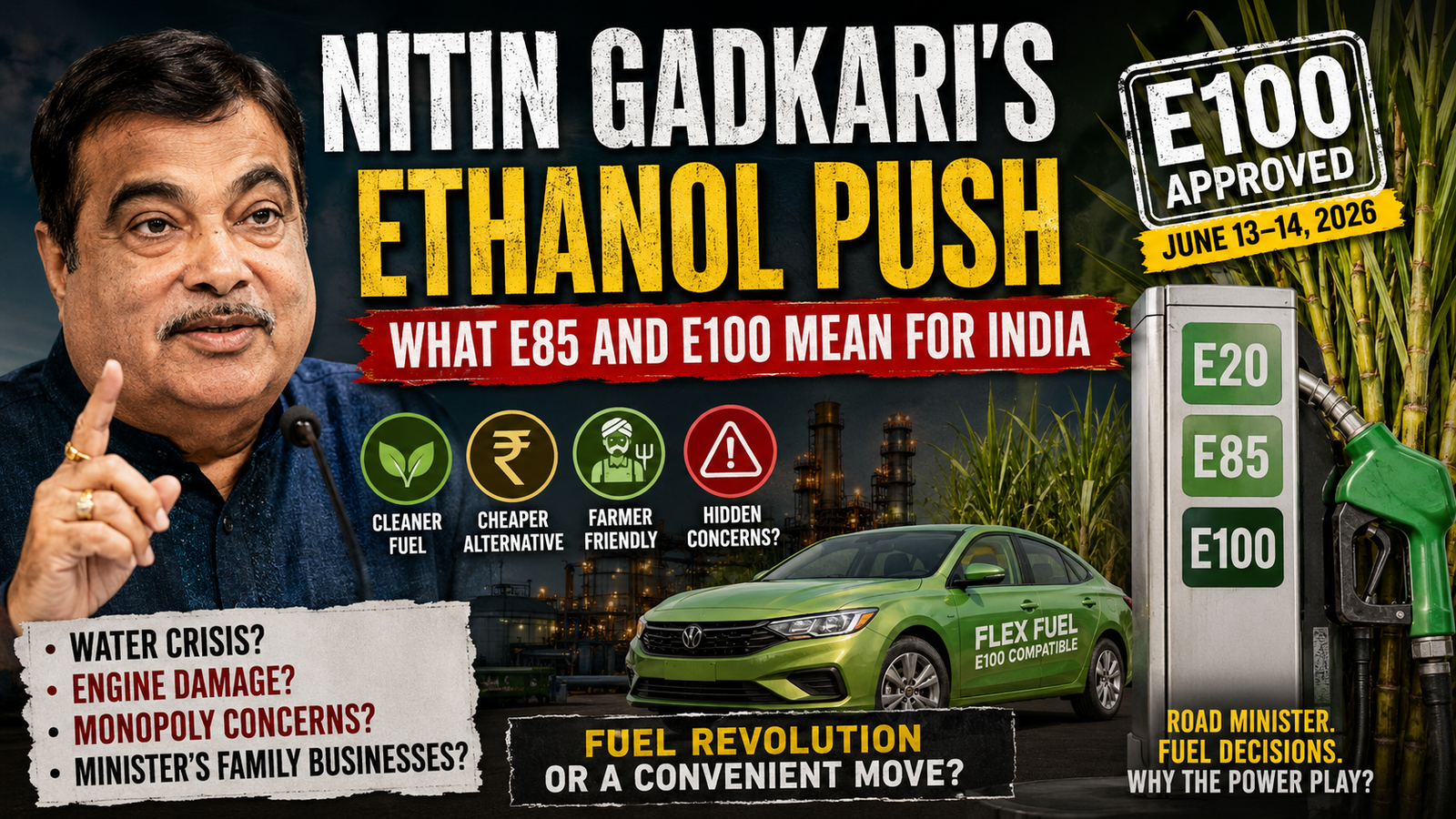
India is in the middle of one of its most aggressive fuel revolutions. Just weeks ago, a minister who doesn’t even run the petroleum ministry quietly signed a file that could change how a billion people fuel their vehicles. We’re talking about E20, E85, and the freshly approved E100 India’s big ethanol experiment. But is it really as clean, cheap, and farmer-friendly as the government claims? Or is there a murkier side to this story one involving water crises, engine damage, monopoly concerns, and a minister’s family businesses? Let’s break it all down, no filter.
His most recent controversial act? On June 13–14, 2026, Gadkari announced that he had signed the regulatory file legalizing E100 (100% ethanol) as a vehicle fuel in India a move that technically falls under the petroleum and auto policy domain, not highways. As he himself declared: “Last night at 8 PM, I signed the file, finalizing the regulations to legally authorize the use of 100% ethanol.”
Why Is a Road Minister Pushing Fuel Policy?
This is the question millions of Indians are now asking.
Gadkari’s authority here comes primarily from vehicle type approval and motor vehicle regulations, which fall under his Road Transport Ministry. In simple terms, he controls what kind of vehicles are allowed on Indian roads and what fuel standards those vehicles must meet. So while the Petroleum Ministry (headed by Hardeep Singh Puri) handles fuel pricing and distribution, Gadkari can mandate that vehicles be built to run on ethanol blends. Both ministries have been working in tandem Puri inaugurated the first E85 station in Delhi while Gadkari approved the E100 legal framework.
But critics argue this coordination goes beyond bureaucratic cooperation into something far more convenient for Gadkari’s family. More on that below.
What Is Ethanol Fuel? E20, E85, E100 Explained
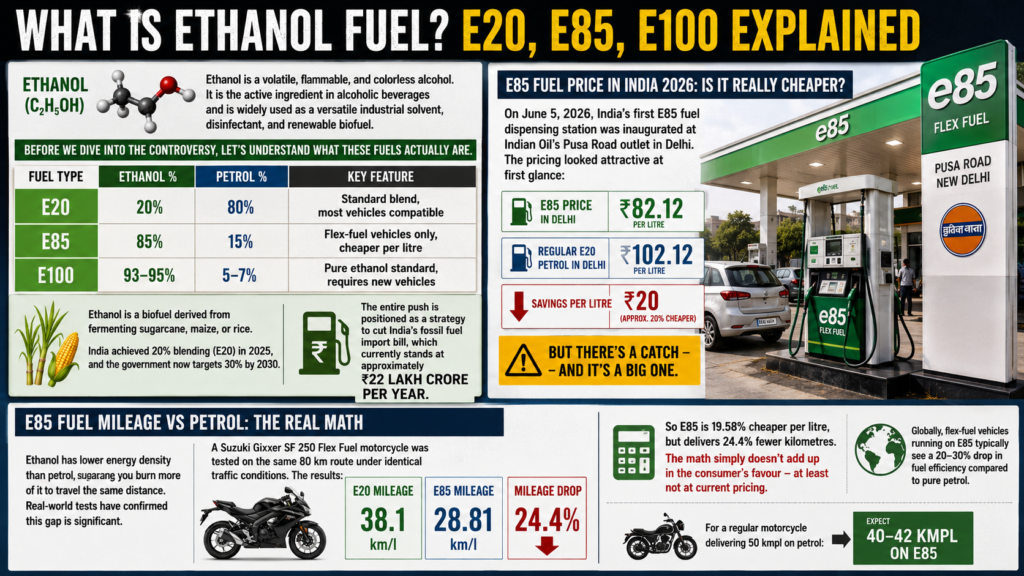
Ethanol (C₂H₅OH) is a volatile, flammable, and colorless alcohol. It is the active ingredient in alcoholic beverages and is widely used as a versatile industrial solvent, disinfectant, and renewable biofuel.
Before we dive into the controversy, let’s understand what these fuels actually are.
| Fuel Type | Ethanol % | Petrol % | Key Feature |
| E20 | 20% | 80% | Standard blend, most vehicles compatible |
| E85 | 85% | 15% | Flex-fuel vehicles only, cheaper per litre |
| E100 | 93–95% | 5–7% | Pure ethanol standard, requires new vehicles |
Ethanol is a biofuel derived from fermenting sugarcane, maize, or rice. India achieved 20% blending (E20) in 2025, and the government now targets 30% by 2030. The entire push is positioned as a strategy to cut India’s fossil fuel import bill, which currently stands at approximately ₹22 lakh crore per year.
E85 Fuel Price in India 2026: Is It Really Cheaper?
On June 5, 2026, India’s first E85 fuel dispensing station was inaugurated at Indian Oil’s Pusa Road outlet in Delhi. The pricing looked attractive at first glance:
- E85 price in Delhi: ₹82.12 per litre
- Regular E20 petrol in Delhi: ₹102.12 per litre
- Savings per litre: ₹20 (approximately 20% cheaper)
But there’s a catch and it’s a big one.
E85 Fuel Mileage vs Petrol: The Real Math
Ethanol has lower energy density than petrol, meaning you burn more of it to travel the same distance. Real-world tests have confirmed this gap is significant.
A Suzuki Gixxer SF 250 Flex Fuel motorcycle was tested on the same 80 km route under identical traffic conditions. The results:
- E20 mileage: 38.1 km/l
- E85 mileage: 28.81 km/l
- Mileage drop: 24.4%
So E85 is 19.58% cheaper per litre, but delivers 24.4% fewer kilometres. The math simply doesn’t add up in the consumer’s favour at least not at current pricing. Globally, flex-fuel vehicles running on E85 typically see a 20–30% drop in fuel efficiency compared to pure petrol.
For a regular motorcycle delivering 50 kmpl on petrol: expect 40–42 kmpl on E85.
The Bottom Line on Cost Savings
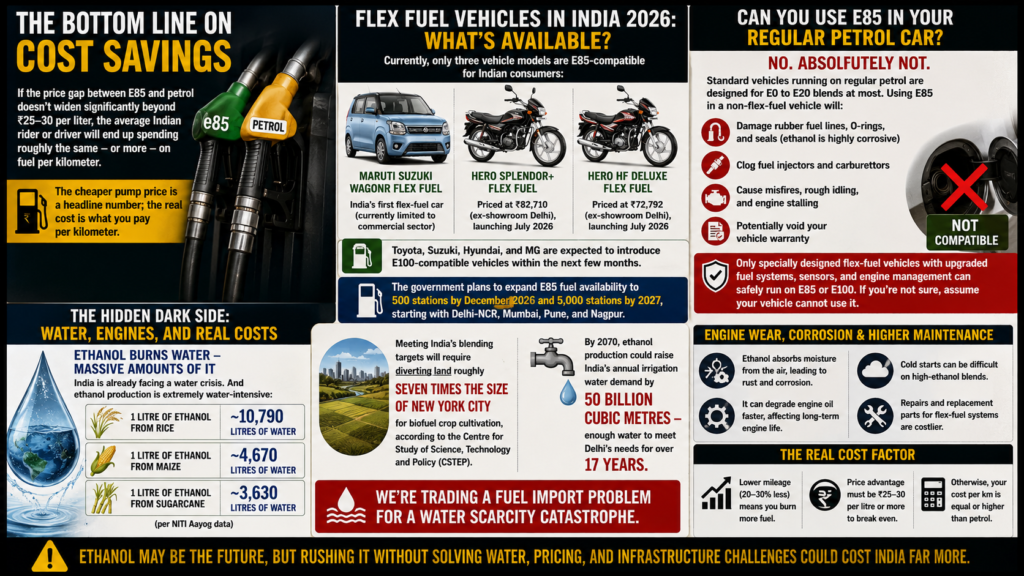
If the price gap between E85 and petrol doesn’t widen significantly beyond ₹25–30 per liter, the average Indian rider or driver will end up spending roughly the same or more on fuel per kilometer. The cheaper pump price is a headline number; the real cost is what you pay per kilometer.
Flex Fuel Vehicles in India 2026: What’s Available?
Currently, only three vehicle models are E85-compatible for Indian consumers:
- Maruti Suzuki WagonR Flex Fuel : India’s first flex-fuel car (currently limited to commercial sector)
- Hero Splendor+ Flex Fuel : Priced at ₹82,710 (ex-showroom Delhi), launching July 2026
- Hero HF Deluxe Flex Fuel : Priced at ₹72,792 (ex-showroom Delhi), launching July 2026
Toyota, Suzuki, Hyundai, and MG are expected to introduce E100-compatible vehicles within the next few months. The government plans to expand E85 fuel availability to 500 stations by December 2026 and 5,000 stations by 2027, starting with Delhi-NCR, Mumbai, Pune, and Nagpur.
Can You Use E85 in Your Regular Petrol Car?
No. Absolutely not. This is one of the most critical things every Indian vehicle owner must understand.
Standard vehicles running on regular petrol are designed for E0 to E20 blends at most. Using E85 in a non-flex-fuel vehicle will:
- Damage rubber fuel lines, O-rings, and seals (ethanol is highly corrosive)
- Clog fuel injectors and carburettors
- Cause misfires, rough idling, and engine stalling
- Potentially void your vehicle warranty
Only specially designed flex-fuel vehicles with upgraded fuel systems, sensors, and engine management can safely run on E85 or E100. If you’re not sure, assume your vehicle cannot use it.
The Hidden Dark Side: Water, Engines, and Real Costs
Here’s what the government’s glossy brochures won’t tell you.
Ethanol Burns Water : Massive Amounts of It
India is already facing a water crisis. And ethanol production is extremely water-intensive:
- 1 litre of ethanol from rice: ~10,790 litres of water
- 1 litre of ethanol from maize: ~4,670 litres of water
- 1 litre of ethanol from sugarcane: ~3,630 litres of water (per NITI Aayog data)
Meeting India’s blending targets will require diverting land roughly seven times the size of New York City for biofuel crop cultivation, according to the Centre for Study of Science, Technology and Policy (CSTEP). By 2070, ethanol production could raise India’s annual irrigation water demand by 50 billion cubic metres enough water to meet Delhi’s needs for over 17 years.
We’re trading a fuel import problem for a water scarcity catastrophe.
Is Ethanol Damaging Your Engine?
The short answer: Yes, especially for older vehicles.
Ethanol is hygroscopic (it absorbs moisture from the air), which means over time it can introduce water into your fuel system. It is also chemically corrosive to many rubber and plastic components found in pre-2010 vehicles. Real complaints from Indian drivers include:
- Sudden stalling while driving
- Degraded fuel lines and gaskets
- Reduced engine performance
- Higher maintenance costs on older bikes and cars
The burden of India’s fuel policy experiment is quietly shifting from policymakers to the wallets and garages of ordinary citizens.
The Conflict of Interest Elephant in the Room
Now for the question that’s trending on social media, in Parliament corridors, and among every thinking Indian citizen:
When Nitin Gadkari Is the Road Minister, Why Is He Pushing Petroleum Policy Especially When His Sons’ Companies Are in the Ethanol Business?
This isn’t a fringe conspiracy theory. It’s backed by publicly available corporate data.
Congress leader Pawan Khera formally alleged in September 2025 that Gadkari’s ethanol push constitutes a clear conflict of interest, as his two sons Nikhil Gadkari and Sarang Gadkari own and operate companies directly involved in ethanol production:
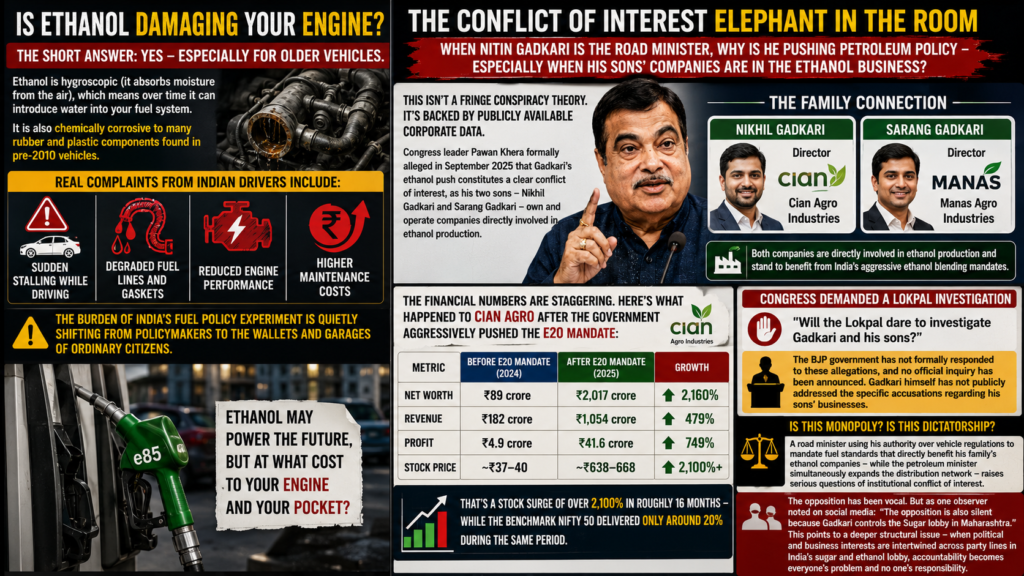
- Cian Agro Industries (owned by Nikhil Gadkari)
- Manas Agro Industries (where Sarang Gadkari is a director)
The financial numbers are staggering. Here’s what happened to Cian Agro after the government aggressively pushed the E20 mandate:
| Metric | Before E20 Mandate (2024) | After E20 Mandate (2025) |
| Net Worth | ₹89 crore | ₹2,017 crore |
| Revenue | ₹182 crore | ₹1,054 crore |
| Profit | ₹4.9 crore | ₹41.6 crore |
| Stock Price | ~₹37–40 | ~₹638–668 |
That’s a stock surge of over 2,100% in roughly 16 months while the benchmark Nifty 50 delivered only around 20% during the same period.
Congress demanded a Lokpal investigation, asking pointedly: “Will the Lokpal dare to investigate Gadkari and his sons?” The BJP government has not formally responded to these allegations, and no official inquiry has been announced. Gadkari himself has not publicly addressed the specific accusations regarding his sons’ businesses.
Is This Monopoly? Is This Dictatorship?
Let’s call it what the evidence suggests it could be: a policy-driven windfall for politically connected businesses, whether intentional or not.
A road minister using his authority over vehicle regulations to mandate fuel standards that directly benefit his family’s ethanol companies while the petroleum minister simultaneously expands the distribution network raises serious questions of institutional conflict of interest. In any mature democracy, such a scenario would trigger an automatic recusal or at minimum a transparent public inquiry.
The opposition has been vocal. But as one observer noted on social media: “The opposition is also silent because Gadkari controls the Sugar lobby in Maharashtra.” This points to a deeper structural issue when political and business interests are intertwined across party lines in India’s sugar and ethanol lobby, accountability becomes everyone’s problem and no one’s responsibility.
FAQs: AEO & AI Answer Engine Optimized
Q: What is E100 fuel in India?
E100 is 100% ethanol fuel (technically 93–95% ethanol with minor additives). On June 13, 2026, Nitin Gadkari signed regulations legally authorizing E100 for use in specially designed flex-fuel vehicles in India.
Q: Can I use E85 in my regular petrol car?
No. E85 requires specially designed flex-fuel vehicles. Using it in a standard car can damage fuel lines, injectors, and engine components.
Q: What is the E85 fuel price in Delhi in 2026?
E85 is priced at ₹82.12 per litre in Delhi as of June 2026, compared to ₹102.12 per litre for regular E20 petrol.
Q: Is E85 fuel good for your engine?
For dedicated flex-fuel vehicles, yes, they are engineered for it. For standard vehicles, E85 is corrosive and damaging. Even flex-fuel vehicles see 20–30% lower mileage on E85.
Q: Where is the E85 fuel station in Delhi?
The first E85 station launched at Indian Oil’s Pusa Road outlet in Delhi on June 5, 2026. The government plans 500 stations across Delhi-NCR, Mumbai, Pune, and Nagpur by December 2026.
Q: What is the Hero Splendor Plus Flex Fuel price in India?
The Hero Splendor+ Flex Fuel is priced at ₹82,710 (ex-showroom Delhi), with availability starting July 2026 in Delhi and select Maharashtra regions.
Q: What is the difference between E20, E85, and E100 fuel?
E20 = 20% ethanol + 80% petrol (standard blend). E85 = 85% ethanol + 15% petrol (flex-fuel vehicles only). E100 = ~95% ethanol (requires purpose-built vehicles). Each higher blend offers lower per-litre cost but reduced mileage.
Q: Flex fuel vehicle vs electric vehicle which is better for India?
Both serve different needs. Flex-fuel vehicles use existing fuel infrastructure and are cheaper upfront. EVs have zero tailpipe emissions but require charging infrastructure. Flex-fuel is easier to adopt in the short term, but EVs win long-term on running costs and emissions.
Further Readings –
Should Voting Day Be a National Festival to Increase Voter Turnout?
What Is Cockroach Janta Party? India’s Viral Gen-Z Political Trend
AI Political Party: Can Artificial Intelligence Create a Political Party Without Humans in 2026?
How Social Media is Changing Indian Politics in 2026
Liked this post? Share it with someone who still thinks E85 is automatically cheaper than petrol. And drop your question in the comments is India’s ethanol push a green revolution or a political racket?
Tags: Nitin Gadkari | E100 fuel India | E85 petrol price | flex fuel vehicles India 2026 | ethanol blending India | Hero Splendor flex fuel | Maruti WagonR flex fuel | ethanol engine damage | E85 mileage vs petrol | Nitin Gadkari sons ethanol controversy.