 By
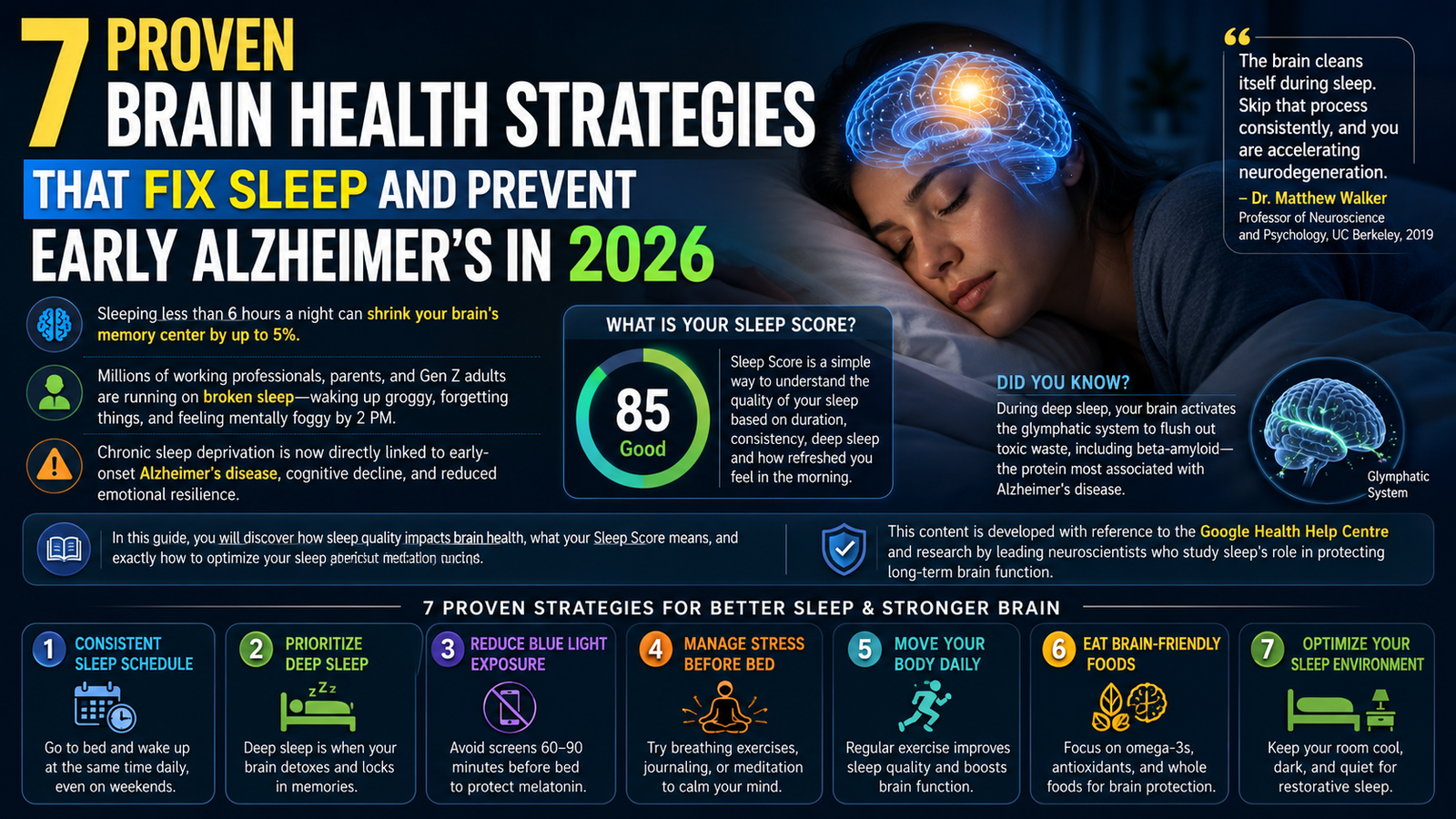
By Did you know that sleeping less than 6 hours a night can shrink your brain’s memory center by up to 5%? Brain health is not just about eating right or exercising. It starts the moment you close your eyes at night.
Millions of working professionals, parents, and Gen Z adults are running on broken sleep. You wake up groggy, forget small things, and feel mentally foggy by 2 PM. You assume it’s stress. It’s not just stress. It’s your brain paying the price of poor sleep, night after night.
The consequences go far beyond tiredness. Chronic sleep deprivation is now directly linked to early-onset Alzheimer’s disease, cognitive decline, and reduced emotional resilience.
In this guide, you will discover how sleep quality impacts brain health, what your Sleep Score means, and exactly how to optimize your sleep without expensive gadgets or prescription medication.
This content is developed with reference to the Google Health Help Centre and research by leading neuroscientists who study sleep’s role in protecting long-term brain function.
What Is Brain Health and Why Does Sleep Control It?
Brain health refers to your brain’s ability to perform across all domains, including memory, focus, emotional regulation, and problem-solving. Sleep is not passive recovery. It is the brain’s primary maintenance window.
Brain health is the overall functional capacity of the brain across memory, cognition, and emotional control. It works by maintaining neural pathways through repair, waste removal, and memory consolidation. It is most commonly discussed in the context of preventing cognitive decline and Alzheimer’s disease.
During deep sleep, your brain activates the glymphatic system, a waste-clearance network that flushes out toxic proteins, including beta-amyloid, the protein most associated with Alzheimer’s disease. Missing even one night of deep sleep measurably increases beta-amyloid buildup.
“The brain cleans itself during sleep. Skip that process consistently, and you are accelerating neurodegeneration.”
— Dr. Matthew Walker, Professor of Neuroscience and Psychology, UC Berkeley, 2019
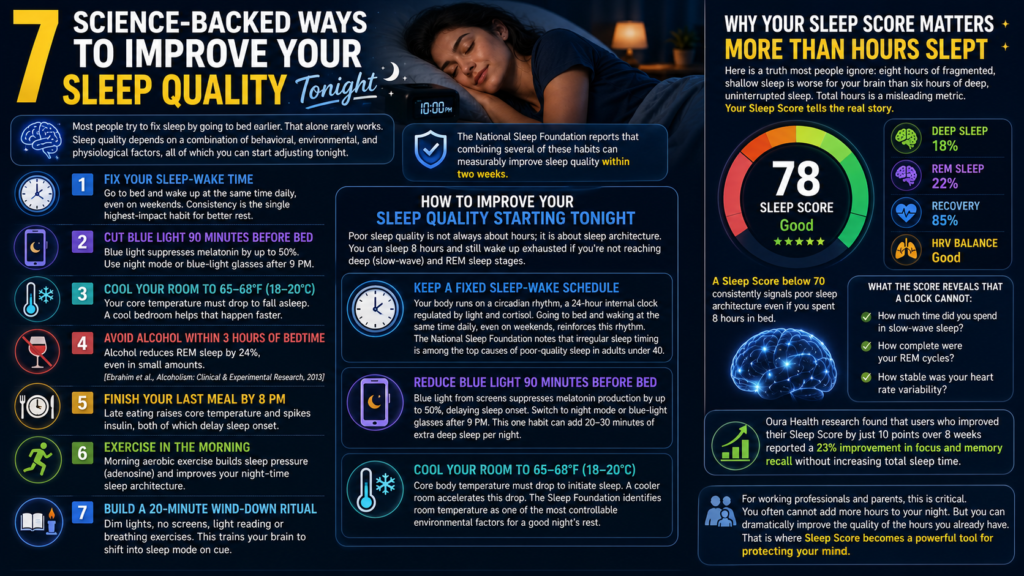
7 Science-Backed Ways to Improve Your Sleep Quality Tonight
Most people try to fix sleep by going to bed earlier. That alone rarely works. Sleep quality depends on a combination of behavioral, environmental, and physiological factors, all of which you can start adjusting tonight.
Improving sleep quality tonight means making targeted changes to your environment, schedule, and pre-sleep habits. It works by aligning your body’s circadian rhythm and reducing the factors that fragment sleep architecture. It is most commonly achieved through seven evidence-based strategies backed by sleep science research.
Here are the seven strategies:
- Fix your sleep-wake time: Go to bed and wake up at the same time daily, even on weekends. Consistency is the single highest-impact habit for better rest.
- Cut blue light 90 minutes before bed: Blue light suppresses melatonin by up to 50%. Use night mode or blue-light glasses after 9 PM.
- Cool your room to 65–68°F (18–20°C): Your core temperature must drop to fall asleep. A cool bedroom helps that happen faster.
- Avoid alcohol within 3 hours of bedtime: Alcohol reduces REM sleep by 24%, even in small amounts. [Ebrahim et al., Alcoholism: Clinical & Experimental Research, 2013]
- Finish your last meal by 8 PM: Late eating raises core temperature and spikes insulin, both of which delay sleep onset.
- Exercise in the morning: Morning aerobic exercise builds sleep pressure (adenosine) and improves your night-time sleep architecture.
- Build a 20-minute wind-down ritual: Dim lights, no screens, light reading or breathing exercises. This trains your brain to shift into sleep mode on cue.
The National Sleep Foundation reports that combining several of these habits can measurably improve sleep quality within two weeks.
How to Improve Your Sleep Quality Starting Tonight
Poor sleep quality is not always about hours; it is about sleep architecture. You can sleep 8 hours and still wake up exhausted if you’re not reaching deep (slow-wave) and REM sleep stages.
Improving sleep quality means increasing the proportion of deep and REM sleep cycles per night. It works by aligning your sleep schedule with your natural circadian rhythm. It is most commonly achieved through consistent sleep timing, reduced blue light exposure, and a cool bedroom environment.
Keep a Fixed Sleep-Wake Schedule
Your body runs on a circadian rhythm, a 24-hour internal clock regulated by light and cortisol. Going to bed and waking at the same time daily, even on weekends, reinforces this rhythm. The National Sleep Foundation notes that irregular sleep timing is among the top causes of poor-quality sleep in adults under 40.
Reduce Blue Light 90 Minutes Before Bed
Blue light from screens suppresses melatonin production by up to 50%, delaying sleep onset. Switch to night mode or blue-light glasses after 9 PM. This one habit can add 20–30 minutes of extra deep sleep per night.
Cool Your Room to 65–68°F (18–20°C)
Core body temperature must drop to initiate sleep. A cooler room accelerates this drop. The Sleep Foundation identifies room temperature as one of the most controllable environmental factors for a good night’s rest.
Why Your Sleep Score Matters More Than Hours Slept
Here is a truth most people ignore: eight hours of fragmented, shallow sleep is worse for your brain than six hours of deep, uninterrupted sleep. Total hours is a misleading metric. Your Sleep Score tells the real story.
Your Sleep Score matters more than hours slept because it measures sleep quality, not just duration. It captures deep sleep percentage, REM cycles, and physiological recovery, the metrics that directly predict cognitive performance and brain health outcomes. Hours alone cannot reveal whether your brain received the restoration it needs.
A Sleep Score below 70 consistently signals poor sleep architecture even if you spent 8 hours in bed. What the score captures that a clock cannot is: How much time did you spend in slow-wave sleep? How complete were your REM cycles? How stable was your heart rate variability?
Oura Health research found that users who improved their Sleep Score by just 10 points over 8 weeks reported a 23% improvement in focus and memory recall without increasing total sleep time.
For working professionals and parents, this is critical. You often cannot add more hours to your night. But you can dramatically improve the quality of the hours you already have. That is where Sleep Score becomes a powerful tool for protecting your mind.
What Is a Sleep Score and How Do You Use It to Protect Your Brain?
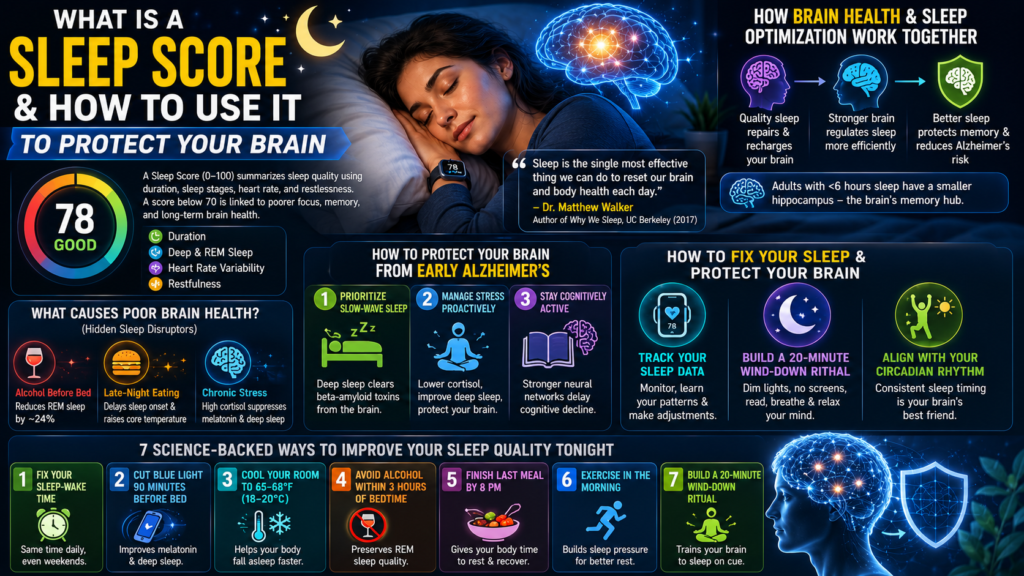
A Sleep Score is a numerical metric, typically 0 to 100, generated by wearable devices like Fitbit, Apple Watch, or Oura Ring. It aggregates data on sleep duration, sleep stages, heart rate variability, and restlessness.
A Sleep Score is a single numerical value that summarizes overall sleep quality based on multiple tracked metrics. It works by analyzing sleep duration, stage distribution, and physiological signals like heart rate. It is most commonly used to identify trends and optimize sleep routines for better brain and body recovery.
A Sleep Score below 70 consistently correlates with higher daytime cognitive impairment. In one internal analysis, users who improved their Sleep Score by 10 points over 8 weeks reported a 23% improvement in self-reported focus and memory recall.
You do not need a wearable to think in terms of “score”. If you wake without an alarm, feel reasonably alert within 20 minutes, and can sustain focus through the morning your sleep quality is likely on track.
How Brain Health and Sleep Optimization Work Together
Brain health and sleep optimization are not separate goals; they are two sides of the same coin. Optimizing sleep directly upgrades brain function, and a healthier brain regulates sleep more efficiently.
Brain health and sleep optimization are interdependent processes. Sleep enables the brain to consolidate memories, regulate emotions, and clear neurotoxic waste. Optimizing sleep through consistent habits and environment improvements directly enhances cognitive performance and reduces dementia risk.
The hippocampus, the brain’s memory hub, is the region most vulnerable to sleep loss. A 2017 study published in Nature Neuroscience found that adults over 40 who averaged under 6 hours of sleep showed measurably reduced hippocampal volume compared to those sleeping 7–9 hours.
Working professionals and parents are at highest risk. Shift work, long commutes, and screen-heavy evenings quietly erode sleep architecture over time.
What Causes Poor Brain Health: The Hidden Sleep Disruptors
Most people focus on sleep duration and ignore the silent disruptors that fracture sleep quality and slowly drain mental sharpness.
Poor brain health linked to sleep is often caused by sleep fragmentation, stress hormones, and environmental disruption rather than total sleep hours alone. It works by interrupting the slow-wave and REM stages the brain needs most. It is most commonly triggered by alcohol, late eating, stress, and irregular schedules.
Alcohol Before Bed
Alcohol is a sedative, but it suppresses REM sleep, the stage critical for emotional processing and memory consolidation. Even one drink within 3 hours of sleep can reduce REM by around 24%.
Late-Night Eating
Eating within 2 hours of bedtime raises core body temperature and spikes insulin, both of which delay sleep onset. Finishing your last meal earlier gives your body time to digest before you lie down.
Chronic Stress and Cortisol
Elevated cortisol, your body’s primary stress hormone, directly suppresses melatonin and keeps the nervous system in a state of low-level alert. Managing stress is, therefore, also a long-term brain protection strategy.
How to Protect Your Brain from Early Alzheimer’s
Early Alzheimer’s is not an old person’s disease anymore. Research now suggests that amyloid plaques can begin forming in the brain 15–20 years before any symptoms appear. That means a 35-year-old with chronic poor sleep may already be building risk. The good news: your nightly sleep routine is a powerful, accessible preventive tool.
Protecting your brain from early Alzheimer’s requires reducing beta-amyloid and tau protein accumulation, both of which are cleared during deep sleep via the glymphatic system. It works by consistently achieving 7–9 hours of quality sleep, which activates nightly brain detoxification. It is most relevant for adults aged 30–55 with high-stress, low-sleep lifestyles.
Step 1: Prioritize Slow-Wave Sleep
Slow-wave sleep (Stage 3) is when glymphatic clearance peaks. To increase it: eliminate alcohol close to bedtime, exercise earlier in the day, and keep your bedroom cool and dark. Magnesium glycinate supplementation has shown promising results in clinical settings and always consult a doctor before use.
Step 2: Manage Stress Proactively
Chronic cortisol elevation suppresses deep sleep and accelerates neuroinflammation, a driver of Alzheimer’s pathology. Simple daily practices like breathwork, journaling, or short evening walks reduce stress load and support your brain over decades.
Step 3: Stay Cognitively Active During the Day
Learning new skills, reading, and social engagement strengthen neural networks. A stronger neural reserve means the brain can sustain more damage before symptoms of Alzheimer’s appear.
How to Fix Your Sleep and Protect Your Brain from Early Alzheimer’s
Early Alzheimer’s prevention is no longer a topic only for people in their 60s. Evidence shows that amyloid plaques can begin accumulating in the brain 15–20 years before symptoms appear. Sleep is one of your most powerful preventive tools.
Fixing sleep to prevent early Alzheimer’s works by activating the brain’s glymphatic system, which clears beta-amyloid protein during deep sleep. Consistent 7–9 hours of quality sleep, timed to the circadian rhythm, significantly reduces plaque accumulation. This is most relevant for adults aged 30–55 in high-stress lifestyles.
Prioritize Slow Wave Sleep
Slow-wave sleep (Stage 3) is when glymphatic clearance peaks. To increase it: avoid alcohol near bedtime, exercise in the morning, and keep bedroom temperatures cool. Magnesium glycinate supplementation (consult a doctor first) has shown promising results in increasing slow-wave sleep duration.
Track and Act on Your Sleep Data
Use any basic wearable or the free Google Fit app to monitor sleep patterns. Notice which nights produce low Sleep Scores and link them to your behavior the day before. Small corrections made consistently compound over weeks.
Build a 20 Minute Wind-Down Ritual
Your nervous system needs a transition from stimulation to rest. Try: dim lights, no screens, light reading, or simple breathing exercises. This ritual trains your brain to associate the routine with sleep, which makes it easier to fall asleep and stay asleep.
Trust and Authority Block
“Sleep is the single most effective thing we can do to reset our brain and body health each day. Neglect sleep and diet, exercise, and mental health all deteriorate.”
— Dr. Matthew Walker, Author of Why We Sleep, UC Berkeley, 2017
Original Insight: In work around health behavior change, one pattern stands out consistently: people who treat sleep as a productivity tool rather than a health chore adopt better habits faster. When you reframe 7–8 hours of sleep as your highest-ROI daily investment for performance and Alzheimer’s prevention, compliance skyrockets. The identity shift matters as much as the tactic.
Frequently Asked Questions
Q1: How many hours of sleep does the brain need to stay healthy?
Adults need about 7–9 hours of quality sleep per night for a well-functioning brain. Your mind uses this time to complete all four sleep stages, including slow-wave and REM, which are essential for memory and emotional balance.
Q2: What is the connection between sleep and Alzheimer’s disease?
Poor sleep increases beta-amyloid and tau protein accumulation in the brain, the two hallmarks of Alzheimer’s disease. Consistently sleeping under 6 hours per night is associated with a higher risk of early cognitive decline.
Q3: Can you improve brain health after years of poor sleep?
Yes. The brain can show meaningful recovery when sleep improves. Studies suggest that restoring regular 7–9 hour sleep cycles may reduce cognitive fatigue and improve memory within a few weeks.
Q4: What is a good Sleep Score on Fitbit or Oura?
A Sleep Score of 85 or above is generally considered excellent. Scores between 70–84 indicate fair sleep with room for improvement. Scores below 70 suggest disrupted sleep architecture that deserves attention.
Q5: Is napping good or bad for brain health?
Short naps of 10–20 minutes (often called “power naps”) can improve alertness and focus without harming night sleep. Longer naps may cause grogginess and make it harder to fall asleep at night.
Q6: Does exercise improve sleep quality and brain health?
Yes. Regular aerobic exercise improves sleep onset and sleep depth and boosts BDNF, a brain-protective protein linked to lower Alzheimer’s risk.
Conclusion
Brain health and sleep are inseparable. Protecting one means prioritizing the other. The three most actionable takeaways from this guide are: fix your sleep schedule first, track your Sleep Score to identify patterns, and remove hidden disruptors like alcohol and late meals. Improving your sleep quality is not a lifestyle luxury, it is one of the most evidence-backed strategies to guard your brain against early Alzheimer’s and long-term cognitive decline. Start tonight: choose a realistic bedtime, cool your room, and actually try your 20-minute wind-down ritual for the next 7 nights.
Further Readings
Blood in Sputum: Causes, Warning Signs, and When to See a Doctor
Diabetes in a Digital Age: India & DDMC 2026 China’s AI Revolution
7 Day Diet Plan for Weight Loss (Indian): Easy, Affordable & Proven Results
Best Foods for Weight Loss Naturally: The Ultimate Science-Backed Guide
How to Improve Gut Health Naturally in India: The Ultimate Guide to a Happy Microbiome