 By
By Introduction
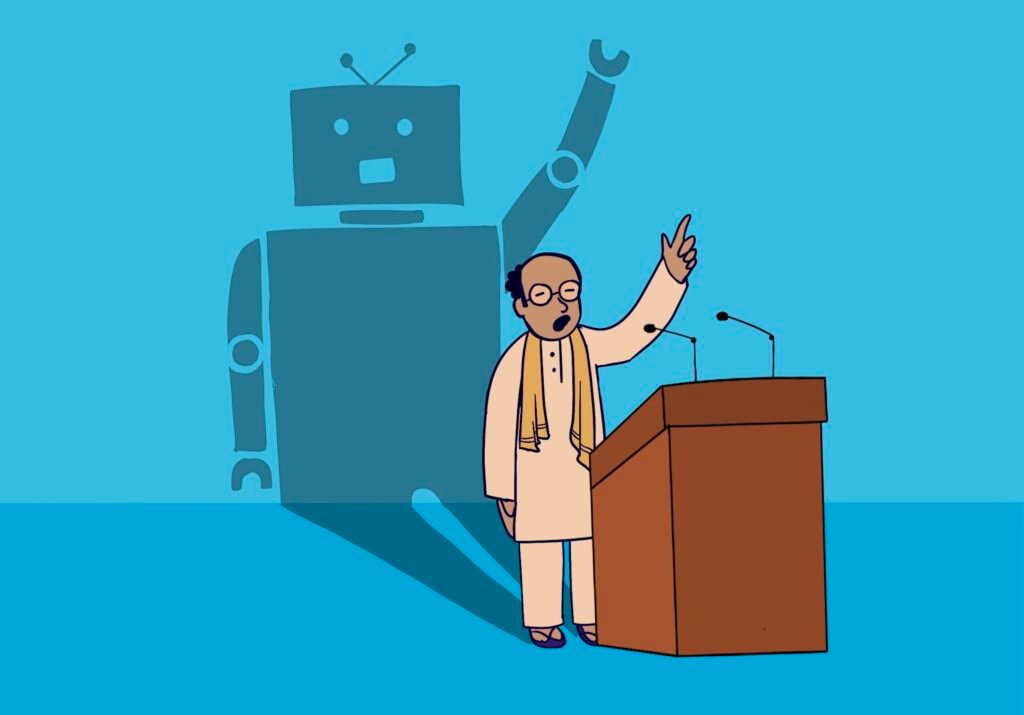
Let’s suppose you wake up in 2026 to news about a political movement that has no leader to follow, no human to be its spokesperson, no one to form its campaign team, because all of its speeches, policy proposals, campaign strategies, and responses to the public are all generated by an artificial intelligence system.
It does not feel real, and it sounds like science fiction.
The rapid improvements in the capabilities of artificial intelligence make the concept less impossible.
AI can already write, analyze data, generate videos, answer queries, assist in decision making, and much more.
Once technology reaches an even higher level of advancement, a question that will start to intrigue will be:
Is it possible to have a Political Party that is completely AI and has no humans in the year 2026?
The answer is not a clear cut yes or no.
Although AI has the capacity to change the way we view and do politics, the complete automation of the political party system will raise a number of serious issues that are related to technology, ethics, and law.
With this article, we want to present the possible scenarios for the future of politics with AI, how an AI Political Party would work, and decide for ourselves whether the benefits of having such a system would outweigh the risks, and whether we are prepared for such a monumental shift.
What is an AI Political Party?
Let’s first break down what we mean when we refer to an AI Political Party.
A conventional political party is built on an elaborate system of human leaders, advisors, campaign managers, volunteers, policy experts, and supporters.
Political decisions are the result of a system of people and are based on ideologies, public perceptions, experiences, and political objectives.
An AI Political Party would not have this structure.
Instead of depending on people to run the organization, an artificial intelligence-based political party would:
- Assess citizen feedback in a timely fashion
- Develop suggestions for policies
- Prepare speeches and messages for campaigns
- Evaluate economic and social measurements
- Anticipate public response
- Automatically reply to citizen feedback
- Use data to improve strategies for governing
In its most radical version, an AI Political Party would run almost completely through algorithms with no human involvement at all.
It may seem highly imaginative, but most components of this are already in existence.
Why AI has a Role in Politics
AI is a hot topic and complex technology right now because of its capability to analyze large volumes of data at a speed unrivaled by human capacity.
Governments produce a ton of data and information daily on many topics like:
- Healthcare
- Education
- Employment
- Infrastructure
- Public safety
- Economic activity
- Environmental protection
Human policymakers are often too slow to review and respond to complex issues that are of a large scale.
Theoretically, an AI Political Party would have the technological capability to solve issues that citizens face by:
- Rapidly identifying large, national, complex issues
- Anticipating significant future issues
- Automatically eliminating “red tape”
- Formulating diverse options of policies that will enhance the welfare of citizens
Intelligent design would be the primary reason for the theoretical success of the type of AI-based political system.
For these reasons, the AI Political Party concept is attracting global attention for the first time.
Speculating about an AI Political Party in 2026
Let’s say a group of people who either are or think they are very talented and skilled create an AI Political Party in 2026.
Instead of opting for a human leader, a powerful AI system is employed.
This system is built on:
- government documents
- economic data
- historical policies
- academic studies
- public response
- social dynamics
Mass amounts of data are constantly collected and analyzed by the AI system in order to represent the voices of millions of citizens.
As new complications arise (such as unemployment), the AI system determines possible solutions and recommends the proposed policies that would help the most.
The AI system would also develop:
- speech
- advertisement designs
- social media posts
- voter response sentiment
- message tailoring
This would allow the party to essentially run 24/7 without the drawbacks of human nature.
This is a leading argument of the AI Political Party of the Future.
Advantages of an AI Political Party
1. Evidence-Based Outcome Preference
Most of the time, the public is left to deal with the outcomes that stemmed from the ideology- and personal belief-driven decisions of human politicians.
An AI Political Party would prioritize results.
Instead of asking:
“what do the people want?”
the Party would ask:
“what is the best solution?”
This type of question would result in increased efficiency for policies.
2. No More Corruption
Personal financial gain, familial interests, and gaining power would leave an AI Political Party outside influence of corruption, which human political parties are subjugated to.
This would leave an AI Political Party outside influence of:
- bribery
- nepotism
- favoritism
It would still be possible to bribe the AI system through the people controlling the system, but it would not possess any self-interests.
3. Quicker Policy Assessment
It can take governments months or years to assess many complicated case issues.
AI can process large amounts of data almost instantaneously.
An AI Political Party would be able to examine:
- Trends in Inflation
- Healthcare
- Transportation
- The Environment
This would be particularly beneficial in responding to a crisis.
4. Constant Public Engagement
Most conventional political systems have periodic elections that occur every few years.
An AI Political Party would be able to gauge public sentiment on a constant basis through digital surveys, real-time feedback mechanisms, and participatory digital platforms.
The rapid evolution of policies would be in direct contrast to the more static nature of policies during election cycles.
5. Fair Allocation of Resources
Budget decisions cause political wrangling.
AI can determine the needs of a particular region, the economic consequences, and the necessities of infrastructure.
This would allow for the fair distribution of resources and account for measurable outcomes and would have no political interference.
This is why an AI Political Party may be attractive in the future.
The Main Concerns about an AI Political Party
1. Bias in Algorithms
AI learns from data.
If existing datasets contain outdated practices, discrimination, or bias, the AI would be able to replicate that without knowledge.
Examples include:
- Housing
- Employment practices
- Law enforcement
This has serious ethical implications.
2. Absence of Human Empathy
Politics cannot be only data.
Some decisions must consider:
- Compassion
- Valuable Morals
- Suffering
- Culture
AI is good for data, but is not able to understand this.
An AI Political Party could develop technologically advanced solutions that are socially and emotionally disconnected.
3. Manipulating AI with Data
AI heavily relies on data.
Bad data produces flawed AI decisions.
A data manipulator can mislead an AI Political Party.
This presents unique cybersecurity problems.
4. The Responsibility Problem
What happens when AI policy causes harm?
Who’s responsible?
- The coders?
- Organizers?
- The data suppliers?
- Government officials?
An AI Political Party makes responsibility harder to determine.
5. Damaging Democracy
Human judgment is an important aspect of democracy.
Humans must vote as representatives because they perceive that only humans can understand their problems and make moral evaluations.
Complete replacement of human governance with algorithms is a threat to democratic systems and will erode the public’s trust.
Have AI Political Parties Already Emerged?
Interestingly, the concept is not entirely theoretical.
Several political experiments around the world have explored AI-driven governance.
Some organizations have used AI tools to:
- Generate policy suggestions
- Analyze public concerns
- Assist legislative decision-making
Although no fully autonomous AI Political Party currently governs a nation, these experiments demonstrate growing interest in AI-assisted politics.
The idea is slowly moving from fiction toward reality.
How Well Could AI Campaign Compared to Humans?
One area where AI is already making a significant impact is political campaigning.
Modern AI systems can:
- Analyze voter preferences
- Create personalized messaging
- Optimize advertising
- Monitor public sentiment
An AI Political Party could potentially conduct highly efficient election campaigns.
It might identify:
- Key voter concerns
- Emerging social issues
- Regional priorities
within seconds.
However, this capability also introduces risks involving misinformation, manipulation, and privacy violations.
The same technology that improves communication can also be used to influence voters unfairly.
Legal Obstacles for an AI Political Party
Even if technology advances rapidly, legal systems may slow adoption.
Most countries require political parties to have:
- Human representatives
- Registered leadership structures
- Financial accountability
- Legal responsibility
Current laws were designed for human organizations.
An AI Political Party would require significant legal reforms before it could operate independently.
Governments would need to determine:
- Who owns the AI?
- Who controls the algorithms?
- Who is responsible for mistakes?
- How transparency is ensured?
These questions remain unresolved.
What would Citizens Think of an AI Political Party?
Public acceptance may be the biggest obstacle.
Many people already trust AI for:
- Navigation
- Online shopping
- Content recommendations
- Customer support
But trusting AI with national governance is a different matter entirely.
Citizens may worry about:
- Surveillance
- Data privacy
- Loss of human representation
- Algorithmic control
For an AI Political Party to succeed, it would need to earn public trust through transparency and accountability.
Without trust, even the most advanced system would struggle to gain support.
Most Likely Future: Politics will be a collaboration of Humans and AI
Rather than replacing politicians completely, a more realistic future involves collaboration.
In this model:
- Humans provide leadership.
- AI provides analysis.
- Humans make final decisions.
- AI offers evidence-based recommendations.
This hybrid approach combines:
- Human judgment
- Emotional intelligence
- Ethical reasoning
with:
- AI efficiency
- Data analysis
- Predictive capabilities
Many experts believe this balance represents the most practical future of politics.
Instead of a fully autonomous AI Political Party, we may see political organizations increasingly powered by artificial intelligence while remaining under human oversight.
Can a Political AI Win Elections in 2026?
Technically, AI could assist with nearly every aspect of a campaign in 2026.
However, a completely human-free political party remains unlikely.
Several obstacles remain:
- Legal restrictions
- Ethical concerns
- Accountability issues
- Public trust challenges
- Democratic principles
While AI can analyze problems and suggest solutions, societies still expect humans to take responsibility for political decisions.
Therefore, the first successful AI Political Party would probably include human representatives working alongside advanced AI systems rather than eliminating people entirely.
Conclusion
The rise of artificial intelligence is transforming nearly every industry, and politics is no exception.
The idea of an AI Political Party operating without human leaders is no longer purely science fiction. AI already possesses many of the capabilities required to analyze public opinion, create policies, manage campaigns, and support governance.
However, major challenges remain.
Questions about accountability, ethics, transparency, democracy, and public trust make a fully autonomous AI Political Party unlikely in 2026. While technology may be ready for some aspects of AI-driven governance, society and legal systems are not yet prepared to hand over complete political control to algorithms.
The more realistic future is a partnership between humans and artificial intelligence, where AI enhances decision-making while elected leaders remain accountable to the people.
Still, the conversation itself reveals something remarkable: for the first time in history, humanity is seriously considering whether software could one day become a political force.
As AI continues to evolve, the question is no longer whether artificial intelligence will influence politics—it already does.
The real question is how much power we are willing to give it.
Frequently Asked Questions (FAQs)
Can an AI Political Party legally exist in 2026?
Currently, most countries require political parties to have human representatives and accountable leadership structures. Because of this, a completely autonomous AI Political Party would face significant legal challenges.
How would an AI Political Party make decisions?
An AI Political Party would rely on large amounts of data, public feedback, economic indicators, and predictive algorithms to recommend policies and make strategic decisions.
What are the biggest risks of an AI Political Party?
Some of the biggest risks include algorithmic bias, lack of human empathy, cybersecurity threats, accountability issues, and potential damage to democratic processes.
Could AI replace human politicians completely?
While AI can assist in policy analysis and decision-making, completely replacing human politicians is unlikely in the near future because political leadership requires accountability, ethics, and human judgment.
Has any country created an AI Political Party?
No country is currently governed by a fully autonomous AI Political Party. However, several political experiments around the world have explored the use of AI in governance and policymaking.
What is the future of AI in politics?
The most likely future is a collaboration between humans and AI, where artificial intelligence supports political decision-making while human leaders remain responsible for governance.