

 By
By Agentic AI is artificial intelligence that can set goals, make plans, and take real actions on its own with little or no human hand-holding. Unlike a chatbot that waits for your next prompt, agentic AI breaks a goal into steps, uses tools like apps and APIs, checks its own results, and keeps going until the job is done. Think of it as the difference between a search engine that answers a question and a digital coworker who finishes the whole project.
And in 2026, this shift from “AI that answers” to “AI that acts” is the biggest story in tech. Let’s break it down in plain English.
What is agentic AI in simple words?
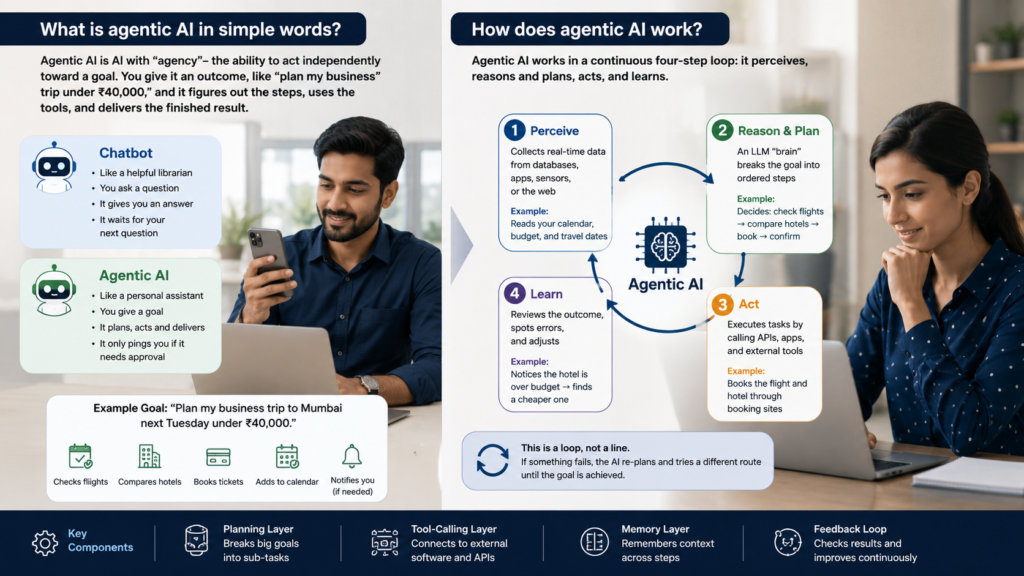
Agentic AI is AI with “agency” the ability to act independently toward a goal. You give it an outcome, like “plan my business trip under ₹40,000,” and it figures out the steps, uses the tools, and delivers the finished result. Traditional AI responds to you. Agentic AI works for you.
The word “agentic” comes from agency, the capacity to make choices and act on them. IBM defines it as a system “capable of autonomously performing tasks on behalf of a user or another system by designing its workflow and using available tools.”
Google Cloud puts it even more simply: agentic AI “can set goals, plan, and execute tasks with minimal human intervention.”
Here’s a metaphor that makes it click:
- A chatbot is like a helpful librarian. You ask a question, it hands you an answer, and it waits for your next question.
- Agentic AI is like a personal assistant. You say “get me to Mumbai for a conference next Tuesday under budget,” and it checks flights, compares hotels, books the tickets, adds them to your calendar and only pings you if something needs your approval.
One waits. One works. That’s the whole idea.
How does agentic AI work?
Agentic AI works in a continuous four-step loop: it perceives (gathers data), reasons and plans (breaks your goal into steps), acts (uses tools and APIs), and learns (checks results and adjusts). AWS, Google Cloud, and NVIDIA all describe this same core cycle.
Here’s what happens at each stage, using the trip-planning example:
| Stage | What the AI does | Trip-planning example |
| 1. Perceive | Collects real-time data from databases, apps, sensors, or the web | Reads your calendar, budget, and travel dates |
| 2. Reason & plan | An LLM “brain” breaks the goal into ordered steps | Decides: check flights → compare hotels → book → confirm |
| 3. Act | Executes tasks by calling APIs, apps, and external tools | Actually books the flight and hotel through booking sites |
| 4. Learn | Reviews the outcome, spots errors, and adjusts | Notices the hotel is over budget → finds a cheaper one |
Under the hood, production systems add a few extra layers: a planning layer (splitting big goals into sub-tasks), a tool-calling layer (connecting to external software), a memory layer (remembering context across steps), and a feedback loop (checking whether each action actually worked).
The key thing to understand: this is a loop, not a line. If step 3 fails, the system doesn’t stop and wait for you it goes back, re-plans, and tries a different route. That self-correction is what separates agentic AI from ordinary automation, which follows a fixed script and breaks the moment something unexpected happens.
What is the difference between agentic AI and AI agents?
Agentic AI is the overall system; AI agents are the individual workers inside it. IBM explains it cleanly: agentic AI is the framework, and AI agents are the building blocks within that framework. One agentic AI system can coordinate many specialized agents toward a single bigger goal.
If you’ve seen both terms used interchangeably on Reddit and LinkedIn, you’re not alone even professionals mix them up. Here’s the cleanest way to think about it:
- An AI agent handles one task with some autonomy. Example: an agent that sorts your inbox and drafts replies.
- Agentic AI is the bigger capability that plans, reasons, and orchestrates multiple agents across systems. Example: a system that runs your entire product launch research agent, writing agent, ad-buying agent, analytics agent all coordinated toward one goal.
A single agent is a musician. Agentic AI is the conductor running the whole orchestra.
How is agentic AI different from generative AI?
Generative AI creates content when you prompt it; agentic AI pursues goals on its own initiative. Generative AI is reactive, it waits for input and produces text, images, or code. Agentic AI is proactive: it decides what to do next, uses tools, and takes real-world actions, often using generative AI as one of its tools.
| Generative AI | Agentic AI | |
| Core behavior | Creates content | Completes goals |
| Trigger | Needs your prompt every time | Needs your goal once |
| Output | Text, images, code | Actions and finished outcomes |
| Tools | Usually none | Calls APIs, apps, browsers, databases |
| Memory | Mostly single conversation | Persistent, across steps and sessions |
| Example | “Write me an email” | “Run my email outreach campaign this week” |
The two aren’t rivals they’re partners. Most agentic AI systems use generative AI models (like GPT or Claude) as their reasoning “brain,” then add planning, memory, and tool access on top.
Want the full side-by-side breakdown with 7 key differences? Read our guide: Agentic AI vs Generative AI: 7 Key Differences Explained Simply
What are real-world examples of agentic AI?
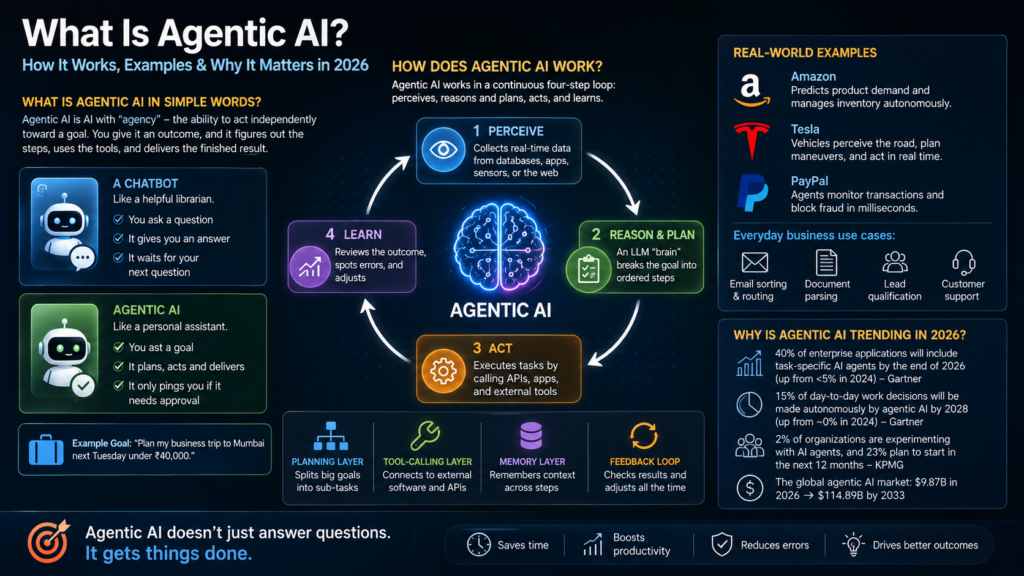
Well-known agentic AI examples include Amazon’s product-demand forecasting agent, Tesla’s autonomous driving decisions, and PayPal’s real-time fraud-detection agent. In everyday business, the most common working examples are email sorting and routing, document parsing, lead qualification, and customer support triage.
Big-name examples you already interact with:
- Amazon uses agentic systems to predict product demand and manage inventory across warehouses.
- Tesla vehicles make continuous driving decisions perceiving the road, planning maneuvers, and acting in real time.
- PayPal runs agents that monitor transactions and block fraud autonomously, in milliseconds.
But the more interesting story is what’s happening inside ordinary companies. When we looked at what practitioners on Reddit’s r/AI_Agents community say actually works (versus the hype), the same “boring but valuable” use cases kept coming up:
- Email classification and routing: not just labeling, but actually moving and actioning messages
- Document parsing: turning form submissions into structured database entries
- Lead qualification: scoring and enriching leads before a human salesperson ever sees them
- First-line customer support: resolving tier-1 tickets by searching documents and completing small tasks
- Cross-system updates: updating the CRM, creating tickets, and generating annotated reports
Notice the pattern: none of these are flashy. All of them save real hours. That’s where agentic AI is quietly winning in 2026.
For 12 detailed examples across healthcare, finance, retail, and manufacturing with named companies read: Agentic AI Use Cases & Real-World Examples Across Industries
Why is agentic AI trending in 2026?
Agentic AI is trending in 2026 because it moved from demos to deployment. Gartner predicts 40% of enterprise applications will include task-specific AI agents by the end of 2026 up from less than 5% in 2024. The global agentic AI market, worth about $9.87 billion in 2026, is projected to reach $114.89 billion by 2033.
The numbers tell the story:
- 33% of enterprise software will include agentic AI by 2028, up from under 1% in 2024: Gartner
- 15% of day-to-day work decisions will be made autonomously by agentic AI by 2028, up from effectively 0% in 2024: Gartner
- 2% of organizations are experimenting with AI agents, and 23% are already scaling them in at least one function: McKinsey
- 42% CAGR: the market is growing from $9.87B (2026) to a projected $114.89B (2033): Coherent Market Insights
But here’s the honest gap most headlines skip: adoption is wide, not deep. Capgemini found that only 2% of organizations have deployed AI agents at full scale, while 61% are still exploring. Gartner’s CIO survey shows a similar picture just 17% have deployed agents, though 42% plan to within 12 months.
In other words: everyone’s at the starting line, very few have finished a lap. That’s exactly why understanding this now gives you an edge.
The Agency Spectrum: our framework for making sense of it all
One reason the agentic AI conversation feels confusing is that everything from a basic chatbot to a self-driving supply chain gets called “an agent.” So we built a simple 5-level scale The Agency Spectrum to classify any AI tool in seconds:
| Level | Name | What it does | Example |
| 0 | Chatbot | Answers when asked | Basic ChatGPT conversation |
| 1 | Copilot | Helps you do a task, you drive | GitHub Copilot, Gemini in Docs |
| 2 | Single agent | Completes one multi-step task alone | An agent that books your flight |
| 3 | Agent team | Multiple agents coordinated on one goal | A system running a full marketing campaign |
| 4 | Agent internet | Agents from different companies transact with each other | Your agent negotiates with a vendor’s agent |
Most products marketed as “agentic AI” in 2026 sit at Level 2. The real action over the next two years is the climb to Levels 3 and 4. When you read any AI news, ask: which level is this actually? It cuts through 90% of the hype.
What are the benefits of agentic AI?
The core benefits of agentic AI are speed, scale, and cost: agents work 24/7, complete multi-step tasks in minutes instead of days, and handle growing workloads without growing headcount. Salesforce data shows organizations tripling their active agents while cutting agent creation time by 53%.
The benefits that matter most in practice:
- It finishes tasks, not just starts them. A copilot helps you write one email. An agent runs the whole outreach sequence research, drafting, sending, follow-ups.
- It works while you sleep. Agents don’t take breaks. PayPal’s fraud agents review transactions at 3 AM with the same accuracy as 3 PM.
- It scales without hiring. One support agent system can resolve thousands of tier-1 tickets simultaneously, something no human team can match.
- It connects your siloed tools. Agents are at their best when moving data between systems CRM to ticketing to email work humans find most tedious.
- Faster deployment than ever. Salesforce reports agent creation times dropping 53%, meaning what took months now takes weeks.
The pattern across all of these: agentic AI doesn’t just make people faster at their jobs. It takes entire workflows off their plates.
What are the risks and limitations of agentic AI?
The biggest risks of agentic AI are failed projects, runaway costs, and autonomous errors at scale. Gartner predicts over 40% of agentic AI projects will be canceled by the end of 2027 due to escalating costs, unclear business value, or inadequate risk controls. Autonomy also creates new security risks traditional software never had.
Let’s be straight about the challenges:
- The failure rate is real. Gartner’s forecast that 40%+ of projects will be canceled isn’t anti-AI FUD it’s a warning that most companies jump in without clear goals or guardrails.
- Error compound. A chatbot that hallucinates gives you one wrong answer. An agent that hallucinates might take ten wrong actions sending emails, changing records, spending money before anyone notices.
- Security is a new frontier. Agents hold credentials, call APIs, and act on your behalf. Each one is a new identity to protect, and security models built for humans don’t fit them.
- Costs can spiral. Agents loop, retry, and call models repeatedly. Without cost controls, a runaway agent can burn through a budget overnight.
- The scaling gap is wide. Remember: 62% are experimenting, but only 23% have scaled. The distance between a cool demo and a reliable production system is where most projects die.
None of this means “avoid agentic AI.” It means the winners in 2026 are the teams that pair ambition with governance approval gates, spending limits, logging, and a named human owner for every agent.
We cover the full risk picture including the six biggest security threats and how to govern autonomous agents here: Agentic AI Risks: What Happens When AI Agents Go Wrong?
Which tools can you use to build agentic AI?
The most popular agentic AI tools in 2026 include frameworks like LangGraph, CrewAI, AutoGen, and Pydantic AI for developers, plus no-code platforms for business users. Two new standards Anthropic’s MCP and Google’s A2A protocol are becoming the common language that lets agents connect to tools and to each other.
You don’t need to be an engineer to start. The tooling landscape splits into three lanes:
- No-code platforms: drag-and-drop agent builders for business users
- Developer frameworks: LangGraph, CrewAI, AutoGen, Pydantic AI (the ones practitioners actually debate on Reddit)
- Protocols: MCP and A2A, the “HTTP moment” that lets agents plug into any tool or talk to other agents
The right choice depends on your goal, your technical comfort, and whether you’re automating one task or orchestrating a whole workflow.
We tested and compared the top options here: 10 Best Agentic AI Tools & Frameworks to Build AI Agents in 2026
Will agentic AI replace jobs?
Agentic AI will reshape far more jobs than it eliminates. BCG’s economic modeling suggests 50–55% of US jobs will be reshaped by AI over the next two to three years, while Gartner predicts “job chaos” rather than a “jobs apocalypse” with over 32 million roles significantly transformed each year starting around 2028–2029.
The honest picture is nuanced. Some tasks data entry, tier-1 support, document processing are genuinely being automated away. But new roles are appearing just as fast: agent orchestrators, AI governance leads, prompt and context engineers.
The workers struggling in 2026 aren’t the ones replaced by agents. They’re the ones who never learned to work with them.
For the full data-driven breakdown which jobs are most exposed, which are safest, and the new careers emerging read: Will AI Agents Replace Jobs? What the 2026 Data Actually Says
What is the future of agentic AI?
The future of agentic AI is teams of specialized agents working together what analysts call the “microservices moment” for AI connected by open protocols like MCP and A2A into an emerging “agent internet.” Single all-purpose agents are giving way to orchestrated multi-agent systems.
Three shifts define where this is heading:
- Multi-agent orchestration. Just as software moved from monoliths to microservices, AI is moving from one big agent to coordinated teams of small, specialized ones. Multi-agent systems already hold a 54.5% share of the agentic AI market in 2026.
- Protocol standardization. Anthropic’s Model Context Protocol (MCP) and Google’s Agent-to-Agent (A2A) protocol are becoming the shared plumbing standards that let any agent use any tool or collaborate with any other agent.
- From tools to teammates. The endgame isn’t software you operate. It’s digital colleagues you delegate to with goals, guardrails, and performance reviews, just like human teams.
The companies and individuals who understand this transition early won’t just use agentic AI. They’ll be the ones directing it.
FAQs About Agentic AI
Is ChatGPT agentic AI?
Standard ChatGPT is generative AI that responds to prompts. But ChatGPT’s agent mode, which can browse the web, use tools, and complete multi-step tasks on its own, crosses into agentic AI. The model is generative; the agent built around it is agentic.
Is agentic AI safe?
Agentic AI is safe when deployed with guardrails: approval gates for sensitive actions, spending limits, activity logging, and a named human owner. Without those controls, autonomous systems can take wrong actions at scale which is why governance is the top concern of 75% of tech leaders.
What is a simple example of agentic AI in daily life?
A travel-planning agent is the simplest example: you say “book a work trip to Mumbai next Tuesday under ₹40,000,” and it checks flights, compares hotels, books both, and adds everything to your calendar only asking you when a decision needs human approval.
Do I need to know coding to use agentic AI?
No. No-code agent platforms let business users build working agents with drag-and-drop interfaces. Coding helps for custom developer frameworks like LangGraph or CrewAI, but many everyday agents email triage, lead qualification, report generation require zero code.
What is multi-agent orchestration?
Multi-agent orchestration is coordinating several specialized AI agents toward one goal like a manager assigning tasks to a team. Instead of one agent doing everything, a research agent, writing agent, and analysis agent each handle their part, passing work between them.
How is agentic AI different from automation?
Traditional automation follows a fixed script and stops when something unexpected happens. Agentic AI perceives the changed situation, reasons about what it means, adjusts its plan, and continues. Automation executes rules; agentic AI pursues goals.
Explore More About Agentic AI:
Want to go deeper? Explore our guides on agentic AI tools, agentic AI use cases, agentic AI risks, and agentic AI vs generative AI. If you’re interested in the future of work, learn whether AI agents will replace jobs or transform existing roles.


2 Comments