 By
By Your chest burns as if it’s on fire. It could be something as simple as bad food. Or maybe you’re just stressed. It could also be something more serious. This one symptom sends thousands of people to the emergency room year after year. It is possibly the best example of how heart attacks and cardiac arrests confuse most people. Understanding the Difference Between Heart Attack and Cardiac Arrest is essential because both conditions require different emergency responses and treatments.
People often confuse the terms heart attack and cardiac arrest as if they are the same thing. In actuality, they are not. They each describe separate medical emergencies. Like heart attacks, cardiac arrests have their own warning signs and cause. They even have their own recommended treatment when they occur. However, the biggest difference is the emergency response; in a cardiac arrest situation, knowing the heart attack vs cardiac arrest distinction comes in handy. Responding quickly to one can save a life. This article is a guide. It explains the burning chest sensation as well as the response for the other warning signs. It also explains the difference when people search the term “what is the difference between heart attack and a cardiac arrest?”. Many people search for the Difference Between Heart Attack and Cardiac Arrest when trying to understand chest pain and other warning signs. Understanding the Difference Between Heart Attack and Cardiac Arrest can help people recognize symptoms early and respond correctly during a medical emergency.
Disclaimer: This article is for general educational and informational purposes only. It is not a substitute for professional medical advice, diagnosis, or treatment. Heart attacks and cardiac arrest are medical emergencies. If you or someone else experiences severe chest pain, difficulty breathing, sudden collapse, or unresponsiveness, seek emergency medical care immediately.
What Is a Heart Attack? (Myocardial Infarction Explained)
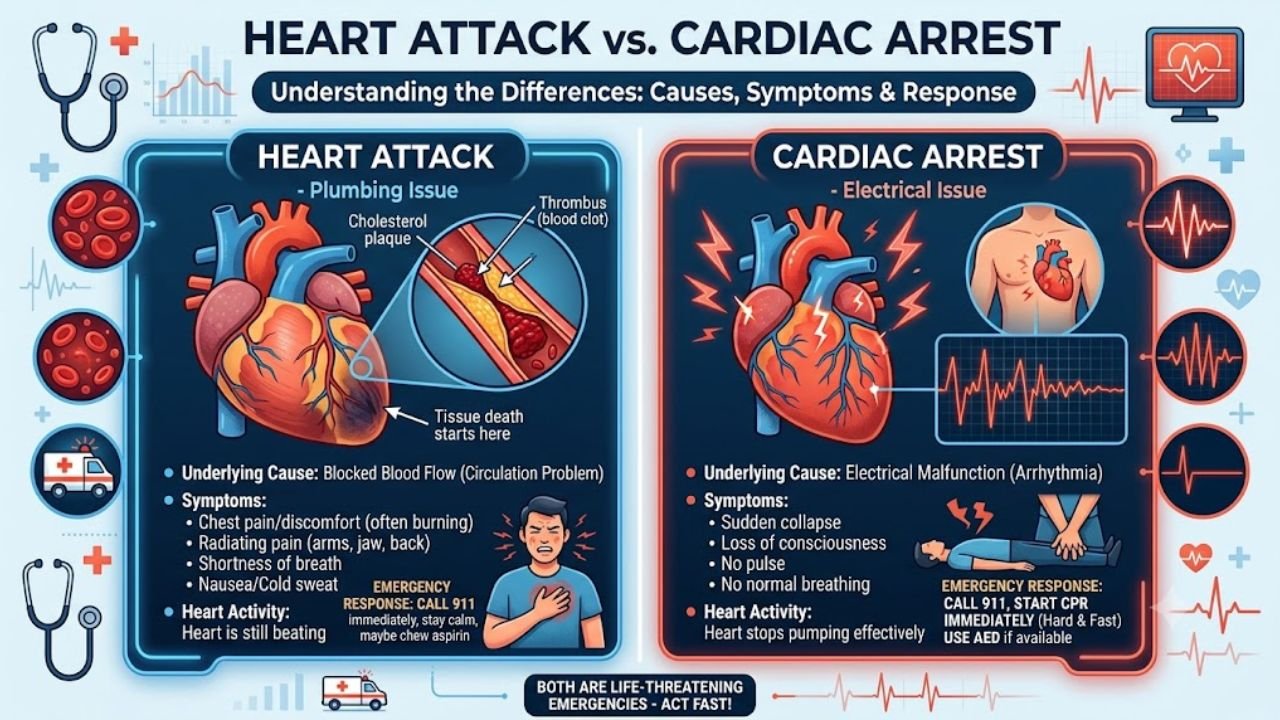
A heart attack, or myocardial infarction, occurs when blood flow becomes completely restricted to a part of heart tissue. Usually, a coronary artery is completely blocked by a thrombus as a result of atherosclerosis. The heart tissue that becomes completely blood starved begins to die. The larger and longer the tissue becomes ischemic, the greater the area of damage becomes. The Difference Between Heart Attack and Cardiac Arrest starts with understanding that a heart attack affects blood flow, while cardiac arrest affects the heart’s electrical activity. The Difference Between Heart Attack and Cardiac Arrest is important because each condition affects the heart in a completely different way.
It is a common misconception that during a heart attack the heart stops beating. In actuality, the heart is still beating in a heart attack. The distinction between a heart attack and cardiac arrest can be understood by knowing that a heart attack is a “plumbing” blocked blood circulation problem, whereas the heart’s electrical system is still functioning. Knowing the Difference Between Heart Attack and Cardiac Arrest makes it easier to understand why these two conditions require different treatments.
Common heart attack symptoms
Recognizing these symptoms makes it easier to understand the Difference Between Heart Attack and Cardiac Arrest during an emergency.
The symptoms for a heart attack can often include the following for both men and women:
- The chest becomes tight or the chest is in severe pain.
- The pain can radiate to other parts of the body, like the back, the neck, and the arms.
- There can be shortness of breath.
- There can be a cold sweat, and one can become nauseous and lightheaded.
- There can be extreme fatigue, especially for women.
These warning signs are an important part of understanding the Difference Between Heart Attack and Cardiac Arrest.
The symptoms of a heart attack can often be experienced in waves for a long time before they become debilitating. The difference between heart attack and cardiac arrest can be understood by knowing that in a cardiac arrest situation the symptoms come on suddenly.
What Is Cardiac Arrest?
Cardiac arrest is an electrical signaling malfunction of the heart, making it an “electrical” problem as opposed to a “plumbing” problem that it is often contrasted with. In an event of cardiac arrest, the heart fails to effectively pump blood around the body. Blood flow to the brain also ceases quickly. When this happens, the affected will collapse, lose consciousness, stop breathing normally, and have no pulse. Knowing the Difference Between Heart Attack and Cardiac Arrest helps bystanders respond correctly before medical professionals arrive.
Cardiac arrest is often confused with heart attack. The two are different for a number of reasons, but most importantly, because the two have different causes of failure. Heart attack symptoms are more probable and precede the actual attack. Unlike a heart attack, most cases of cardiac arrest occur with no warning. Further, without the immediate administration of CPR and defibrillation, a cardiac arrest will almost always be a fatal occurrence within minutes. A heart attack will not stop the heart. However, during a cardiac arrest, the electrical signaling of the heart fails completely, so it stops beating. Remembering this singular distinction will be instrumental when differentiating between cardiac arrest and a heart attack during an emergency, when the stakes are high. The Difference Between Heart Attack and Cardiac Arrest becomes clearer when you understand how blood flow and electrical activity affect the heart differently.
Difference Between Heart Attack and Cardiac Arrest: Side-by-Side Comparison
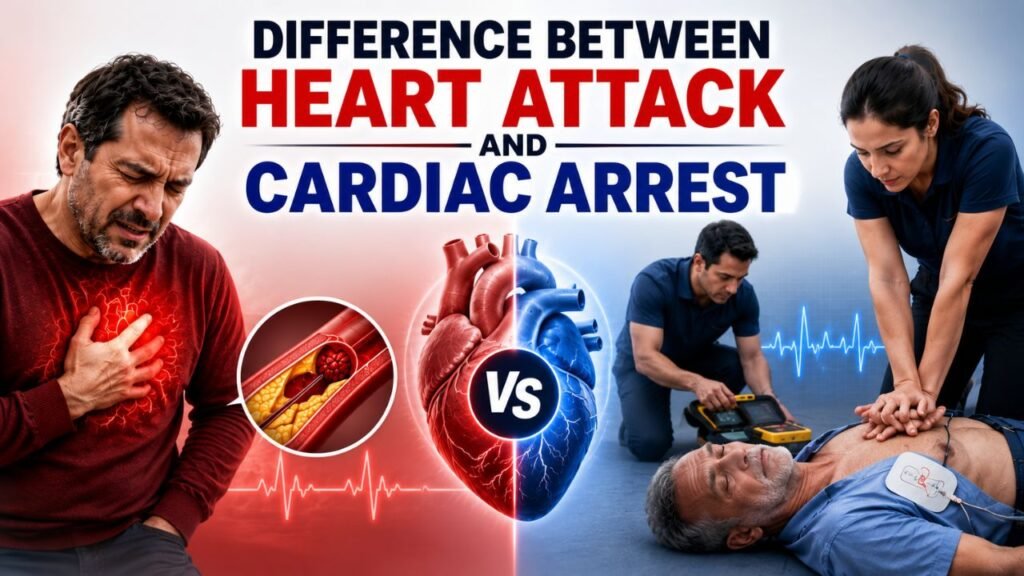
This comparison clearly explains the Difference Between Heart Attack and Cardiac Arrest and highlights why immediate treatment differs for each condition.
| Aspect | Heart Attack | Cardiac Arrest |
| Underlying problem | Blocked blood flow (circulation issue) | Electrical malfunction (heart stops beating) |
| Onset | Usually gradual, with warning signs | Sudden, often without warning |
| Heart activity | Heart is usually still beating | Heart stops pumping effectively |
| Consciousness | Person is usually conscious | Person loses consciousness immediately |
| Immediate response | Call emergency services, chew aspirin if advised, get to hospital | Start CPR immediately, use an AED, call emergency services |
| Survival factor | Time to reopen blocked artery | Time to first CPR/defibrillation (every minute matters) |
This table summarizes the Difference Between Heart Attack and Cardiac Arrest in a simple and easy-to-understand format.
Making sense of this chart is the quickest way to differentiate cardiac arrest from heart attack in the future, whether in a health article or in a life-threatening situation. This kind of quick differentiation is a useful skill for caregivers of individuals who have heart issues, as they need to know the correct emergency response in seconds.
Burning Sensation in Chest: Could it Be a Heart Attack, Cardiac Arrest, or Something Else?
One of the most frequently misunderstood symptoms of an emergency is burning in the chest. This symptom is difficult because it can be so many things. A burning sensation alone cannot confirm the Difference Between Heart Attack and Cardiac Arrest, making immediate medical evaluation extremely important. A burning sensation in the chest alone cannot determine the Difference Between Heart Attack and Cardiac Arrest without proper medical evaluation.
Here are a few possible causes of burning chest pain:
- A Heart Attack: especially if there is pain that radiates to an arm or to the jaw.
- GERD or acid reflux: symptoms typically of acid reflux can be burning chest pain after a meal or while laying down, and even a sour taste. This can be difficult to distinguish from cardiac pain without an evaluation, as these are very close in presentation.
- Anxiety or panic attacks: a burning sensation along with hands that are tingling may happen. There is usually a feeling of impending doom for the person experiencing a panic attack.
- Muscle strain: Pain in the chest from strained muscles can feel like a burning sensation, but generally gets worse with movement or is tender to the touch.
A burning sensation alone cannot determine the Difference Between Heart Attack and Cardiac Arrest, which is why immediate medical evaluation is essential. Let’s distill the key elements for the discussion differentiating cardiac arrest from a heart attack. Rather than a series of symptoms rapidly culminating in a loss of consciousness, cardiac arrest typically comes without warning, and thus does not commonly correlate with a burning pain. If a patient feels a burning pain in the chest while remaining fully conscious, and responsive, it is far less likely to be cardiac arrest and much more likely to be chest pain related to a heart attack. However, severe and inconsistent burning in the chest, even if it is only for a few and is a single symptom, should be immediately and thoroughly evaluated by a medical professional. While the case is being evaluated, it is best to not attempt any further diagnosis.
Myocardial Infarction vs Cardiac Arrest: Are They the Same?
No. However, it is worthwhile to differentiate the two terms since they are the most common terms interchanged by even some medical professionals. A myocardial infarction literally means heart muscle death from the lack of blood supply to the heart, while a cardiac arrest means a state in which the heart totally stops beating due to the failure of the electrical system of the heart and is a total loss of circulation. Learning the Difference Between Heart Attack and Cardiac Arrest also helps people understand why these two medical emergencies should never be used interchangeably.
It is useful to explore the relationship between the two. It is a clinical fact that a heart attack can cause cardiac arrest because the now dead heart muscle can cause a fatal disturbance of heart rhythm. Understanding the Difference Between Heart Attack and Cardiac Arrest also helps explain why myocardial infarction and cardiac arrest should never be considered the same condition. However, a person can also go into cardiac arrest without ever having a heart attack, such as in the case of congenital heart rhythm disorders. Thus in the discussion of the two terms, myocardial infarction vs cardiac arrest, a heart attack should be thought of as one of many potential causes of cardiac arrest, and should never be compared as two similar states. In short, the distinction between cardiac arrest and myocardial infarction is the difference between the total failure of the electrical system of the heart and a total failure of circulation, even though one can cause the other.
Difference Between Cardiac Attack and Heart Attack: Clearing Up a Common Mix-Up
The term “cardiac attack” is not used in the medical lexicon. People say it to describe the terms “heart attack” and “cardiac arrest.” There is a lot of confusion caused. When people ask for the difference between “cardiac attack” and “heart attack,” they are in fact asking about the difference between “heart attack” and “cardiac arrest.” If you hear “cardiac attack,” it is a good idea to ask for clarification. The medical emergency requires different responses depending on the case. The difference between “cardiac attack” and “heart attack” is just a term used to describe a medical emergency. There is no third medical condition. The Difference Between Heart Attack and Cardiac Arrest becomes even clearer when heart failure is included as a separate chronic condition.
Difference Between Heart Attack, Heart Failure, and Cardiac Arrest
A third term that is often used is heart failure. This term is different from both above. The difference that separates heart attack heart failure and cardiac arrest is mechanism and timeline:
- Heart Attack: The sudden event of a blocked heart that stops blood from flowing to the heart.
- Heart Failure: A chronic condition in the heart that causes the heart muscle to become insufficient to pump blood. This condition progresses slowly and is a result of previous “Heart Attacks” or “Cardiac Events.” The Difference Between Heart Attack and Cardiac Arrest becomes even more important when heart failure is included in the discussion.
- Cardiac Arrest: Sudden failure of the heart’s electrical system to pump blood to the body. This can occur as a “Heart Attack” or advanced “Heart Failure.”
This clearly outlines how a heart attack, heart failure, and cardiac arrest show an example of three different points along the spectrum of heart disease, easily demonstrating that they aren’t the same issue that are simply relabeled.
The Difference between Cardiac Arrest, Heart Attack, and Stroke
Stroke is also sometimes included in this grouping because, like the others, it is a type of cardiovascular emergency. However, a stroke affects the brain. It is important to differentiate heart attack and cardiac arrest and stroke as they have different emergency presenting symptoms.
- Heart attack: Symptoms may include chest pain, a burning sensation, pain in the arm (or jaw), shortness of breath.
- Cardiac arrest: Sudden collapse, no pulse and unresponsive.
- Stroke: sudden drooping of one side of the face, weakness in the other arm, and slurred speech. This is remembered in the acronym FAST (face, arms, speech, time). This is also caused by a sudden blockage of blood to the brain. Learning the Difference Between Heart Attack and Cardiac Arrest also helps distinguish these conditions from stroke during emergencies.
While it is important that all three trigger an emergency medical response, the nature of the emergency should provide enough information to the bystanders and first responders to act appropriately. The opposite of this grouping of stroke, cardiac arrest and heart attack can be used to accurately describe an emergency to a 911 operator to orient them and channel appropriate resources to the location.
Which Is More Dangerous: Heart Attack or Cardiac Arrest?
This is one of the most popular questions to ask, and the truth is that it is really dependent on the treatment speed. On a general basis, cardiac arrest will tend to be more quickly threatening to one’s life. When someone is trying to differentiate heart attack vs cardiac arrest, the reason for their query is due to the fact that cardiac arrest means that there’s a total stop of blood flow to the body and brain in a matter of seconds. Not performing CPR or using a defibrillator will cause the chances of survival to rapidly diminish. Heart attacks, while dangerous and possibly fatal, actually give more time to get to emergency help before the heart comes to a total stop. However, heart attacks can also become cardiac arrest. In the end, trying to figure out the answer for heart attack vs cardiac arrest actually matters much less than considering the fact that they are both real emergencies that require an instant call for help.
Recognizing the Warning Signs
Recognizing these warning signs is one of the easiest ways to understand the Difference Between Heart Attack and Cardiac Arrest.
Knowing the signs of cardiac arrest and a heart attack can save a life. Below are the signs for both.
Signs of a Heart Attack:
- Chest discomfort, pressure, tightness, or burning that lasts for several minutes.
- Discomfort in the shoulders, arms, back, neck, and/or jaw.
- Shortness of breath, with or without chest discomfort.
- Dizziness, nausea, and/or cold sweats.
- Unexplained fatigue.
Signs of Cardiac Arrest:
- Suddenly falling unconscious.
- No pulse.
- No normal breathing (may or may be limited to gasping).
- Unconscious and unresponsive to shouting or shaking.
Causes and Risk Factors
Heart attack risk factors are high blood pressure, high cholesterol, smoking, diabetes, obesity, a sedentary lifestyle, family history of heart disease, and stress.
Risk factors for cardiac arrest include having a heart attack or heart disease in the past, having arrhythmias, having congenital heart diseases, having severe imbalances of electrolytes, and having physical trauma to the chest during a critical moment in the heart’s electrical cycle.
Pairing these risk factors is another way to illustrate the heart attack vs cardiac arrest relationship. Many factors of unmanaged heart attack risk factors cause cardiac arrest. Because of this, doctors treat both heart attack and cardiac arrest risk factors as part of the same equation. Many of these risk factors highlight the Difference Between Heart Attack and Cardiac Arrest and how one condition can sometimes lead to the other.
What to Do in an Emergency
And this is precisely why the heart attack vs cardiac arrest difference matters at the moment and not only in theory because your emergency response should vary depending on which condition you are facing. Understanding the Difference Between Heart Attack and Cardiac Arrest allows you to provide the correct first aid while waiting for emergency services. The Difference Between Heart Attack and Cardiac Arrest determines whether CPR, an AED, or urgent hospital treatment should be the immediate priority.
What to do for heart attack:
- Contact emergency medical services right away, do not drive yourself.
- Sit down, keep calm, and rest the person.
- Emergency responders may recommend chewing an aspirin over the phone if prescribed and not allergic.
- Loosen any constrictive clothing and watch their breathing until help arrives.
What to do for cardiac arrest:
- Again, call emergency medical services.
- Perform CPR. Cardiac arrest victims need CPR more than anything else. Push hard and fast in the center of the chest at a rate of 100 – 120 compressions per minute.
- If available, an instant defibrillator can be a lifesaver and is better than CPR alone. Follow its voice instructions.
- Professional help will arrive, but never stop CPR until the person shows a sign of life.
Survival rates for a victim of cardiac arrest without fast responding CPR and Defibrillation disintegrate. Fast responding services are the backbone of all emergency services, including EER24.
Prevention Tips
Learning the Difference Between Heart Attack and Cardiac Arrest is only one part of protecting your heart; prevention is equally important.
While adopting any or all of these habits can help foster better heart health, combine them for best results:
1. Manage BP, cholesterol, sugar get regular primary care check-ups
2. Stop smoking and drinking
3. Work out consistently
4. Eat whole food, plant-based
5. Manage stress though sleep and relaxation
6. Know your family history tell your doctor too
7. Learn CPR to prepare for a cardiac emergency
Many of these tips also share factors due to the relationship of a cardiac arrest and heart attack. Knowing this information can help prioritize heart health the most. Understanding the Difference Between Heart Attack and Cardiac Arrest should be combined with healthy lifestyle habits to reduce cardiovascular risk.
Know When to Seek Emergency Medical Attention
Never wait to see if the symptoms of heart attack will pass, the sting in your chest or burning in the chest will not go away, or if someone has collapsed. These are signs of cardiac arrest. Time is of the essence in heart attack and cardiac arrest. If you or someone is experiencing chest burning or chest pain and has collapsed or is unresponsive you should call for emergency help. EER24 will dispatch emergency trained medics to the patient in the quickest time possible. In heart emergencies, time is of the essence. The Difference Between Heart Attack and Cardiac Arrest determines whether CPR, an AED, or rapid hospital treatment becomes the immediate priority.
Whether you want to know the difference between heart attack and cardiac arrest for your own education or if you want to prepare for a loved one with heart disease, knowing the times you should call for help is the most vital knowledge you can ever have. By remembering the Difference Between Heart Attack and Cardiac Arrest, you can recognize symptoms earlier and respond with confidence during a medical emergency.
Conclusion
The difference between heart attack and cardiac arrest can help you understand how to identify a life-threatening situation and potential to save a life in the future, even if it is your own. One heart issue is about blood flow being blocked, while the other is about the heart ceasing to function. Both situations are life-threatening and require a swift and educated response. By understanding the Difference Between Heart Attack and Cardiac Arrest, families can make faster and more informed decisions during emergencies. If you or someone with you is experiencing a burning or tingling sensation in the chest, you are in a life-threatening situation and emergency medical help is needed. EER24 is on call 24/7 to respond to cardiac emergencies and help the heart of the matter. Understanding the Difference Between Heart Attack and Cardiac Arrest can help you recognize life-threatening symptoms quickly and potentially save a life.
Frequently Asked Questions
Q1: Can a heart attack cause cardiac arrest?
Yes. A heart attack can damage the heart and trigger a dangerous rhythm that may lead to cardiac arrest.
Q2: Does cardiac arrest always cause chest pain?
No. Cardiac arrest usually causes sudden unconsciousness, unresponsiveness, and abnormal or absent breathing rather than chest pain.
Q3: Can you be awake during a heart attack?
Yes. A person having a heart attack is often conscious and may experience chest pressure, pain, sweating, nausea, or shortness of breath.
Q4: What is the main sign of cardiac arrest?
Sudden collapse with no normal breathing and unresponsiveness is a major sign of cardiac arrest.
Q5: Can heartburn feel like a heart attack?
Yes. Acid reflux can cause burning chest discomfort that may resemble heart-related pain, so unexplained or severe symptoms should be medically evaluated.
Q6: What should you do if someone has cardiac arrest?
Call emergency services, begin CPR immediately, and use an AED if one is available. Follow the AED’s instructions.
Q7: Can a heart attack happen without severe chest pain?
Yes. Some people may have mild or unusual symptoms such as shortness of breath, nausea, sweating, fatigue, or discomfort in the back, neck, jaw, or arms.
Q8: How quickly should cardiac arrest be treated?
Immediately. CPR and early defibrillation can be critical because the chances of survival decrease rapidly without treatment.