 By
By Lifestyle describes the way a person lives, including daily habits, food preferences, work patterns, physical activity, relationships, hobbies, spending habits, social interactions, and personal priorities. There are many Different Kinds of Lifestyle, and no single approach works equally well for everyone. People develop different routines based on their goals, culture, family environment, occupation, financial circumstances, location, interests, and personal values.
Understanding Different Kinds of Lifestyle can help you recognize your current habits and make informed decisions about your routine. Lifestyle is not only about fashion, appearance, or social status. It can influence physical health, emotional well-being, productivity, relationships, and overall quality of life.
What Does Lifestyle Mean?
Lifestyle refers to the overall pattern of how someone spends time and organizes everyday life. It includes eating habits, work routines, leisure activities, social interactions, living arrangements, spending patterns, and personal priorities.
The Different Kinds of Lifestyle should not be treated as rigid categories. A person can combine characteristics from several lifestyle types. For example, someone may have a health-conscious lifestyle while working remotely, traveling frequently, following a vegetarian diet, and maintaining a minimalist home.
Lifestyle can also change over time. A student may have a flexible and social routine, while a working professional may develop a structured lifestyle based on career responsibilities. Family responsibilities, relocation, retirement, financial changes, and new interests can further change daily routines.
Read more about: 10 Simple Healthy Lifestyle Habits | Healthy Lifestyle | Benefits of Walking Daily |
Why Are There Different Kinds of Lifestyle?
There are Different Kinds of Lifestyle because people have different circumstances, responsibilities, opportunities, and priorities. Individual choices matter, but lifestyle can also be influenced by social and economic conditions.
Important factors include:
- Age and stage of life
- Family responsibilities
- Occupation and working hours
- Income and financial priorities
- Culture and traditions
- Geographic location
- Education and social environment
- Health and fitness goals
- Food preferences
- Personal values
- Hobbies and interests
- Social relationships
- Technology use
- Environmental concerns
For this reason, Different Kinds of Lifestyle categories should be flexible. They are useful for identifying common patterns, but they cannot describe every individual perfectly.
Major Different Kinds of Lifestyle
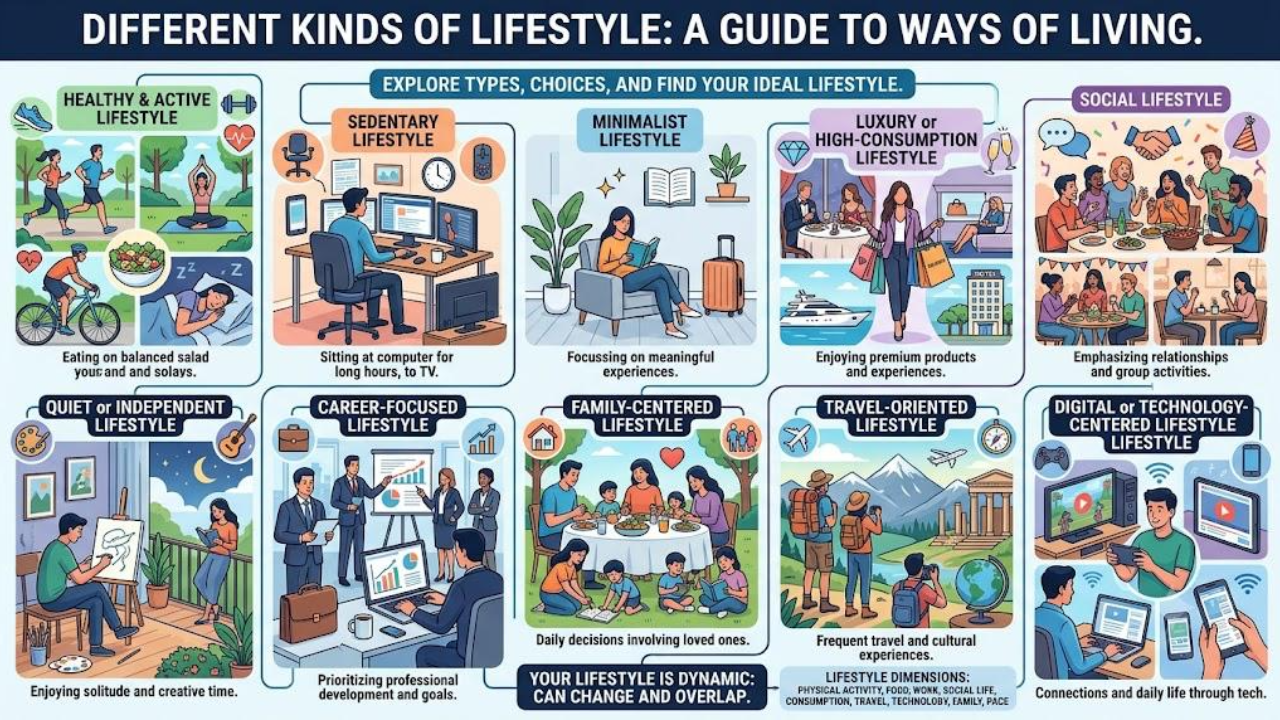
There are many Different Kinds of Lifestyle based on health, work, relationships, consumption, technology, travel, and personal interests. The following categories provide a practical overview.
1. Healthy and Active Lifestyle
An active lifestyle generally emphasizes regular physical movement, nutritious food, adequate sleep, stress management, and preventive health practices.
People following this lifestyle may include walking, running, cycling, swimming, strength training, yoga, sports, or other physical activities in their routine. They may also focus on hydration, balanced meals, sleep quality, and recovery.
A healthy lifestyle does not require perfection. Sustainable habits are often more practical than extreme routines. Individual health requirements differ, so people should adapt their routines according to their circumstances.
2. Sedentary Lifestyle
A sedentary lifestyle involves spending a large portion of the day sitting or engaging in limited physical activity. It can occur among office workers, students, remote employees, drivers, gamers, and people whose responsibilities involve prolonged sitting.
Common characteristics include:
- Long hours at a desk
- Limited walking
- Extended screen time
- Little planned exercise
- Sitting during commuting
- Passive leisure activities
A person with a desk job does not necessarily have to remain inactive throughout the day. Walking breaks, stretching, exercise, and recreational activities can introduce more movement into a sedentary routine.
3. Minimalist Lifestyle
Minimalism focuses on simplicity, intentional consumption, and reducing unnecessary possessions or commitments.
A minimalist lifestyle may involve:
- Fewer possessions
- Functional purchases
- Organized living spaces
- Lower consumption
- Intentional spending
- Focusing on meaningful experiences
Minimalism does not require owning a particular number of possessions. Instead, it generally involves making conscious decisions about what provides value.
4. Luxury or High-Consumption Lifestyle
A luxury-oriented lifestyle emphasizes premium products, high-end experiences, travel, fashion, fine dining, sophisticated homes, or exclusive services.
People who follow this lifestyle may prioritize comfort, convenience, quality, exclusivity, or experiences. However, enjoying luxury products in one area does not necessarily mean someone follows a high-consumption lifestyle in every aspect of life.
Lifestyle preferences are also important in consumer research because businesses often study how people’s interests, motivations, and purchasing priorities influence buying behavior.
5. Social Lifestyle
A social lifestyle places considerable importance on relationships, community activities, entertainment, gatherings, and shared experiences.
A highly social routine may include:
- Family gatherings
- Community events
- Clubs
- Parties
- Sports groups
- Cultural activities
- Networking events
- Group hobbies
Social interaction can be an important part of well-being, although the amount of social activity people prefer varies considerably.
6. Quiet or Independent Lifestyle
A quiet lifestyle generally emphasizes privacy, smaller social circles, personal hobbies, reading, creative activities, nature, or independent time.
Enjoying solitude should not automatically be confused with loneliness. A person can enjoy spending time alone while maintaining meaningful relationships with family, friends, and colleagues.
Different Kinds of Lifestyle should also not be confused with personality. A person’s routine may change depending on circumstances even when their personality remains relatively stable.
7. Career-Focused Lifestyle
A career-focused lifestyle prioritizes professional development, achievement, learning, networking, business development, and work-related goals.
Common characteristics include:
- Long-term career planning
- Professional education
- Networking
- Skill development
- Goal setting
- Leadership responsibilities
- Entrepreneurship
Career development can be an important priority, but personal relationships, recreation, sleep, and other areas of life may also require attention.
8. Family-Centered Lifestyle
A family-centered lifestyle prioritizes relationships with partners, children, parents, relatives, or extended family.
Daily decisions may involve:
- Family meals
- Childcare
- Household responsibilities
- Family activities
- Education
- Shared traditions
- Financial planning
A family-centered person can also have other lifestyle characteristics. For example, someone may be family-oriented, health-conscious, career-focused, and financially careful at the same time.
9. Travel-Oriented Lifestyle
A travel-oriented lifestyle places significant emphasis on exploring new places, experiencing different cultures, outdoor adventures, or frequent vacations.
Travel can influence:
- Food choices
- Work arrangements
- Spending habits
- Hobbies
- Social relationships
- Cultural interests
Some people travel occasionally, while location-independent professionals may organize significant parts of their lives around frequent movement.
10. Digital or Technology-Centered Lifestyle
Technology has created new lifestyle patterns involving smartphones, social media, streaming, gaming, remote work, online learning, digital businesses, and virtual communities.
A technology-centered Different Kinds of Lifestyle can provide convenience and flexibility. However, excessive screen use may interfere with sleep, movement, concentration, or offline social interaction. Creating reasonable boundaries around devices can help maintain balance.
Different Diet and Eating Lifestyles
Food is one of the most visible components of lifestyle. Different people choose eating patterns for cultural, ethical, environmental, financial, personal, or health-related reasons.
Common dietary patterns include:
- Vegetarian
- Vegan
- Flexitarian
- Mediterranean-style eating
- Plant-focused eating
- Low-carbohydrate approaches
- High-protein diets
- Traditional regional diets
- Omnivorous diets
Different eating lifestyles describe broader approaches to food rather than one universal diet. A suitable eating pattern should consider nutritional adequacy, individual needs, preferences, food availability, and sustainability.
People with medical conditions or specific nutritional requirements should seek advice from a qualified healthcare professional or registered dietitian.
Different Forms of Lifestyle Based on Daily Routine
Another way to understand Different Kinds of Lifestyle is by examining how people organize their time.
Structured Lifestyle
A structured lifestyle involves planned schedules, calendars, meal planning, exercise routines, and clearly defined responsibilities.
Flexible Lifestyle
A flexible Different Kinds of Lifestyle allows people to change their schedules according to circumstances. Freelancers, entrepreneurs, remote workers, and people with flexible occupations may have greater control over when and where they work.
Fast-Paced Lifestyle
A fast-paced lifestyle can involve frequent commitments, deadlines, travel, social activities, and professional responsibilities.
Slow-Paced Lifestyle
A slow-paced lifestyle generally emphasizes deliberate routines, relaxation, nature, personal relationships, and fewer commitments.
These forms can change throughout life. The same person may have a structured career routine during one period and a more flexible routine after changing jobs.
What Are Lifestyle Choices?
Lifestyle choices are decisions and behaviors that contribute to the way a person lives. They can include:
- Choosing what to eat
- Deciding whether to exercise
- Selecting work arrangements
- Managing sleep schedules
- Choosing leisure activities
- Deciding how to spend money
- Choosing transportation
- Managing screen time
- Developing social routines
However, not every lifestyle factor is completely voluntary. Income, healthcare access, work requirements, family responsibilities, neighborhood conditions, and social circumstances can affect the choices available to a person.
Lifestyle Choices Examples
Some practical lifestyle choices examples include:
- Choosing a vegetarian diet
- Joining a fitness program
- Working remotely
- Practicing meditation
- Traveling regularly
- Living with fewer possessions
- Building a consistent sleep routine
- Participating in community activities
- Learning new skills
- Creating a household budget
These individual choices can combine to create a person’s broader lifestyle.
How to Identify Your Lifestyle
If you want to understand your current lifestyle, begin by observing what you actually do rather than focusing only on what you would like to do.
Ask yourself:
- How do I spend most of my time?
- How physically active am I?
- What foods do I usually eat?
- How much time do I spend working?
- How do I relax?
- How often do I socialize?
- What do I spend money on?
- What activities give me energy?
- What habits create stress?
- What values guide my decisions?
The answers can reveal patterns and help you understand which lifestyle categories describe your current routine.
Your lifestyle does not have to remain permanent. You can change individual habits without completely changing your identity or personality.
How to Choose a Healthier Lifestyle
There is no universal lifestyle that is automatically appropriate for everyone. A healthier routine is generally one that supports an individual’s physical, emotional, social, and practical needs.
Improve Daily Movement
Add walking, stretching, exercise, sports, or other appropriate physical activities to your routine.
Improve Nutrition
Focus on a varied and balanced eating pattern that provides essential nutrients while fitting your preferences and circumstances.
Protect Sleep
Create a consistent sleep routine and reduce activities that regularly interfere with adequate rest.
Manage Stress
Consider relaxation techniques, hobbies, time management, social support, or professional support when appropriate.
Build Social Connections
Meaningful relationships and community involvement can form an important part of a balanced lifestyle.
Review Digital Habits
Set reasonable boundaries around social media, entertainment, gaming, and unnecessary screen time.
Small and sustainable changes are generally easier to maintain than sudden, extreme changes.
Classification of Lifestyle: A Practical Framework
A useful classification of lifestyle can examine several dimensions instead of placing a person into only one category.
| Lifestyle Dimension | Examples |
| Physical activity | Active, moderate, sedentary |
| Food | Vegetarian, vegan, omnivorous, plant-focused |
| Work | Career-focused, flexible, remote |
| Social life | Social, community-oriented, private |
| Consumption | Minimalist, moderate, luxury-oriented |
| Travel | Local, occasional traveler, frequent traveler |
| Technology | Low-tech, balanced, technology-centered |
| Family | Independent, family-centered, community-based |
| Pace | Slow-paced, balanced, fast-paced |
This framework demonstrates that Different Kinds of Lifestyle can overlap. One person might be a remote worker, vegetarian, frequent traveler, minimalist, and fitness enthusiast. Another might be a family-centered professional who enjoys traditional food, local travel, and community activities.
Can Your Lifestyle Change?
Yes. Lifestyle is dynamic rather than permanently fixed. Major life events can change routines, including:
- Starting a new job
- Moving to another city
- Getting married
- Becoming a parent
- Entering retirement
- Changing financial circumstances
- Developing new interests
Even small changes can gradually reshape daily life.
For example:
Current pattern: Long work hours → irregular meals → little movement → late-night screen use
Possible gradual change: Scheduled meals → movement breaks → planned exercise → consistent bedtime
The goal is not to copy another person’s routine. Instead, identify which parts of your current lifestyle support your goals and which areas may benefit from adjustment.
How Businesses Use Lifestyle Understanding
Lifestyle analysis is also important for businesses, wellness providers, travel companies, food brands, fitness services, fashion companies, and technology platforms.
Understanding customer lifestyles can help businesses develop relevant products, services, content, and experiences.
For example:
- Fitness brands can serve beginners, athletes, and recreational users.
- Food companies can develop products for different dietary preferences.
- Travel businesses can serve families, adventure travelers, luxury travelers, and budget travelers.
- Technology companies can create products for professionals, students, creators, and gamers.
- Wellness services can address different routines and personal goals.
Lifestyle-related variables can therefore be useful in consumer research and marketing.
How to Create a Lifestyle That Fits You
Instead of searching for one perfect lifestyle, consider creating a routine that matches your circumstances and priorities.
If health is important, focus on movement, nutrition, sleep, and preventive care.
If family is important, create meaningful time for relationships.
If career development is important, make space for learning and professional growth.
If simplicity matters, review unnecessary purchases and commitments.
If travel is important, organize finances and work arrangements around realistic travel goals.
A practical lifestyle plan should be realistic enough to maintain consistently.
Read moe about: Half Black Screen | Dell Display Problem | Green Dots on Laptop Screen | Why Is My Computer Screen Red Tinted?
Final Thoughts on Different Kinds of Lifestyle
The Different Kinds of Lifestyle reflect the variety of ways people organize their lives. Active, minimalist, social, family-centered, career-focused, travel-oriented, and technology-centered lifestyles can all overlap.
There is no requirement to fit into one category. Your lifestyle can be a combination of habits, values, responsibilities, interests, and circumstances.
Understanding Different Kinds of Lifestyle can help you examine your daily routine more objectively. By identifying your priorities, reviewing your habits, and making realistic changes, you can create a routine that better supports your goals and overall well-being.
The most useful question is not which lifestyle looks impressive from the outside. Instead, consider which habits, relationships, routines, and priorities fit your needs and circumstances.
Frequently Asked Questions
1. What are the main types of lifestyles?
The main types can include active, sedentary, minimalist, luxury-oriented, social, quiet, career-focused, family-centered, travel-oriented, technology-centered, and various dietary lifestyles. Most people combine multiple categories.
2. What is the classification of lifestyle?
The classification of lifestyle is a framework for grouping common patterns according to factors such as physical activity, diet, work, social behavior, consumption, family life, technology use, and personal priorities.
3. What are the main categories of lifestyle?
Common categories include health-focused, active, sedentary, minimalist, social, family-centered, career-oriented, travel-focused, technology-centered, and different food-related lifestyles.
4. What are lifestyle types based on daily routine?
Common lifestyle types based on routine include structured, flexible, fast-paced, slow-paced, active, sedentary, social, and independent patterns.
5. How can I identify the type of my life?
Examine your regular habits, including work, diet, physical activity, social life, spending, hobbies, sleep, technology use, and personal priorities. The combination provides a broader picture of your lifestyle.
6. What are lifestyle choices?
Lifestyle choices are decisions and behaviors that influence how you live. Examples include food preferences, physical activity, sleep routines, work patterns, recreation, spending, transportation, social activities, and technology use.
7. What are some lifestyle choices examples?
Lifestyle choices examples include exercising regularly, choosing a particular eating pattern, reducing unnecessary spending, working remotely, maintaining a consistent sleep schedule, traveling frequently, practicing hobbies, and spending time with family or community.
8. What are the different diet lifestyles?
Different diet lifestyles can include vegetarian, vegan, flexitarian, plant-focused, Mediterranean-style, low-carbohydrate, high-protein, and traditional dietary patterns.
9. What are different eating lifestyles?
Different eating lifestyles generally refer to broader approaches to food, such as plant-based, vegetarian, vegan, omnivorous, culturally traditional, or flexible eating patterns.
10. What are different forms of lifestyles?
Different forms of lifestyles can be understood through dimensions such as active versus sedentary, minimalist versus consumption-oriented, social versus private, career-focused versus leisure-focused, and fast-paced versus slow-paced.
11. Why are there different kinds of lifestyles?
There are Different Kinds of Lifestyle because people have different cultures, resources, responsibilities, environments, interests, values, occupations, and goals.
12. Can someone have different lifestyle choices at the same time?
Yes. A person can be health-conscious, vegetarian, career-focused, minimalist, family-oriented, and interested in travel at the same time. Lifestyle categories can overlap.
13. How can I improve my lifestyle?
You can improve your lifestyle by making realistic changes involving physical activity, nutrition, sleep, stress management, relationships, work-life balance, and digital habits.
14. Are Different Kinds of Lifestyle permanent?
No. Different Kinds of Lifestyle can change as circumstances and priorities change. Career changes, relationships, family responsibilities, relocation, financial circumstances, health needs, and new interests can all influence daily routines.