
 By
By Artificial intelligence has evolved rapidly over the past few years. While AI chatbots like ChatGPT, Claude, and Google Gemini are excellent at answering questions and generating content, a new category of AI is beginning to reshape how people work. Instead of simply responding to prompts, these systems can complete entire tasks on behalf of users with minimal supervision.
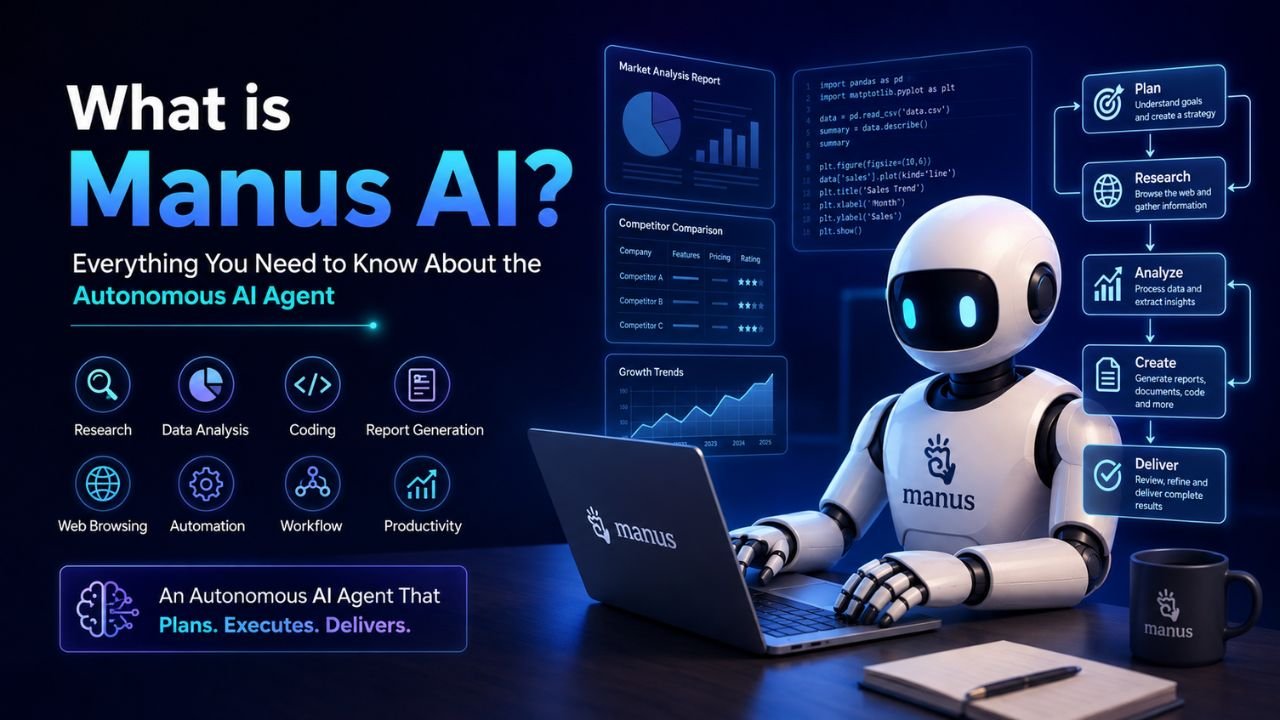
One of the most talked-about innovations in this space is Manus AI. Unlike traditional conversational AI, Manus AI is designed as an autonomous AI agent that can research topics, analyze data, browse the web, write reports, generate code, and execute complex workflows from a single instruction. This capability positions it as a major step toward AI that acts more like a digital employee than a chatbot.
Whether you’re a student, developer, business owner, marketer, researcher, or content creator, understanding it can help you see where autonomous AI is heading and how it may transform productivity across industries.
Read more about: 7 Day Diet to Lower Triglycerides | Low Blood Pressure Symptoms In Women | 7 Day Diet Plan for Weight Loss (Indian)
What is Manus AI?
Manus AI is an advanced autonomous AI agent that can independently plan, execute, and complete complex digital tasks using multiple AI models and specialized tools. Rather than waiting for continuous user instructions, it breaks a goal into smaller tasks, decides the best execution strategy, uses appropriate tools, monitors progress, and delivers complete results.
For example, instead of asking:
“Write me a summary.”
You could instruct Manus AI:
“Research the electric vehicle market in Europe, compare the top manufacturers, analyze growth trends, create graphs, and prepare a presentation.”
Instead of only generating text, it can perform multiple steps automatically, including:
- Searching reliable online sources
- Collecting and organizing data
- Analyzing information
- Creating reports
- Writing code
- Generating spreadsheets
- Producing presentations
- Revising outputs based on findings
This autonomous workflow makes it different from conventional AI assistants that primarily generate responses without independently completing multi-step tasks.
The Evolution of AI Agents
To understand Manus AI, it’s helpful to see how AI has evolved over time.
Traditional AI
Early AI systems performed only one predefined function, such as translation, image recognition, or spam detection. These systems were highly specialized and lacked flexibility.
AI Chatbots
Large language models such as ChatGPT, Claude, and Gemini introduced conversational intelligence. They could answer questions, write articles, solve coding problems, and assist with creative work. However, they generally relied on users to guide each step of a process.
Autonomous AI Agents
Autonomous AI agents represent the next stage of development. They don’t just answer they can:
- Understand goals
- Create action plans
- Use external tools
- Adapt when conditions change
- Complete end-to-end workflows
It belongs to this emerging category, focusing on reducing manual effort by handling entire projects rather than isolated prompts.
The Story Behind Manus AI
Manus AI was introduced as an autonomous AI agent with the vision of helping users accomplish meaningful work instead of merely generating text. The platform gained significant attention after demonstrations showed it completing sophisticated tasks with very little human intervention.
Its name is derived from the Latin word “Manus,” meaning “hand.” The concept reflects the idea of giving users a digital helping hand capable of performing real work rather than simply providing information.
Unlike many AI products that rely on a single language model, it uses a coordinated system where multiple models and tools work together to solve problems efficiently. This orchestration enables it to manage tasks that involve reasoning, web browsing, coding, document creation, and data processing within one workflow.
As businesses increasingly seek AI solutions that automate repetitive work, it has become one of the prominent examples of the shift from conversational AI to task-oriented autonomous agents.
How Does Manus AI Work?
At its core, Manus AI follows a structured workflow that allows it to execute complex assignments efficiently.

1. Understanding the Goal
The process begins when a user provides a high-level objective.
For example:
- Analyze competitor websites
- Build a marketing strategy
- Generate a financial report
- Research a scientific topic
- Create a travel itinerary
Instead of asking numerous follow-up questions, it first interprets the user’s intent and identifies the desired outcome.
2. Breaking the Task into Smaller Steps
After understanding the request, Manus AI automatically creates a task plan.
For example, if asked to prepare a market research report, it may divide the project into stages such as:
- Research competitors
- Gather statistics
- Analyze trends
- Organize findings
- Create charts
- Write conclusions
- Generate a presentation
This planning stage enables it to manage complex workflows systematically.
3. Selecting the Right Tools
One of Manus AI’s defining strengths is its ability to choose and use different tools depending on the task.
These tools may include:
- Web browsers for research
- Code execution environments
- Spreadsheet processors
- Document generators
- Data analysis utilities
- File management systems
- Search engines
- Visualization tools
Rather than relying on a single capability, it combines multiple resources to achieve better results.
4. Executing Tasks Autonomously
Once the plan is established, Manus AI begins executing each step.
During execution, it can:
- Visit websites
- Read documents
- Extract information
- Run scripts
- Analyze datasets
- Generate visualizations
- Create files
- Continue working until the objective is completed
This autonomous execution reduces the amount of manual supervision required from users.
5. Reviewing and Refining Results
Instead of stopping after generating an initial output, it evaluates its own progress throughout the workflow.
If inconsistencies, missing information, or errors are detected, it can revisit earlier steps, gather additional data, or revise its outputs before presenting the final result. This iterative approach helps improve accuracy and completeness, especially for tasks involving research, coding, or analysis.
Core Components of Manus AI
Several technologies work together behind the scenes to make it an autonomous agent rather than a standard chatbot.
| Component | Purpose |
| Large Language Models | Understand instructions and generate natural language responses. |
| Planning Engine | Breaks complex goals into manageable tasks. |
| Tool Integration Layer | Connects with browsers, coding environments, and productivity tools. |
| Memory System | Retains context across multiple steps during a workflow. |
| Reasoning Module | Makes decisions, prioritizes actions, and adapts when new information is found. |
| Execution Engine | Performs tasks such as browsing, coding, analyzing, and document creation. |
Together, these components allow Manus AI to operate more like a project assistant capable of coordinating multiple activities rather than simply responding to isolated prompts.
Why Is Manus AI Different?
Most AI chatbots excel at producing text in response to prompts, but they often rely on the user to guide every step of a larger task. It shifts that responsibility by planning and executing workflows on its own. Instead of repeatedly asking, “What should I do next?”, it works toward the final objective with minimal intervention.
This makes Manus AI especially useful for tasks such as research, report generation, competitive analysis, coding projects, and workflow automation areas where completing the entire process is more valuable than generating a single response.
Key Features of Manus AI
The growing popularity of Manus AI is largely due to its ability to function as an autonomous AI agent rather than a traditional chatbot. It combines reasoning, planning, tool usage, and execution into a single workflow, enabling users to complete complex projects with minimal supervision.
Below are some of the most important features that set Manus AI apart.
1. Autonomous Task Execution
One of the biggest strengths of Manus AI is its ability to execute tasks independently. Instead of requiring users to provide instructions for every step, it can understand the overall objective, develop a strategy, and complete the work from start to finish.
For example, if you ask Manus AI to:
“Research the best CRM software for small businesses and prepare a comparison report.”
It can:
- Search multiple sources
- Compare features
- Analyze pricing
- Create comparison tables
- Summarize findings
- Generate a professional report
without needing additional prompts.
2. Multi-Step Planning
Complex tasks usually involve several stages. It automatically breaks a large objective into manageable subtasks and executes them in a logical order.
A typical workflow may include:
- Understanding the request
- Researching information
- Collecting data
- Cleaning and organizing results
- Performing analysis
- Creating charts
- Writing conclusions
- Exporting the final document
This structured planning makes it suitable for business and research projects.
3. Intelligent Web Browsing
Unlike many AI models that rely only on existing knowledge, Manus AI can browse the web to gather relevant information for supported tasks.
It can:
- Search current information
- Visit websites
- Compare multiple sources
- Extract useful content
- Summarize findings
- Organize references
This capability is particularly useful for market research, competitor analysis, trend monitoring, and data collection.
4. Coding Assistance
Developers can use Manus AI for a wide range of programming tasks.
It can assist with:
- Writing code
- Debugging programs
- Explaining algorithms
- Refactoring existing code
- Building scripts
- Automating repetitive development tasks
- Creating documentation
Instead of simply generating code snippets, Manus AI can work through larger development workflows.
5. Document Generation
Creating business documents is another area where Manus AI excels.
It can generate:
- Reports
- Research papers
- Business proposals
- Presentations
- Meeting summaries
- Technical documentation
- Marketing content
- Project plans
The AI organizes information into structured formats that require minimal editing.
6. Data Analysis
Organizations often spend hours processing spreadsheets and datasets. Manus AI helps automate much of this work.
Its capabilities include:
- Reading datasets
- Identifying patterns
- Performing calculations
- Creating visual charts
- Summarizing insights
- Highlighting anomalies
- Preparing executive summaries
This makes it useful for analysts, finance teams, researchers, and business managers.
7. Workflow Automation
Many business processes involve repetitive tasks that consume valuable time.
Manus AI can automate activities such as:
- Research
- Data collection
- Report creation
- Information organization
- Documentation
- Code execution
- File management
Automation allows professionals to focus on higher-value decision-making.
8. Context Retention
Unlike many AI assistants that lose track during lengthy conversations, Manus AI maintains context throughout an entire project.
This enables it to:
- Remember previous steps
- Avoid repeating work
- Continue long-running tasks
- Connect related information
- Produce more consistent outputs
Context awareness is especially valuable when working on multi-day or large-scale projects.
Manus AI Architecture
Although the internal implementation details are proprietary, the platform can be understood through its major functional components.
User Input Layer
Every workflow begins with a user-defined objective.
Examples include:
- Build a competitor analysis
- Generate a business plan
- Analyze stock market data
- Create a website
- Research climate change
The system interprets the request and determines the desired outcome.
Planning Engine
The planning engine converts a broad goal into smaller executable tasks.
Instead of immediately producing an answer, Manus AI first asks internally:
- What needs to be done?
- Which tools are required?
- What sequence is most efficient?
This planning stage resembles how a human project manager organizes work before execution.
Reasoning Module
The reasoning system evaluates available information and determines the best path forward.
It helps Manus AI:
- Prioritize actions
- Make decisions
- Handle unexpected situations
- Revise plans when necessary
- Improve overall task quality
Tool Integration Layer
One of Manus AI’s defining capabilities is its ability to use external tools.
Depending on the assignment, it may interact with:
- Search engines
- Web browsers
- Code interpreters
- Document editors
- Spreadsheet software
- Data visualization tools
- File systems
Instead of limiting itself to text generation, Manus AI performs real digital work.
Execution Engine
The execution engine carries out the planned tasks.
Examples include:
- Visiting websites
- Collecting information
- Running code
- Editing documents
- Organizing files
- Creating reports
- Producing presentations
Each completed step feeds into the next until the overall objective is achieved.
Memory System
The memory module stores important information throughout the workflow.
It remembers:
- User objectives
- Previous actions
- Intermediate findings
- Tool outputs
- Pending tasks
This enables Manus AI to manage long and complex workflows more effectively.
Real-World Use Cases of Manus AI
Manus AI is designed for practical applications across multiple industries.
1. Business Research
Companies can use Manus AI to:
- Analyze competitors
- Study industry trends
- Generate SWOT analyses
- Research customer behavior
- Monitor market developments
2. Content Marketing
Marketing teams can automate tasks such as:
- Keyword research
- SEO content planning
- Blog writing
- Content calendars
- Competitor analysis
- Campaign reports
3. Software Development
Developers benefit from Manus AI by using it for:
- Code generation
- Bug fixing
- API integration
- Documentation
- Testing support
- Script automation
4. Academic Research
Students and researchers can use Manus AI to:
- Collect references
- Summarize papers
- Compare studies
- Organize literature reviews
- Prepare presentations
5. Financial Analysis
Finance professionals may use Manus AI to:
- Analyze company reports
- Create investment summaries
- Compare financial statements
- Build dashboards
- Generate forecasts
6. Human Resources
HR departments can streamline tasks like:
- Resume screening
- Job description creation
- Interview planning
- Employee documentation
- Recruitment reports
7. Project Management
Project managers can use Manus AI to:
- Create timelines
- Organize tasks
- Prepare meeting notes
- Track milestones
- Generate progress reports
Manus AI vs ChatGPT vs Claude vs Gemini
Choosing the right AI platform depends on your goals. While all four platforms are powerful, they focus on different strengths.
| Feature | Manus AI | ChatGPT | Claude | Gemini |
| Conversational AI | Excellent | Excellent | Excellent | Excellent |
| Autonomous Task Execution | ✅ Advanced | Limited | Limited | Moderate |
| Multi-Step Planning | ✅ Yes | Partial | Partial | Partial |
| Tool Usage | Extensive | Available in supported modes | Moderate | Strong Google ecosystem |
| Coding Support | Excellent | Excellent | Very Good | Excellent |
| Research Automation | Excellent | Good | Good | Very Good |
| Report Generation | Excellent | Excellent | Excellent | Very Good |
| Workflow Automation | Excellent | Limited | Limited | Moderate |
| Business Productivity | Excellent | Very Good | Very Good | Very Good |
When Should You Choose Manus AI?
Manus AI is a strong choice if you need:
- End-to-end workflow automation
- Autonomous research
- Business intelligence reports
- Data analysis
- Multi-step task execution
- Project automation
When Is ChatGPT Better?
ChatGPT is often the better option for:
- Daily conversations
- Learning new topics
- Brainstorming ideas
- Writing assistance
- Coding help
- Creative content generation
When Is Claude Better?
Claude is well suited for:
- Long-form writing
- Document analysis
- Summarization
- Detailed reasoning
- Working with lengthy context windows
When Is Gemini Better?
Gemini integrates well with Google’s ecosystem, making it useful for:
- Google Workspace users
- Gmail and Docs workflows
- Google Search integration
- Multimodal tasks involving text, images, and other media
Industries Using Manus AI
Autonomous AI agents like Manus AI are finding applications across a wide range of industries, including:
- Information Technology
- Healthcare
- Banking and Finance
- Education
- Marketing and Advertising
- Consulting
- E-commerce
- Manufacturing
- Legal Services
- Research Organizations
- Startups
- Government Agencies
As AI agents continue to evolve, organizations are exploring how they can reduce manual work, improve productivity, and accelerate decision-making through intelligent automation.
Advantages of Manus AI
As organizations increasingly adopt AI-powered workflows, Manus AI stands out because it goes beyond generating text. Its ability to plan, execute, and refine multi-step tasks makes it valuable for professionals across industries. Here are some of its key advantages.
1. Saves Time Through Automation
One of the biggest benefits of Manus AI is its ability to automate repetitive and time-consuming tasks. Instead of manually researching, organizing data, creating reports, and formatting documents, users can delegate these responsibilities to the AI.
For example, a marketing manager can request a competitor analysis, and Manus AI can gather information, compare strategies, summarize findings, and prepare a presentation all with minimal human input.
2. Increases Productivity
By handling routine digital work, Manus AI allows professionals to focus on strategic thinking and decision-making. Businesses can complete projects faster, while individuals can manage more work without increasing their workload.
3. Handles Complex Workflows
Traditional chatbots are often limited to answering individual prompts. Manus AI, on the other hand, can coordinate multiple tasks within a single workflow.
Examples include:
- Conducting market research
- Building financial reports
- Writing technical documentation
- Generating presentations
- Creating software prototypes
- Automating business processes
This makes it suitable for projects that require planning, execution, and continuous refinement.
4. Improves Research Efficiency
Manus AI can search, organize, and summarize information from multiple sources, reducing the time required for manual research. This is especially useful for students, researchers, consultants, and analysts who work with large volumes of information.
5. Supports Multiple Professional Roles
Rather than serving a single audience, Manus AI is versatile enough for:
- Developers
- Business analysts
- Content creators
- Marketing professionals
- Educators
- Researchers
- Entrepreneurs
- Project managers
Its adaptability makes it a valuable assistant across different industries.
6. Reduces Manual Errors
Because Manus AI follows structured workflows and continuously evaluates progress, it can help reduce repetitive mistakes in data organization, report preparation, and documentation. However, human review remains essential for critical business or legal decisions.
Limitations of Manus AI
Despite its impressive capabilities, Manus AI is not without limitations. Understanding these challenges helps users set realistic expectations and determine when human oversight is necessary.
1. May Produce Inaccurate Information
Like other AI systems, Manus AI can occasionally generate incorrect, outdated, or incomplete information. Users should verify important facts, especially in fields such as healthcare, finance, and law.
2. Dependent on Available Data
The quality of Manus AI’s output depends heavily on the information it can access. If relevant data is limited or unreliable, the final results may also be affected.
3. Complex Tasks Still Need Human Review
Although Manus AI can automate many workflows, some projects require human expertise, creativity, or ethical judgment. Business strategy, legal advice, and scientific research often benefit from professional oversight.
4. Learning Curve
Users who are unfamiliar with autonomous AI agents may need some time to understand how to write effective prompts, define objectives, and make the best use of the platform’s features.
5. Privacy Considerations
When using any cloud-based AI platform, organizations should consider data privacy, security policies, and compliance requirements before uploading confidential or sensitive information.
How to Get Started with Manus AI
If you’re interested in exploring Manus AI, getting started is relatively straightforward. While features and access methods may evolve over time, the general process includes the following steps:
Step 1: Create an Account
Visit the official Manus AI platform and sign up using your email or supported login method.
Step 2: Access the Dashboard
After registration, you’ll be taken to the main dashboard where you can create and manage AI tasks.
Step 3: Describe Your Objective
Instead of giving step-by-step instructions, describe your overall goal.
Examples:
- “Research AI trends for 2026.”
- “Generate a business proposal for a SaaS startup.”
- “Analyze my sales spreadsheet and create charts.”
Step 4: Review the Execution Plan
Manus AI will typically break your request into smaller tasks before beginning execution, allowing you to understand how it plans to complete the objective.
Step 5: Review the Results
Once the workflow is complete, review the generated reports, code, documents, or analyses. Make any necessary edits or refinements before using the output in professional settings.
Pricing and Availability
Manus AI’s pricing model may change as the platform continues to evolve. Depending on the version and access level, users may encounter:
- Free trial or limited-access plans
- Subscription-based pricing
- Team or enterprise plans
- Usage-based billing for advanced features
For the most accurate and up-to-date information, check the official Manus AI website.
The Future of Manus AI
Autonomous AI agents are expected to play a significant role in the future of work. As these systems become more capable, they may take on increasingly complex responsibilities, including:
- End-to-end business process automation
- Advanced software development assistance
- Personalized education and tutoring
- Scientific research support
- Customer service automation
- Workflow orchestration across multiple applications
Manus AI represents an important step in this direction by demonstrating how AI can move beyond conversation and actively complete meaningful work. While it is unlikely to replace human expertise entirely, it has the potential to become a valuable collaborator that enhances productivity and accelerates innovation.
Conclusion
Artificial intelligence is evolving from simple chatbots to intelligent systems capable of completing real-world tasks, and Manus AI is one of the leading examples of this transformation. By combining advanced reasoning, multi-step planning, tool integration, and autonomous execution, it offers a glimpse into the future of AI-powered productivity.
Whether you’re researching a new market, building software, analyzing data, writing reports, or managing projects, Manus AI aims to reduce manual effort and help users accomplish more in less time. Its ability to automate complex workflows makes it an attractive option for individuals and organizations seeking greater efficiency.
However, like any AI technology, Manus AI should be viewed as a collaborative assistant rather than a replacement for human expertise. Verifying important information, exercising professional judgment, and maintaining oversight remain essential for achieving the best results.
As autonomous AI agents continue to mature, platforms like Manus AI are likely to become an integral part of how businesses and professionals work. Learning how to use these tools effectively today can provide a valuable advantage in the increasingly AI-driven workplace.
Also read: Bug in Monitor | Pressure Marks on Laptop Screen | Top 10 Inverter Battery in India
Frequently Asked Questions
Q1: What is Manus AI used for?
Manus AI can handle tasks such as research, data analysis, coding, content creation, and document preparation.
Q2: Is Manus AI an AI agent?
Yes. Manus AI is designed as an autonomous AI agent that can plan tasks, use tools, and complete multi-step workflows.
Q3: Can Manus AI create websites?
Yes. Manus AI can assist with website development by generating code, creating project files, and completing development tasks.
Q4: Can Manus AI analyze data?
Yes. It can process datasets, identify patterns, perform analysis, and help create reports or visualizations.
Q5: Is Manus AI better than ChatGPT?
They serve different purposes. ChatGPT is strong for conversation and content generation, while Manus AI focuses more on autonomous task execution.
Q6: Can students use Manus AI?
Yes. Students can use Manus AI for research, summaries, data analysis, presentations, coding, and other academic productivity tasks.
Q7: Does Manus AI work without human input?
Manus AI can complete many multi-step tasks independently, but human review is still recommended for important or sensitive work.
Q8: Is Manus AI suitable for businesses?
Yes. Businesses can use Manus AI to automate research, reporting, analysis, content workflows, and other repetitive digital tasks.




3 Comments