 By
By Every time you eat carbohydrates, your body breaks them down into glucose : a simple sugar that floods into your bloodstream. Your pancreas responds by releasing insulin, which works like a key, unlocking your cells so they can absorb that glucose and turn it into energy. Pretty straightforward, right?
Here’s where it gets interesting :
and honestly, kind of fascinating.
Glucose doesn’t just float quietly in your blood waiting to be used. It’s sticky. One of the proteins it loves to bond with is hemoglobin :the oxygen-carrying molecule packed inside your red blood cells.
Glucose + Hemoglobin = Glycated Hemoglobin (HbA1c)
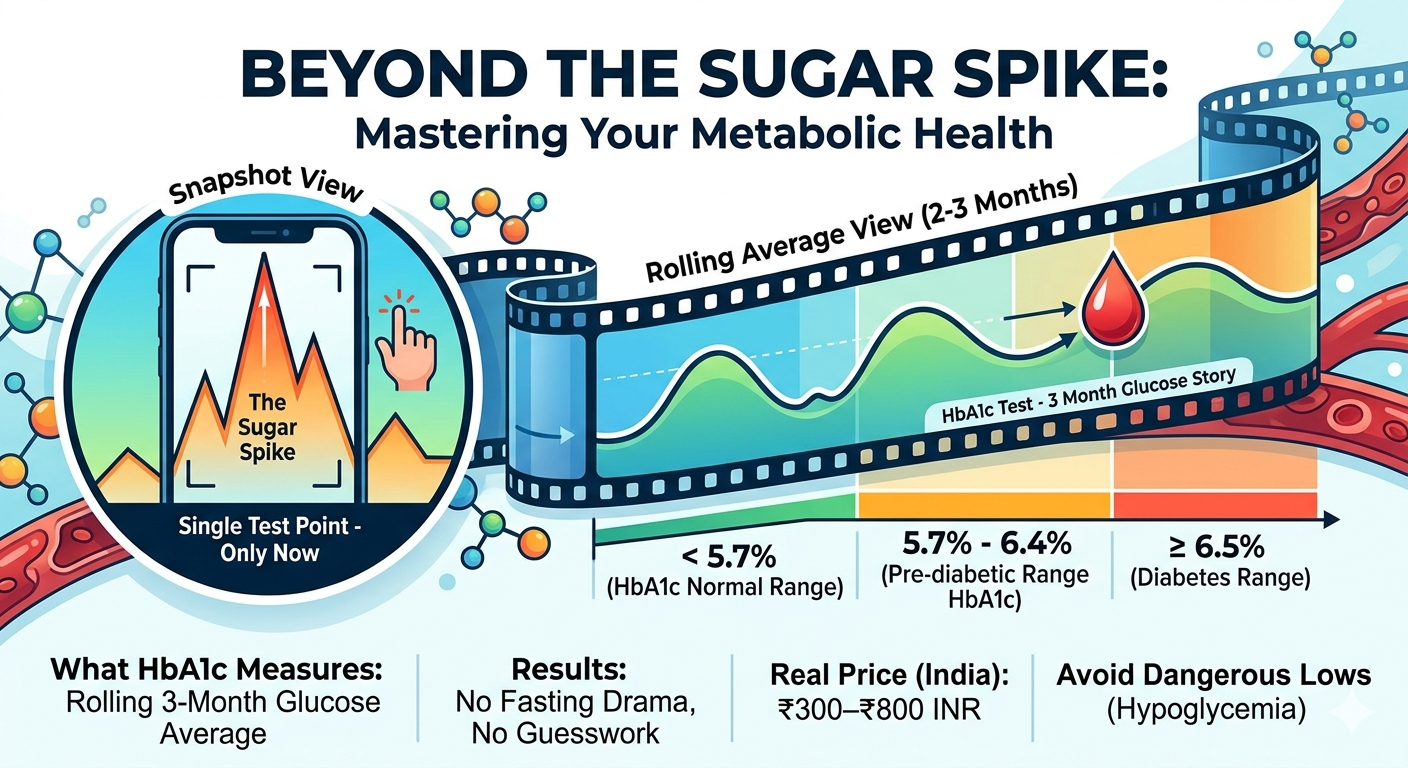
This bonding process is called glycation. Once a glucose molecule latches onto a hemoglobin protein, it stays there for the entire life of that red blood cell, roughly 90 to 120 days. So by measuring what percentage of your hemoglobin has been glycated, the HbA1c test delivers a medically accurate weighted average of your sugar levels in blood across the past two to three months.
That’s it. That’s the magic.
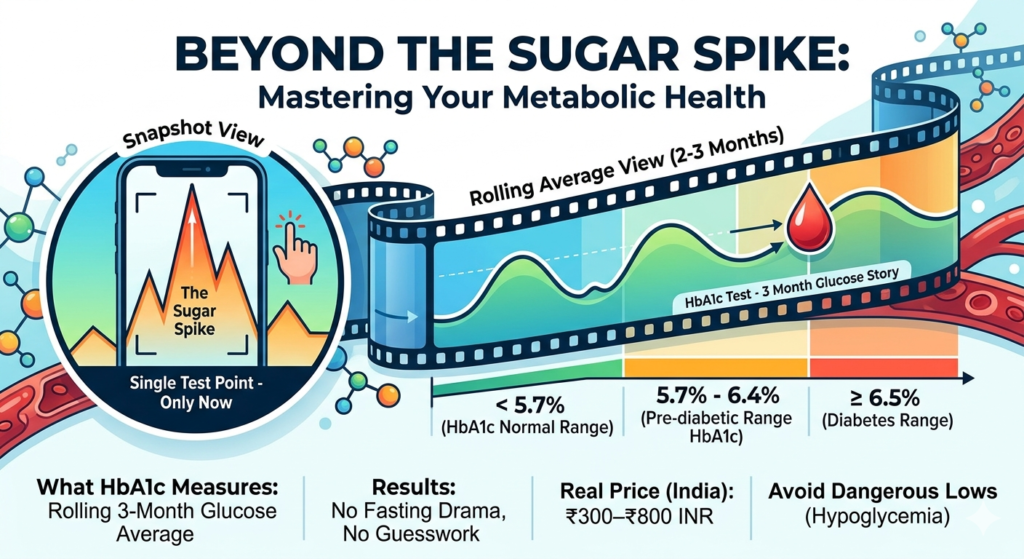
Why the A1C Test Is Far More Reliable Than a Fasting Test
Think about your finances for a second. Checking your blood sugar with a standard fasting glucose test is like looking at your bank balance on one random Tuesday morning. If you splurged on pizza and dessert the night before, the number looks alarming. If you fasted hard or exercised a lot, it looks pristine. Either way, one number doesn’t tell you how your money’s actually being managed.
The A1C test is your quarterly bank statement. It smooths out every daily spike and valley into one honest, three-month picture of how your metabolism’s really been performing. You can’t cheat it by eating clean for two days before your appointment. That three-month window catches everything, and that’s precisely what makes it the gold standard for metabolic health.
Understanding Your A1C Test Results: The Full Spectrum
When your A1C test results arrive, they come as a single percentage. That number tells you exactly how much of your hemoglobin has permanently bonded with glucose. Here’s what it means:
| Category | HbA1c % | What’s Actually Happening |
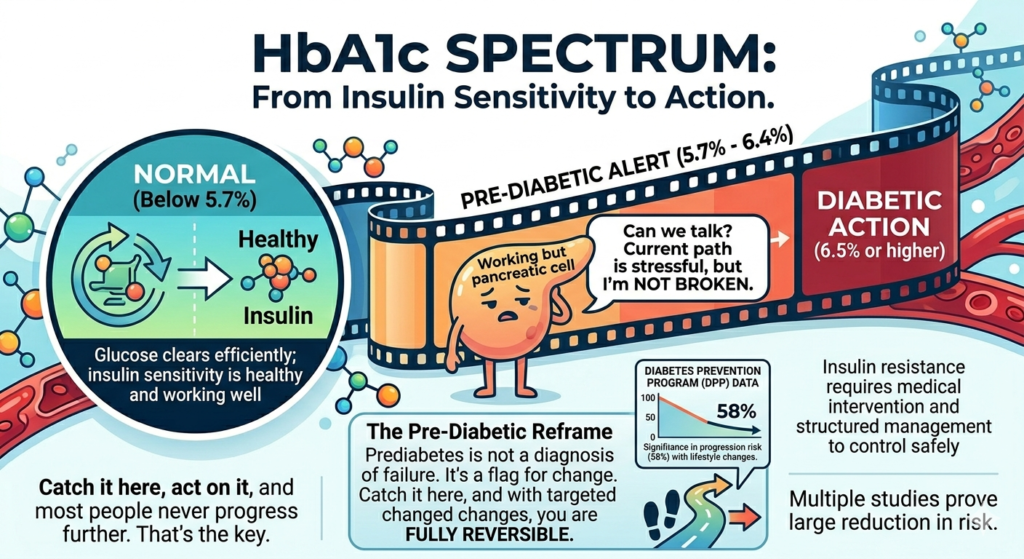
| HbA1c Normal Range | Below 5.7% | Glucose is clearing efficiently; insulin sensitivity is healthy and working well |
| Pre Diabetic Range HbA1c | 5.7% – 6.4% | Early insulin resistance is developing; still fully reversible with lifestyle changes |
| Diabetic Range | 6.5% or higher | Insulin resistance requires medical intervention to manage safely |
What Does the Pre Diabetic Range HbA1c Actually Mean for You?
Finding out your result sits in the pre diabetic range HbA1c : between 5.7% and 6.4% can feel like a gut punch. I get it. The word “pre-diabetic” sounds heavy.
But here’s the reframe that genuinely changes everything: prediabetes isn’t a diagnosis of something broken. It’s your body waving a flag and saying, “Hey, what we’re doing right now isn’t working for me. Can we talk?”
At this stage, your insulin-producing cells are overworked. Not broken. That distinction matters enormously. Multiple large-scale studies, including the landmark Diabetes Prevention Program (DPP) trial, show that people in the pre diabetic range HbA1c who make targeted lifestyle changes reduce their risk of progressing to full diabetes by 58%. That’s not a marketing claim, that’s real data from real people in controlled trials.
Catch it here, act on it, and most people never progress further. That’s the part nobody really emphasizes enough.
Daily Sugar Levels in Blood: What Normal Actually Looks Like
Your A1C test gives you the long view. But it’s your day-to-day sugar levels in blood that determine how you actually feel from hour to hour. These are measured with a standard glucose meter or a Continuous Glucose Monitor (CGM) and reported in mg/dL.
| Measurement Time | Healthy Target | Prediabetes Signal |
| Fasting (morning, before eating) | Below 100 mg/dL | 100–125 mg/dL |
| Postprandial (1–2 hrs after meals) | Below 140 mg/dL | 140–199 mg/dL |
Why Glucose Spikes Are the Silent Driver of a Rising A1C
When you eat highly refined carbohydrates : white bread, sugary drinks, pastries, your glucose spikes fast. Your pancreas panics a little and floods your system with insulin to correct it. That insulin surge frequently overshoots, crashing your blood sugar just as sharply as it rose.
And that’s where the damage quietly accumulates.
One spike won’t wreck your health. But daily, recurring spikes compound over weeks and months : and they’re precisely what pushes your A1C test score out of the HbA1c normal range without you even noticing. That brutal afternoon fog, the intense sugar cravings, the jitteriness that seems to come from nowhere? That’s not bad luck. That’s your glucose on a rollercoaster.
What Is Hypoglycemia? Symptoms, Risks, and What to Do
We spend so much energy worrying about blood sugar going too high. But the opposite extreme? Weirdly, it often gets overlooked : even though in the short term, it can be more immediately dangerous.
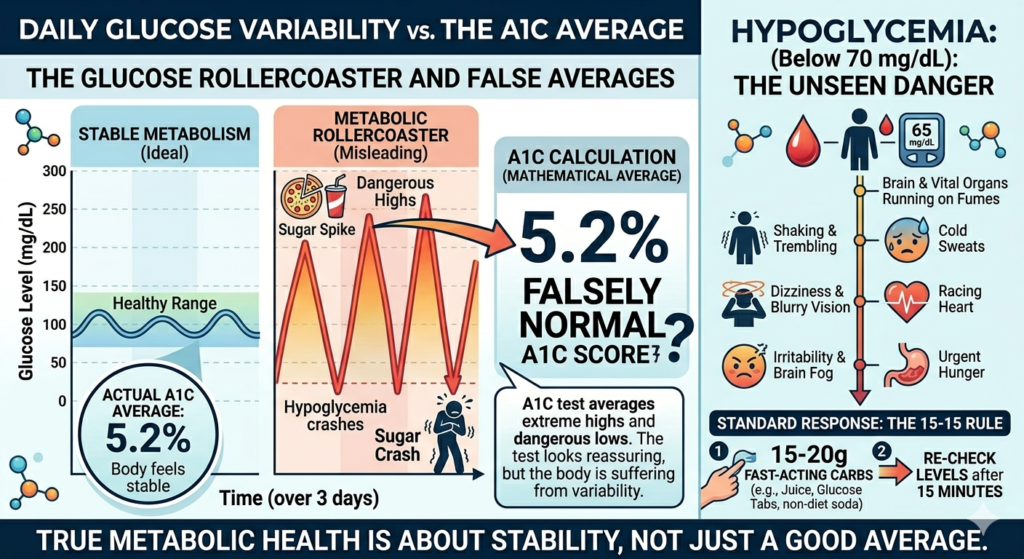
Hypoglycemia is the medical term for abnormally low blood sugar : clinically defined as sugar levels in blood dropping below 70 mg/dL. When this happens, your brain and vital organs are suddenly running on fumes. Your nervous system responds with a full-scale alarm.
Recognizing Hypoglycemia Symptoms Before They Escalate
Because your brain runs entirely on glucose, it sends out unmistakable distress signals when levels drop too fast or too far:
- Shaking hands, trembling, or a strange internal vibration you can’t explain
- Cold sweats and sudden chills even at normal room temperature
- Dizziness, lightheadedness, or suddenly blurry vision
- A racing or irregular heartbeat that comes out of nowhere
- Overwhelming, urgent hunger paired with a queasy stomach
- Sudden mood shifts : irritability, anxiety, or a brain fog that rolls in fast
Left untreated, severe hypoglycemia can progress to fainting, seizures, or worse. The standard first response: consume 15–20 grams of fast-acting carbohydrates — fruit juice, glucose tablets, or regular (non-diet) soda — and re-check your levels after 15 minutes.
How Hypoglycemia Can Make Your HbA1c Score Dangerously Misleading
Here’s one of the most important nuances in metabolic medicine and honestly, it surprises most people when they hear it.
A low A1C score is not automatically a sign of good health.
Because the HbA1c test is a mathematical average, someone who regularly swings between dangerous highs (200+ mg/dL) and severe hypoglycemia crashes (under 60 mg/dL) can average out to a result that looks perfectly fine on paper : say, 5.2%. The extremes cancel each other out. The test looks reassuring. The body doesn’t feel it.
This is why doctors don’t just look at your A1C test percentage in isolation. They evaluate your daily glucose variability alongside it. True metabolic health isn’t about a good average : it’s about genuine stability, day after day.
HbA1c Test Price in India and Globally: What to Expect
If reading all of this has convinced you it’s time to actually get tested, good. Because the HbA1c test price won’t break your budget, and the process couldn’t be simpler.
Do You Need to Fast Before an HbA1c Test?
No. And this is honestly one of the biggest misconceptions I come across.
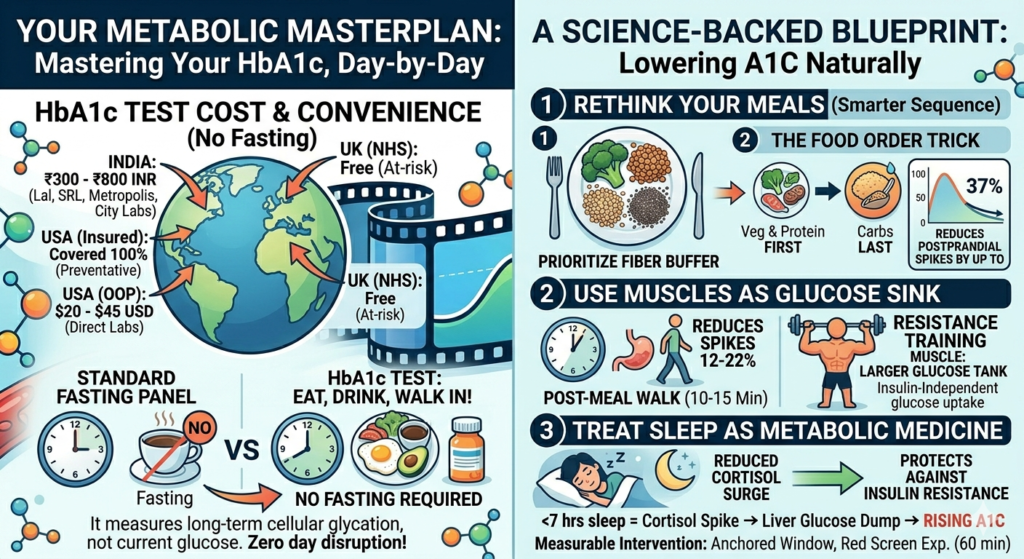
Unlike a standard fasting glucose panel, the HbA1c test requires zero fasting. Since it’s measuring long-term cellular glycation, not the glucose currently floating in your blood : you can eat breakfast, drink your morning coffee, take your medications, and walk straight into the lab. Zero disruption to your day.
HbA1c Test Price by Region
| Location | HbA1c Test Price | Notes |
| India | ₹300 – ₹800 INR | Available at Dr. Lal PathLabs, SRL, Metropolis, and most city labs |
| USA (With Insurance) | Covered at 100% | Ordered as preventative care — most insurance plans cover it fully |
| USA (Out-of-Pocket) | $20 – $45 USD | Available via direct-to-consumer lab portals online |
| UK (NHS) | Free | Covered for at-risk individuals under NHS guidelines |
For what it tells you about three months of your body’s history? The HbA1c test price is genuinely one of the best value health investments you can make.
How to Lower Your A1C Naturally: A Science-Backed Blueprint
Whether your labs showed you sitting in the pre diabetic range HbA1c, or you simply want to stabilize your sugar levels in blood and stop flirting with hypoglycemia dips — here’s the truth: you hold more power over your biology than most people realize.
Step 1 — Rethink Your Meals (Without Eliminating Them)
You don’t need to declare war on carbohydrates. You just need to be smarter about their quality and sequence.
- Prioritize fiber at every meal. Fiber acts like a slow-release buffer in your gut, softening the glucose wave before it hits your bloodstream. Best sources: avocado, broccoli, chia seeds, lentils, quinoa.
- Try the food order trick. Eat vegetables and protein first : save the carbs for last. Research published in Diabetes Care shows this simple sequence can reduce postprandial glucose spikes by up to 37%. No calorie counting. No restriction. Just order.
Step 2 — Use Your Muscles as a Glucose Sink
Here’s something that doesn’t get nearly enough credit. Your skeletal muscles can pull glucose directly out of your bloodstream during exercise without insulin’s help at all.
- Walk for 10–15 minutes after your biggest meals. Clinical trials show post-meal walking reduces glucose spikes by 12–22% compared to sitting still.
- Add resistance training twice a week. Lean muscle is essentially a larger glucose storage tank for your body — one that permanently improves your A1C test scores over time, even on rest days.
Step 3 — Treat Sleep Like the Metabolic Medicine It Actually Is
This one doesn’t get talked about enough. Honestly.
Sleep deprivation is a direct, clinically proven driver of insulin resistance. Getting fewer than 7 hours of sleep triggers a cortisol surge that tells your liver to dump stored glucose into your blood, raising your fasting sugar levels in blood even when you ate perfectly the day before. Your A1C test score creeps up. Your energy crashes harder. And it keeps happening until the sleep debt is paid.
Anchor a consistent sleep window. Reduce screen exposure 60 minutes before bed. These aren’t wellness clichés they’re measurable metabolic interventions.
Frequently Asked Questions About the HbA1c Test
What is the HbA1c normal range for a healthy adult?
The HbA1c normal range is below 5.7%. This means your body’s efficiently clearing glucose and your insulin sensitivity is functioning well. That’s exactly where you want to be.
What falls under the pre diabetic range HbA1c?
The pre diabetic range HbA1c spans 5.7% to 6.4%. It’s an early warning phase and importantly, it’s fully reversible through diet, exercise, and lifestyle changes before any medication is needed.
How much does the HbA1c test price cost in India?
The HbA1c test price across major Indian labs typically runs between ₹300 and ₹800 INR, depending on your city and provider.
Does hypoglycemia affect HbA1c results?
Yes — and it’s sneaky. Because the HbA1c test is an average, severe hypoglycemia episodes can mathematically cancel out blood sugar highs, making your result look falsely normal. That’s why daily glucose variability tracking matters alongside your A1C test.
Can I eat before an HbA1c test?
Absolutely no fasting needed. The HbA1c test measures long-term glycation, so eat normally, take your meds, and head straight to the lab.
How quickly can lifestyle changes move results from the pre diabetic range to the HbA1c normal range?
Research from the Diabetes Prevention Program shows consistent diet and exercise changes can return results from the pre diabetic range HbA1c to the HbA1c normal range in as little as 3–6 months for many people : no medication required.
Your metabolic health isn’t a fixed sentence. It’s a living, dynamic relationship between your biology and your daily choices and tools like the HbA1c test remove every bit of guesswork from that equation.
Understanding the HbA1c normal range, knowing what the pre diabetic range HbA1c really means, recognizing the warning signs of hypoglycemia, and keeping your daily sugar levels in blood stable, this isn’t abstract health theory. It’s a concrete, measurable framework you can act on starting today.
Don’t wait for symptoms to force your hand. Look up the HbA1c test price at a diagnostic lab near you. Book it. Get the number. Then use this guide to do something with it.
Your body’s already talking. This test just helps you finally hear it. Medically reviewed by Dr. Mudit Sabharwal, MBBS, Diabetologist at Dharma Diabetes & Metabolic Clinics.