 By
By There’s a moment in every sport when someone walks onto the field and you realise the rulebook you’ve been reading your whole life has just been quietly rewritten. For cricket, that moment arrived on the evening of May 27, 2026 — in a packed, high-stakes IPL playoff — when a 15-year-old from a small town in Bihar picked up his bat and reminded an entire planet that age is, in fact, just a number somebody made up.
We’ve always talked about the evolution of T20 cricket in broad strokes. The format, we said, had killed the patient opener. The days of seeing off the new ball, respecting the bowler’s rhythm, gauging the pitch — all of that, we agreed, belonged to another era. But even against that backdrop of constant reinvention, nobody truly expected the final word on ultra-aggressive batting to come from a teenager who still attends school.
And yet, here we are. Here he is.
97 Runs off 29 balls,
334 Strike rate,
12 Sixes in that innings,
65 Season sixes — a new IPL record.
In the IPL 2026 Eliminator between the Rajasthan Royals and Sunrisers Hyderabad, Vaibhav Suryavanshi did not simply bat well. He batted in a way that made experienced commentators search for new words, because the old ones felt completely inadequate. Ninety-seven runs. Twenty-nine deliveries. A strike rate of 334.48. Twelve sixes that didn’t just clear the rope — they cleared rows of people twenty deep beyond it. And with those 12 maximums, he quietly shattered a record that had stood for 14 years: Chris Gayle’s single-season six-hitting benchmark, pushing his own 2026 tally to a jaw-dropping 65 maximums.
This isn’t a purple patch. It isn’t beginner’s luck on the grandest stage. What we are watching — and I want you to sit with this thought for a moment — is the genuine, irreversible redefinition of what batting in cricket can look like.
Who Is Vaibhav Sooryavanshi and What Is His Professional Background?
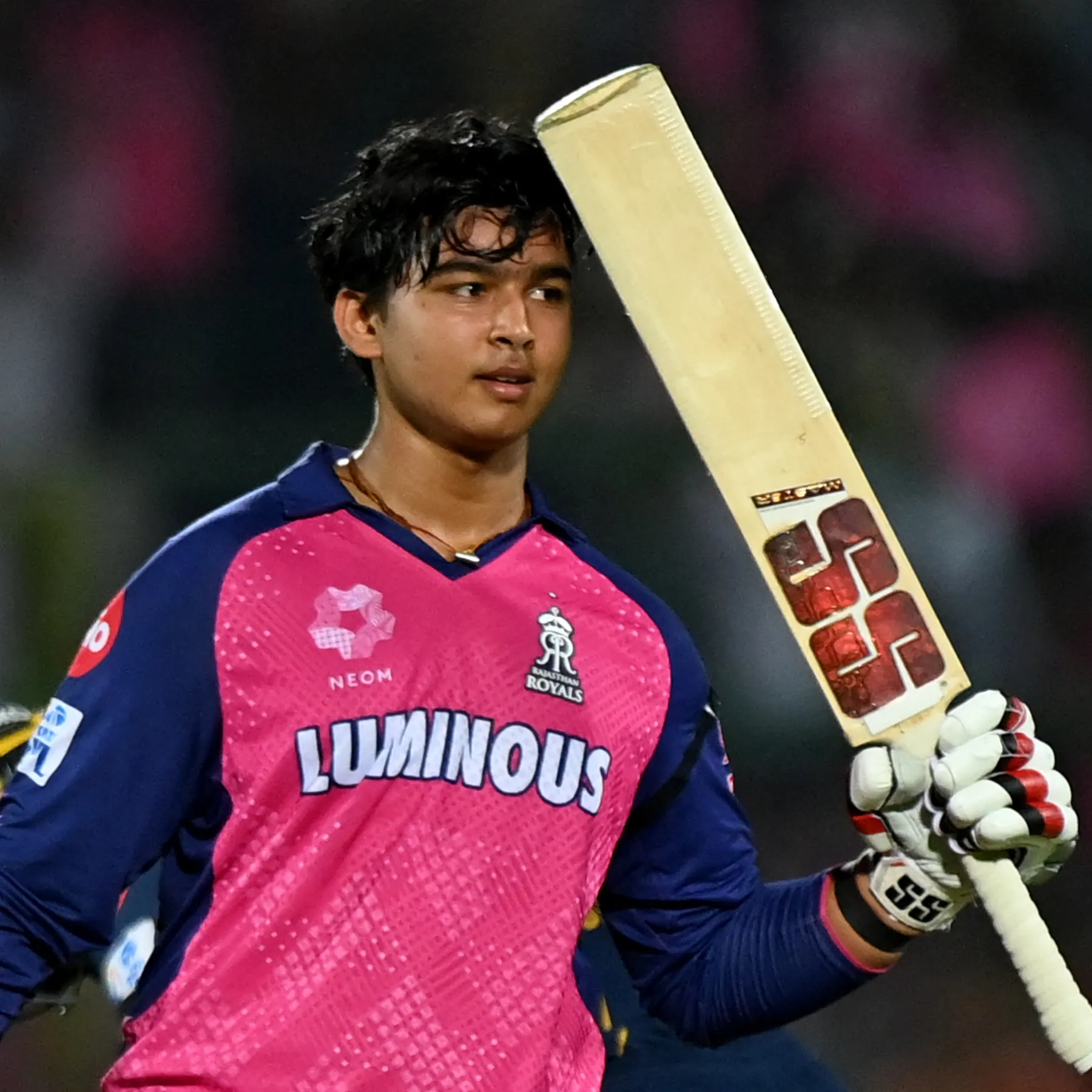
If you’ve been following the rr playing 11 today discussions on social media, you’ll have noticed that the conversation almost always begins — and ends — with one name. But for those just catching up: Vaibhav Sooryavanshi was born on March 27, 2011, in Bihar, India. He’s a naturally gifted left-handed top-order batter who also bowls slow left-arm orthodox spin when needed. He is, at the time of writing, 15 years old. He is also, without question, the most exciting young batting talent the game has produced in a generation.
The remarkable thing about his backstory isn’t simply that he’s young. It’s that his journey into professional cricket reads less like a standard career path and more like something a novelist would edit out for being too implausible.
The Historic First-Class Debut
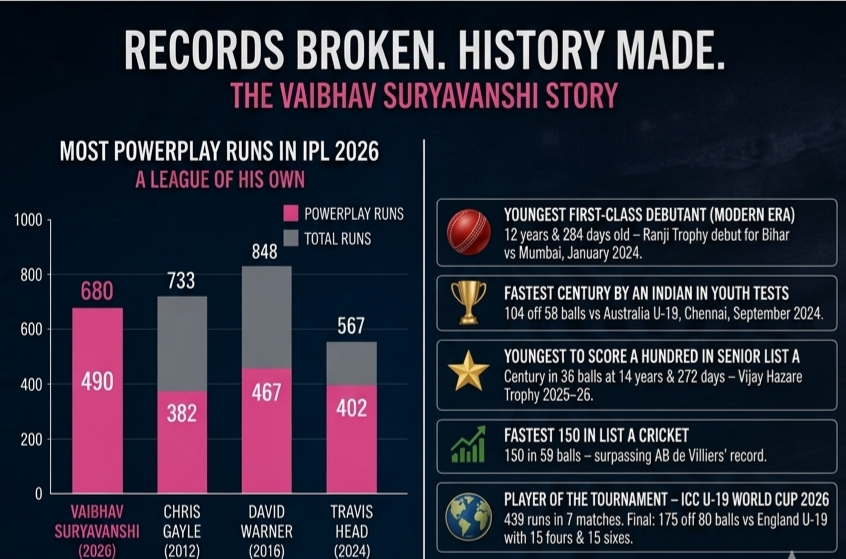
Let’s start with the number that still makes people do a double-take: 12 years and 284 days old. That’s how old Vaibhav was when he walked out to make his first-class debut for Bihar against Mumbai in the Ranji Trophy in January 2024. Not 18. Not 16. Twelve.
In doing so, he became the youngest player in the modern era of Indian first-class cricket — comfortably overtaking a record previously held by Yuvraj Singh, who debuted at 15 years and 57 days. Historically, Vaibhav sits as the fourth-youngest Indian first-class debutant of all time, sharing the record books with names from the 1940s. What struck observers in the press box that day wasn’t just his age, though. It was the calmness. The way he left balls outside off stump. The maturity in his defensive alignment against seasoned red-ball bowlers who were old enough to be his father. Scouts didn’t need a second look.
Rapid White-Ball Ascent
Once cricket administrators realised that keeping him confined to the four-day game was like putting a sports car on a dirt road, things moved quickly. In November 2024, at just 13 years and 241 days, he made his T20 debut for Bihar against Rajasthan in the Syed Mushtaq Ali Trophy. Barely a month later — December 2024 — he became the youngest Indian to ever play List A cricket, pulling on the Bihar jersey for the Vijay Hazare Trophy at 13 years and 269 days.
At every level, in every format, the answer was the same: he belonged there, and then some.
The Million-Dollar Call-Up
The moment the broader cricket world sat up and truly paid attention came at the TATA IPL 2025 Mega Auction. While most franchises were hunting for capped overseas players and proven Indian internationals, the Rajasthan Royals had done their homework quietly and thoroughly. Their scouts had watched him dismantle net bowlers at closed-door trials with an ease that bordered on embarrassing for the bowlers involved.
When his slot came up in the auction room, the Delhi Capitals made their move. The Royals didn’t flinch. They kept bidding. The hammer fell: INR 1.10 Crore. At 13 years old, Vaibhav Sooryavanshi became the youngest player in IPL history to earn a professional contract.
“At 13, he was sold at auction. At 15, he’s broken records that stood for 14 years. There is no roadmap for what comes next.”
— On Vaibhav Suryavanshi, IPL 2026
Today, the commercial story has taken on a life of its own. Fans across the country snap up Rajasthan Royals merchandise specifically to wear his name and number. His post-six “A” celebration — a spontaneous, joyful gesture he started doing in the nets — has become one of the most-shared cricket clips on social media worldwide. He has crossed the line from promising prospect to genuine franchise icon, and he still hasn’t turned 16.
From Samastipur to Stadiums: The Untold Journey of Vaibhav Suryavanshi
Every great cricketer has a hometown story. Usually it involves nets, coaches, some early tournament wins, and a supportive family. Vaibhav’s story has all of those things — it just has them in a version that makes you put the book down and stare at the ceiling for a while.
He grew up in Tajpur, a modest town in the Samastipur district of Bihar’s Mithila region. Bihar, as any cricket administrator will tell you, has historically been the underdog’s underdog in Indian domestic cricket. No towering budgets. No world-class facilities. No conveyor belt of capped internationals to inspire the next generation. Getting to the top from Samastipur meant doing it the hard, unglamorous way, with no safety net and no shortcuts.
A Father’s Unfulfilled Dream
The driving force behind everything — and this is not a metaphor — was Vaibhav’s father, Sanjiv Sooryavanshi. Sanjiv had been a cricketer himself once, an aspiring player whose own dreams had run aground on the twin rocks of financial constraint and geographical isolation. He never made it out of the local fields of Tajpur.
When his four-year-old son picked up a bat for the first time and instinctively produced a clean, straight drive — the kind of swing that batting coaches spend years trying to teach — Sanjiv made a decision. A quiet, permanent, life-altering decision. He cleared a section of the family’s farming plot, levelled the ground by hand, and constructed a set of rudimentary cricket nets using bamboo poles and nylon fishing mesh. Every evening, he would throw hundreds of balls to his little boy — tracking his footwork, making sure his head was still, watching him improve in the amber glow of the setting sun.
The Grinding 100-Kilometer Scooter Rides
By the time Vaibhav was eight, it was obvious to anyone watching that backyard nets and local throwdowns were no longer enough. The talent had simply outgrown its container. Sanjiv identified Manish Ojha’s GenNex Cricket Academy in Patna as the right environment — the kind of place with real pitches, structured coaching, and competition that would push his son.
There was one small problem. Patna was roughly 100 kilometres away.
What followed is, by now, part of Bihar cricket folklore. On alternate days, regardless of the season, Sanjiv would load young Vaibhav onto the back of his scooter and ride those 100 kilometres to Patna. In 45-degree summer heat. Through monsoon rains that flooded the roads and turned the highway into a river. In the dense, near-zero-visibility fog of Bihar winters. Three hours of coaching at the academy. Then another 100 kilometres home in the dark, the boy sleeping against his father’s back with his kitbag squeezed between his legs.
“There were days when my back would completely lock up from riding the scooter on broken roads. But I would look back at Vaibhav sleeping against my shoulder with his kitbag between his legs, and I knew we couldn’t stop.”— Sanjiv Sooryavanshi, Vaibhav’s Father
Read that again. Two hundred kilometres on a scooter. For a three-hour coaching session. On broken roads. Across years. The mental image of that — a father and son on a scooter cutting through Bihar’s fog at 6 in the morning, chasing something bigger than either of them could fully name — is not just a cricket story. It’s one of the great stories in Indian sport, full stop.
Channeling the Great Brian Lara
At the GenNex Academy, coach Manish Ojha found himself working with a student who was almost unsettlingly coachable. Correct his elbow position once, and it was corrected permanently. Talk through weight transfer on a cover drive, and he’d have it by the next session. But what really shaped Vaibhav’s batting identity was his deep, almost reverential admiration for Brian Lara.
He pored over videotapes of the West Indian master — that high backlift, the magnificent arc of the bat through the ball, the liquid elegance of the cover drive. He didn’t just study Lara; he absorbed him. And the result was a batting style that blends the raw, unfiltered power developed on a farming plot in Samastipur with the graceful, Caribbean swagger of one of cricket’s immortals. It’s a combination that, as we’ve seen in 2026, is essentially impossible to bowl at.
Cricket’s Future Is Here: How Vaibhav Suryavanshi Is Redefining T20 Batting
We tend to categorise T20 batters into neat boxes. Powerplay marauder. Middle-overs accumulator. Death-overs finisher. These compartments exist because, for most of cricket’s modern history, specialisation was the only rational response to the format’s demands. Nobody could do everything.
Vaibhav Suryavanshi, politely and very publicly, does not accept this framing. He bats as though every ball in the game is an invitation to hit a six, and he has the technique and the nerve to back that instinct up.
Deconstructing the Mechanics of His Bat Speed
Watch any slow-motion clip of Vaibhav at the crease and something interesting jumps out: his stillness. Where many modern T20 openers are all shuffle-across and pre-movement, giving the game away before the ball is even released, Vaibhav stays completely inert until the absolute last microsecond. His head is locked over his front toe. His eyes are trained on the bowler’s hand. He gives nothing away.
Then, when the ball is released and the trajectory is identified, the swing happens — and it happens extraordinarily fast. Analysts who’ve studied his footage believe his bat speed is currently among the highest in world cricket. The key is his wrist strength and his lightweight frame working together, allowing him to generate enormous leverage without the kind of brute physicality you’d usually associate with power hitting. He doesn’t muscle sixes. He whips them, with a timing so clean that the ball simply doesn’t have the option of going anywhere other than the stands.
The Powerplay Revolution
Traditional powerplay batting in T20 cricket is about exploiting the fielding restrictions — finding the gaps, rotating the strike, picking off boundaries through the infield. It is, at its core, a game of placement.
Vaibhav has a different view. If the ball is going twenty rows back into the stands, the location of the fielders inside the circle becomes entirely irrelevant. And that is not a theoretical position. That is what his 2026 numbers actually show.
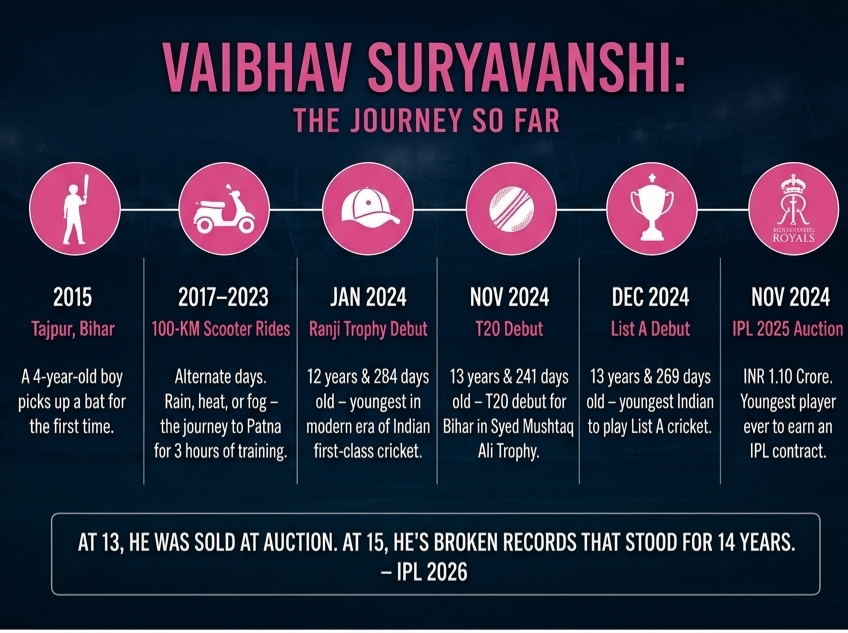
| Batter & Season | Season Runs | Powerplay Runs | Season Sixes | Strike Rate |
| Vaibhav Sooryavanshi (2026) | 680 | 490 | 65 | 242.86 |
| Chris Gayle (2012) | 733 | 382 | 59 | 160.74 |
| David Warner (2016) | 848 | 467 | 31 | 148.85 |
| Travis Head (2024) | 567 | 402 | 31 | 191.55 |
Across 15 appearances in IPL 2026, Vaibhav compiled 680 runs at an average of 45.33 and an overall strike rate of 242.86. But the number that truly reframes the conversation is the powerplay column: 490 of his 680 runs came in the first six overs. He wasn’t just accelerating after a careful start. He was taking matches apart before most bowlers had even found their rhythm. Opposition captains were running out of plans before their spinners had even touched the ball.
The Boy Who Broke Cricket’s Records Before Turning 15
To look only at the IPL stats is to miss the full picture. Vaibhav Suryavanshi has been breaking records in every format he has played, across every age group and level of competition. He is not a T20 specialist who got lucky on a good surface. He is a cricketer — a genuinely well-rounded, multi-format talent — who happens to also be terrifying in the powerplay.
The Chennai Youth Test Storm — September 2024
Representing India U-19 against Australia U-19 in a four-day Youth Test in Chennai, Vaibhav didn’t grind out a careful opening. He smashed a century in just 58 balls, finishing on 104 before a run-out ended his innings. It stands as the fastest century by an Indian player in youth Test history and the second-fastest in the global history of U-19 international cricket.
The Historic List A World Record — December 2025
In the 2025–26 Vijay Hazare Trophy, playing for Bihar against Arunachal Pradesh, he reached a century in just 36 deliveries — becoming the youngest human being in history to score a hundred in senior List A cricket at 14 years and 272 days. He then surpassed AB de Villiers’ long-standing record for the fastest 150 in List A cricket (59 balls), eventually finishing on a breathtaking 190 off 84 balls, with 16 fours and 15 sixes.
The World Cup Crown Jewel — Early 2026
As India’s anchor at the 2026 ICC Under-19 Cricket World Cup, Vaibhav was named Player of the Tournament after amassing 439 runs across seven matches. In the final against England U-19, under the full weight of global expectation, he delivered one of the great innings in youth cricket history: 175 off 80 balls, with 15 fours and 15 sixes, bringing the World Cup home to India. The comparisons to Kapil Dev’s legendary 175 against Zimbabwe at the 1983 World Cup were immediate, and not entirely unwarranted.
Conclusion: The Long Road to Immortality
As the 2026 cricket calendar begins to find its final shape, the story of Vaibhav Sooryavanshi has stopped being a heartwarming local tale and become something larger — a genuine challenge to the assumptions we make about talent, geography, and what’s possible in sport when stubbornness of purpose meets natural gift.
He’s living proof that the traditional metropolitan pathways into Indian cricket — Mumbai, Delhi, Bengaluru — are no longer the only routes to the top. A boy from Samastipur, who learned his cricket on a hand-levelled dirt pitch in a paddy-field backyard, who arrived at the crease of the world’s most glamorous cricket tournament on the back of years of 200-kilometre scooter rides, has told every kid in a structurally underserved district of India that the door is, in fact, open.
The challenges ahead are real. International bowling coaches are already feeding his footage into their systems, looking for the edge in his high backlift, the millimetre of vulnerability in his setup. The pressures of a cricket-mad country that has already cast him in the role of national saviour will only compound as he grows. There will be bad days. There will be setbacks.
But here’s what the scooter rides taught him, long before the stadiums and the IPL contracts and the record books: you don’t stop just because the road is rough. You look ahead, you keep your head still, and you trust the process.
We are watching the opening chapters of what could be the most extraordinary batting career cricket has ever seen. Enjoy every single ball of it.
Frequently Asked Questions,
Is Vaibhav Suryavanshi the youngest IPL centurion?
Yes – Vaibhav Suryavanshi is widely regarded as the youngest IPL centurion and the youngest professional player to star at this level. His records across the 2026 season have established him as a generational outlier in IPL history.
How many runs did Vaibhav Suryavanshi score in IPL 2026?
Vaibhav scored 680 runs in 15 IPL 2026 appearances at an average of 45.33 and a strike rate of 242.86. He hit 65 sixes across the season a new all-time IPL record – with 490 of those runs coming during the powerplay.
What is Vaibhav Suryavanshi’s strike rate in IPL 2026?
His overall season strike rate in IPL 2026 was 242.86 – the highest of any opener across the competition’s history. In powerplay overs specifically, he scored 490 of his 680 total runs, making him the most destructive powerplay batter the tournament has ever seen.
What IPL record did Vaibhav Suryavanshi break in 2026?
He broke Chris Gayle’s 14-year-old record for the most sixes hit in a single IPL season. Gayle had held the record with 59 sixes in 2012; Vaibhav surpassed that during the 2026 Eliminator and finished the season with 65 maximums.
What is the RR playing 11 today – is Vaibhav Suryavanshi playing?
Vaibhav Suryavanshi has been a first-choice opener for the Rajasthan Royals throughout IPL 2026, cementing his place in the playing 11 across all 15 of the Royals’ appearances this season. For the latest confirmed squad and playing 11, check the official Rajasthan Royals app or BCCI/IPL website on match day.
How did Vaibhav Suryavanshi perform in the IPL 2026 Eliminator?
In the IPL 2026 Eliminator against Sunrisers Hyderabad on May 27, 2026, Vaibhav scored 97 runs off just 29 deliveries at a strike rate of 334.48. He hit 12 sixes in the innings, pushing his season six tally to 65 – breaking Chris Gayle’s long-standing IPL record.