

 By
By Let me be upfront about something: I’ve read a lot of articles about AI agents lately, and most of them feel like they were written for someone who already works at a tech company in San Francisco. If you’re a marketer, a local shop owner, a project manager in Bengaluru, or literally anyone who doesn’t eat, breathe, and dream in Python — those articles probably left you more confused than when you started.
So let’s actually talk about this. Plainly. Honestly.

Because something is genuinely changing in 2026, and it’s happening faster than most people realize.
From “AI That Answers” to “AI That Acts”
There’s a term dominating every tech conversation right now: Agentic AI. It’s all over LinkedIn, it’s in every enterprise keynote, and Google Cloud is calling this shift “the agent leap.” But behind all the jargon, what’s actually happening?
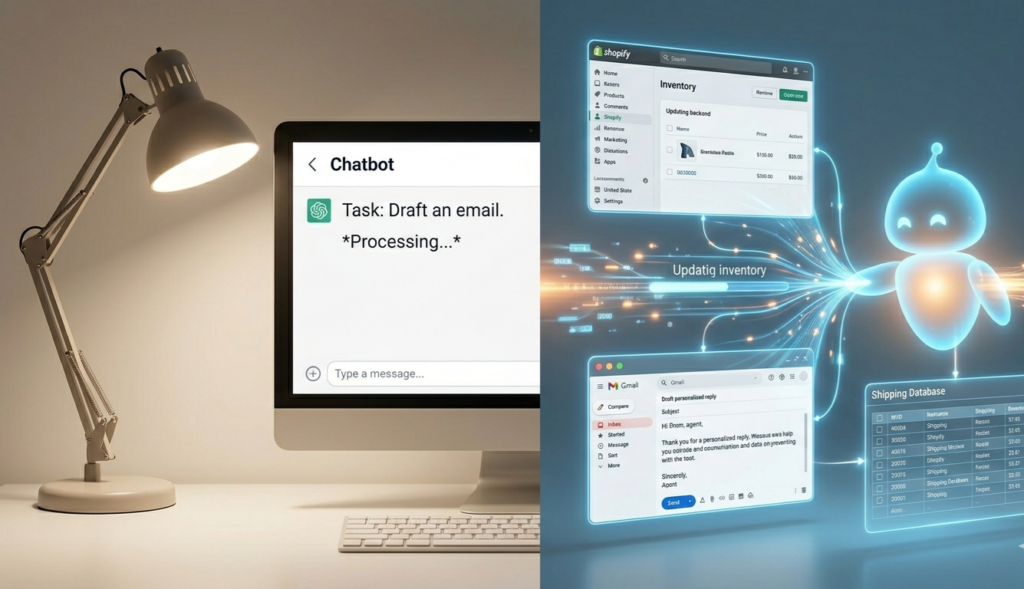
Think back to how most of us used AI in 2023 and 2024. You typed something in, it gave you something back. Maybe a draft email, a summary, a piece of code. You still had to take that output, copy it somewhere, format it, send it, act on it yourself. The AI did one thing and then stopped. It was helpful — genuinely — but it was passive. Like a really smart reference librarian who hands you the right book but doesn’t walk you to the checkout counter.
AI agents are different. A proper AI agent doesn’t just generate text. It takes a goal, figures out what steps are needed to achieve it, connects to the tools and software around it — your CRM, your calendar, your inventory system, your email — and then executes those steps. It adjusts when something doesn’t work. It loops back. It finishes the job.
What is an AI agent, explained simply? It’s the difference between someone who writes you a to-do list and someone who actually does the to-do list.
And according to recent industry data, 80% of enterprise applications shipped or updated this year already embed at least one of these agents. This isn’t a future thing anymore. It’s a right-now thing.
“Okay But Will AI Agents Replace My Job?” — The Honest Answer
This is the question everyone’s actually asking, even if they phrase it differently. So let’s not dance around it.
Some tasks will absolutely be automated. If your workday consists of copying data from one spreadsheet into another, sending templated follow-up emails, generating the same weekly report by stitching together numbers from four different tools — yes, AI agents that execute multi-step tasks autonomously will do that faster, cheaper, and without complaining about it.
But here’s what the doom-and-gloom crowd keeps getting wrong: AI agents are replacing workflows, not workers.
Think about what that actually means. When you stop spending three hours doing something mechanical, those three hours don’t disappear — they become available. For thinking. For connecting with people. For the kind of strategic work that actually moves a business forward. The people who will thrive aren’t the ones who resist this shift; they’re the ones who step into it and use it.
The comparison between an AI agent and a human worker is revealing. An AI agent is extraordinary at speed, repetition, data processing, availability (it doesn’t take lunch breaks or get distracted by a difficult morning). A human worker is extraordinary at empathy, taste, judgment, and reading a room. One set of strengths doesn’t cancel out the other — they complement each other.
We’re not being replaced. We’re being promoted. From operator to orchestrator.

How AI Copilots Actually Work in Real Life — Three Examples
Let’s get out of the abstract and into the real. Here’s how this technology is actually showing up in people’s work right now.
The Local Shop Owner
Imagine you run a small clothing boutique — maybe in a mall in Pune, or in a market in Lucknow, or online through Instagram and Shopify. Two years ago, keeping track of inventory, reordering stock, and handling customer messages was eating your evenings.
Now, with an agentic AI workflow in place, when a specific item drops below five units, the AI agent checks the supplier’s live inventory automatically. It calculates the optimal restock amount based on which sizes are selling fastest and what season is coming. It drafts the purchase order. But — and this matters — it doesn’t just send it. It flags it for you first. You review it, approve it, and the agent handles the rest: updating the website, emailing waitlisted customers in a warm, natural tone that you wrote once and now just works.
The owner doesn’t spend less time caring about the business. They spend more time actually running it.
The Content Creator
Anyone who creates content for a living knows the grind. Recording is the fun part. Everything after — editing clips, writing captions, figuring out when to post, reformatting for six different platforms — is exhausting.
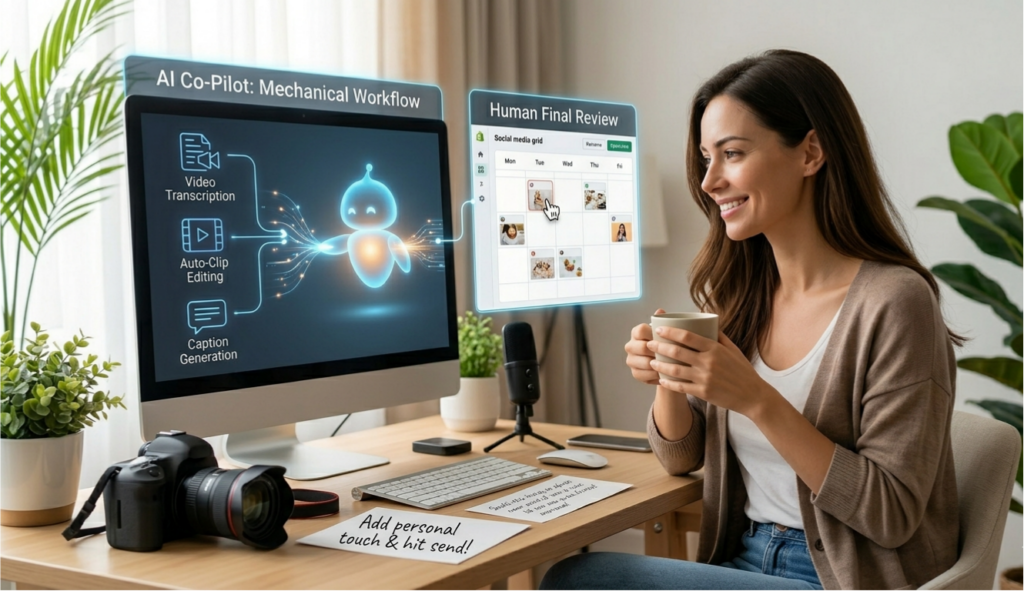
Here’s what an AI workflow can look like: You record a 20-minute podcast. The agent transcribes it, finds the three most shareable moments, cuts them into short-form clips, writes captions in your actual voice (based on examples you gave it upfront), and schedules everything across LinkedIn, Instagram, and Threads for when your audience is most active.
What do you do with the time you got back? You actually reply to comments. You have a real conversation with your community. The AI handled the distribution mechanics. You handled the human connection — which is the part nobody else can do for you.
The Corporate Professional
For anyone working inside a larger organization, AI copilots are becoming embedded in the tools you already use every day.
Say you’re a project manager who needs to prep a quarterly review. Instead of hunting down data from Jira, cross-referencing Slack threads, digging through Google Drive for that one document, and then building the deck from scratch — you describe what you need and the agent assembles it. It pulls the metrics, cross-references them against your initial KPIs, builds the slides, and flags where data is incomplete or missing.
What you bring is the context the AI can’t have: why a gap exists, what it means strategically, and what story needs to be told. That’s the judgment part. That’s irreplaceable.
Using AI Agents Without Becoming Generic
Here’s the risk nobody is talking about enough: if everyone outsources their voice to the same AI tools, the internet becomes a blur of interchangeable content. The emails sound the same. The social posts sound the same. The customer service responses sound the same.
This is a real problem — and it’s avoidable. Here’s a practical framework for building AI automation into your work without losing what makes you you:
Start with an energy audit. Don’t automate the things you love. If writing your weekly newsletter helps you think clearly, keep doing it yourself. Find the tasks that drain you — the repetitive ones, the administrative ones, the ones you procrastinate on because they’re boring — and put those on the automation list.
Be specific about boundaries. When you set up an AI agent, treat it like you’re managing a new hire. Tell it exactly what it’s allowed to do and what decisions need to come back to you. Maybe the agent can schedule internal meetings automatically, but any communication that goes to a client requires your sign-off first.
Teach it your taste. AI technologies are only as good as the context you give them. If you want an agent to write in your voice, feed it actual examples of your writing. Give it a style guide. Tell it: “We don’t use corporate buzzwords. We’re direct. We always default to warmth.” The more specific you are, the more it sounds like you.
Keep a human checkpoint. The best agentic workflows are semi-autonomous, not fully autonomous. Let the agent do 90% of the work — gathering information, drafting responses, building the structure — and then you step in for the final 10%. You read it, adjust the tone, add a specific detail only you would know, and hit approve. That last 10% is where your fingerprint stays on the output.
How Indian Professionals Can Adapt to AI Agents — And Why India Is Actually Well-Positioned
Let’s talk about the Indian context specifically, because it’s different from what you’ll read in most Western tech publications.
India has an enormous, highly skilled workforce — in tech, in BPO, in professional services, in creative industries. And yes, some of the work that has traditionally been done manually in these sectors is exactly the kind of work that agentic AI will start to handle. That’s a real disruption and it deserves honest acknowledgment.
But here’s the flip side: India is also one of the most adaptable, entrepreneurially-driven countries in the world. And the shift that AI automation is creating is not a closing door — it’s an opening one, if you know which direction to walk through.
Move from execution to orchestration
If you’ve spent your career being very good at executing tasks, the skill the market now wants is the ability to manage the systems that execute tasks. A customer support executive who can manage an AI agent handling 1,000 tickets — and who knows when to step in, how to escalate, how to configure the system — is far more valuable than one who’s simply answering 100 tickets manually.
The skill set shifts from doing to directing.
Your local knowledge is actually a competitive edge
Artificial intelligence and AI technologies in general are brilliant at processing information. What they genuinely lack is lived experience and cultural context. An AI agent might know the textbook formula for a marketing campaign — but it doesn’t intuitively understand what resonates during Navratri in Rajasthan versus what works during Onam in Kerala. It doesn’t know the specific trust dynamics that matter when you’re selling to a family business in tier-2 cities.
That localized knowledge isn’t a soft skill. In the agentic era, it’s a moat.
Learn to think in systems
The days of “write me a good prompt” as a standalone skill are fading. What’s genuinely useful now is the ability to think about a business goal and break it down into a sequence of conditional steps that an AI agent can follow. That’s not coding — it’s clear, logical, structured thinking. It’s project management applied to AI automation. Most professionals already have the underlying ability; it just needs to be redirected toward this new kind of work.
Stay curious, not just current
The half-life of any specific technical skill is shrinking. What matters more than knowing the right tool today is the habit of learning — experimenting with new platforms, understanding how agentic workflows function at a basic level, building something small just to understand the mechanics. The professionals who thrive over the next decade won’t be the ones who locked in the right certification in 2026. They’ll be the ones who stayed genuinely curious.

The Bigger Picture
There’s a narrative that artificial general intelligence and the rise of autonomous AI is a threat to human employment, full stop. And while it’s not unreasonable to take that concern seriously, it mischaracterizes what’s actually being built and deployed right now.
The AI agents rolling out across businesses in 2026 are not autonomous overlords. They are powerful, tireless tools that need human direction, human judgment, and human taste to do anything that actually matters.
What’s changing is the cost of execution. When executing a complex, multi-step business workflow costs almost nothing — when you can describe a goal and have an AI build the process to reach it — the things that remain expensive and rare are creativity, empathy, relationships, and vision.
In other words: the more automated the world gets, the more your humanity is worth.
That’s not a consolation prize. That’s actually the whole point.
Don’t fear the agent leap. Figure out which parts of your week are mechanical and hand them over. Use the time you get back to do the work only you can do. In an increasingly automated world, the professionals who will stand out aren’t the ones who resist AI — they’re the ones who freed themselves up to be more human because of it.
Frequently Asked Questions
Q1: What is an AI agent and how does it work?
An AI agent is a software system designed to think, plan, and act — not just respond. Unlike a regular chatbot that answers one question at a time, an agentic AI takes a goal, breaks it into steps, connects to tools and apps around it, and completes the entire task from start to finish — without you having to babysit every step.
Here’s a simple way to picture it: traditional artificial intelligence is like a GPS that tells you where to turn. An AI agent is like a self-driving car — it reads the same map, but it actually drives. It adjusts when there’s traffic. It reroutes when a road is closed. And it gets you there.
In practice, AI agents that execute multi-step tasks autonomously can do things like:
- Monitor your inventory, detect low stock, draft a purchase order, and flag it for your approval — all without you opening a single spreadsheet
- Transcribe a podcast, identify highlights, cut short-form clips, write captions in your voice, and schedule posts across platforms
- Pull performance data from multiple tools, cross-reference KPIs, and build a slide deck draft — before you’ve finished your morning chai
What powers all of this is the combination of AI technologies — language models, reasoning engines, and software integrations — working together inside a single automated loop. The result is AI automation that feels less like using a tool and more like working with a capable colleague who never sleeps.
Q2: Is agentic AI the same as artificial general intelligence (AGI)?
No — and this confusion is worth clearing up because it shapes how people think about the risk and reality of AI technologies today.
Artificial general intelligence (AGI) refers to a hypothetical AI system that can think, reason, and learn across any domain the way a human can — with full understanding, self-awareness, and independent judgment. It doesn’t exist yet. Researchers debate whether it’s years, decades, or further away. Most working AI scientists are cautious about timelines.
Agentic AI, on the other hand, is very real and very much already here. It refers to AI systems that can execute complex, multi-step tasks autonomously within defined domains. They’re powerful — impressively so — but they’re not general. They do what they’re configured to do, within the boundaries you give them. They don’t have opinions. They don’t have ambitions. They don’t go rogue.
The distinction matters practically: agentic AI in 2026 is less “robot overlord” and more “very capable, very fast, very literal assistant that needs clear instructions.” The tech is remarkable, but it still needs humans to set the goals, define the guardrails, and make the judgment calls that require real-world context.
So when you read breathless headlines about artificial general intelligence taking over jobs — step back. What’s actually transforming the workplace right now is agentic AI: narrower, more focused, and much more manageable than the sci-fi version people imagine.
Q3: Will AI agents take over jobs in India by 2026?
This is the question most Indian professionals are sitting with right now, and it deserves a layered answer — not a blanket reassurance.
The honest reality: AI agents are already automating specific categories of work. High-volume, repetitive, rule-based digital tasks — data entry, templated customer responses, routine reporting, form processing — are being absorbed by AI automation workflows at scale. If your role is built almost entirely around executing those kinds of tasks manually, that pressure is real.
The bigger picture: What AI agents are changing about jobs in 2026 isn’t simply headcount — it’s job composition. The same professional who once spent 70% of their day on execution can now spend 70% of their day on thinking, strategizing, and relationship-building — because an AI workflow handles the mechanical work. That’s not elimination. That’s elevation — if you’re willing to make the shift.
For Indian professionals specifically, a few things are worth knowing:
- India’s enormous talent base in tech, services, and professional sectors gives it significant capacity to lead the orchestration layer — managing, configuring, and improving AI systems rather than being replaced by them
- Cultural and domain expertise (local market knowledge, language nuances, relationship context) remains a genuine competitive edge that AI technologies cannot replicate
- The sectors most exposed to disruption are also the ones with the most room to move up the value chain — from doing tasks to managing the AI automation that does them
The professionals most at risk aren’t those whose work requires judgment. They’re those who haven’t yet built the habit of asking: “Could I be directing this instead of doing it?”
Q4: How can a non-technical person start using AI agents for their business?
You don’t need to write code. You don’t need a tech background. You don’t need to understand how large language models work under the hood. What you need is the ability to think clearly about what you want done — and that’s a skill most professionals already have.
Here’s a beginner-friendly way to start using AI agents for business automation:
Step 1 — Identify your “energy drains.” Look at your week and find the tasks that are repetitive, multi-step, and boring. The ones you procrastinate on not because they’re hard, but because they’re tedious. Those are your first automation candidates.
Step 2 — Start with one workflow. Don’t try to automate everything at once. Pick one specific process — say, responding to routine customer enquiries, or compiling a weekly performance summary — and set up a single AI workflow around it. Most no-code tools today make this genuinely accessible.
Step 3 — Give the agent good context. The quality of your AI automation depends almost entirely on how clearly you communicate. Tell the agent what to do, what tone to use, what decisions require your approval, and what tools it can access. Treat it like onboarding a new team member.
Step 4 — Keep a human checkpoint. Never let an AI agent run fully unchecked, especially on anything customer-facing. The best setup is semi-autonomous: the agent does 90% of the work, you review and approve the final step. This keeps your outputs filtered through human judgment without requiring your time at every stage.
Step 5 — Expand from there. Once you understand how one AI workflow works, adding the next one gets significantly easier. The goal isn’t to hand everything over to AI technology — it’s to hand over the right things so you can do the irreplaceable things better.
Q5: What are the best use cases for AI agents in small businesses?
AI agents aren’t just for large enterprises with big budgets and dedicated tech teams. Some of the most effective AI automation use cases are happening in small and mid-sized businesses right now. Here are the ones delivering the most real-world value:
Customer Support Automation An AI agent can handle routine enquiries — order status, return policies, FAQs — around the clock, in multiple languages, without a support team member having to be online. It escalates only the complex, emotionally sensitive cases to a human. This is one of the most common and highest-ROI AI workflow setups for small businesses today.
Inventory and Reorder Management For retail and product businesses, agentic AI can monitor stock levels in real time, predict demand based on seasonal trends and sales history, and trigger purchase orders automatically — requiring only a final human approval before they go out.
Lead Nurturing and Follow-Up Sales follow-ups are famously where deals die from neglect, not rejection. An AI agent can monitor inbound leads, send personalized follow-up sequences at the right intervals, flag warm leads for personal outreach, and update your CRM automatically — all without manual input.
Content Distribution For businesses investing in content marketing, AI automation can take a single piece of content (a blog, a video, a podcast) and distribute it intelligently across channels — reformatting, resizing, rewriting captions for each platform, and scheduling at optimal times.
Reporting and Analytics Instead of manually pulling numbers from four different tools every Monday morning, an AI workflow can compile the data, highlight anomalies, and deliver a plain-English summary — so you spend your time deciding what to do about the numbers, not finding them.
The through-line in all of these: the AI handles the mechanics. The human handles the meaning.
Q6: What skills do professionals need to work with AI agents in 2026?
The skill set the market is rewarding in 2026 has shifted — and it’s not the skills most people expect.
It’s not coding. It’s not data science. Those remain valuable, but they’re not the gateway to working effectively with AI agents for the majority of professionals.
Here’s what actually matters:
Systems thinking. Working with agentic AI requires the ability to look at a business goal and break it down into logical, sequential steps. What needs to happen first? What depends on what? What should trigger what? This is less about tech and more about structured, clear thinking — something most experienced professionals can develop quickly.
Clear, specific communication. The single biggest bottleneck in most AI automation setups isn’t the technology — it’s vague instructions. Professionals who can communicate precisely (what they want, what they don’t want, what the exceptions are) get dramatically better results from AI agents than those who use fuzzy, open-ended prompts.
Domain expertise. AI technologies are generalists. They know a lot about a lot of things, but they don’t know your specific business, your specific customers, or your specific market. The professional who combines deep domain knowledge with the ability to direct AI workflows is the combination that’s genuinely hard to replace.
Adaptability. The half-life of any specific tech skill is shrinking fast. The professionals who will compound their advantage over the next decade aren’t the ones who learned the right tool in 2025 — they’re the ones who built the habit of continuous learning. Staying curious about how AI is evolving in your industry isn’t optional anymore. It’s the baseline.
Human judgment and taste. In a world where AI automation can execute almost anything, the scarce resource becomes the ability to know what’s worth executing. Strategic vision. Creative taste. Ethical judgment. Empathy. These aren’t soft skills — in the agentic era, they’re premium ones.
Q7: How is agentic AI different from traditional automation tools like macros or RPA?
If you’ve ever used Excel macros, Zapier, or robotic process automation (RPA) tools, you’ve seen an earlier version of the same idea: software doing repetitive tasks so humans don’t have to.
Agentic AI is meaningfully different — and the difference matters.
Traditional automation tools follow rigid, pre-defined rules. They do exactly what you programmed them to do, in exactly the order you specified, and they break the moment something unexpected happens. If a webpage changes its layout, if an email arrives in an unusual format, if a step in the process fails — traditional AI workflow tools typically stop, throw an error, and wait for a human to fix them.
AI agents can handle ambiguity. They can reason about what to do when something unexpected happens. They can look at a task they’ve never seen before and figure out the most logical approach. They can communicate in natural language — understanding instructions like “summarize the key concerns in this email and draft a diplomatic reply” rather than requiring those instructions to be hard-coded.
The practical result: agentic AI can handle far more complex, variable, and judgment-dependent workflows than traditional automation ever could. It’s the difference between a machine that follows a script and one that understands the goal behind the script.
For businesses and professionals evaluating AI technologies, this means the ceiling for what you can automate is dramatically higher than it was even two years ago — and it’s still rising.
Q8: Can AI agents make mistakes? How much should I trust them?
Yes — AI agents make mistakes. Understanding where and why is essential to using them well.
The most common failure modes in agentic AI systems:
Confident incorrectness. AI agents can produce outputs that look right but contain errors — wrong numbers, outdated information, misinterpreted instructions. The more consequential the output, the more important it is to have a human review it.
Instruction drift. If your instructions are vague or contradictory, the agent will interpret them as best it can — which may not match what you actually wanted. Specificity in how you set up AI workflows directly reduces this risk.
Context blindness. An AI agent doesn’t know what it doesn’t know. It won’t flag that a customer email carries an unusual emotional undertone, or that a supplier relationship has a complicated history, or that a data point looks statistically right but is actually anomalous for your business. Human judgment fills these gaps.
The right trust calibration: Treat AI agents the way you’d treat a highly capable junior employee on their first week. You’d give them real work, but you’d check their output before it went to clients. You’d give them clear instructions, not vague ones. You’d build trust incrementally.
Over time, as you understand exactly what your AI automation setup does well and where it needs oversight, you can adjust how much you review. But the “human-in-the-loop” principle — keeping a human checkpoint in any workflow that touches customers, finances, or sensitive decisions — is one of the most important guardrails in responsible AI technology use.
The goal isn’t to trust your AI agent blindly. The goal is to understand it well enough to trust it appropriately.