 By
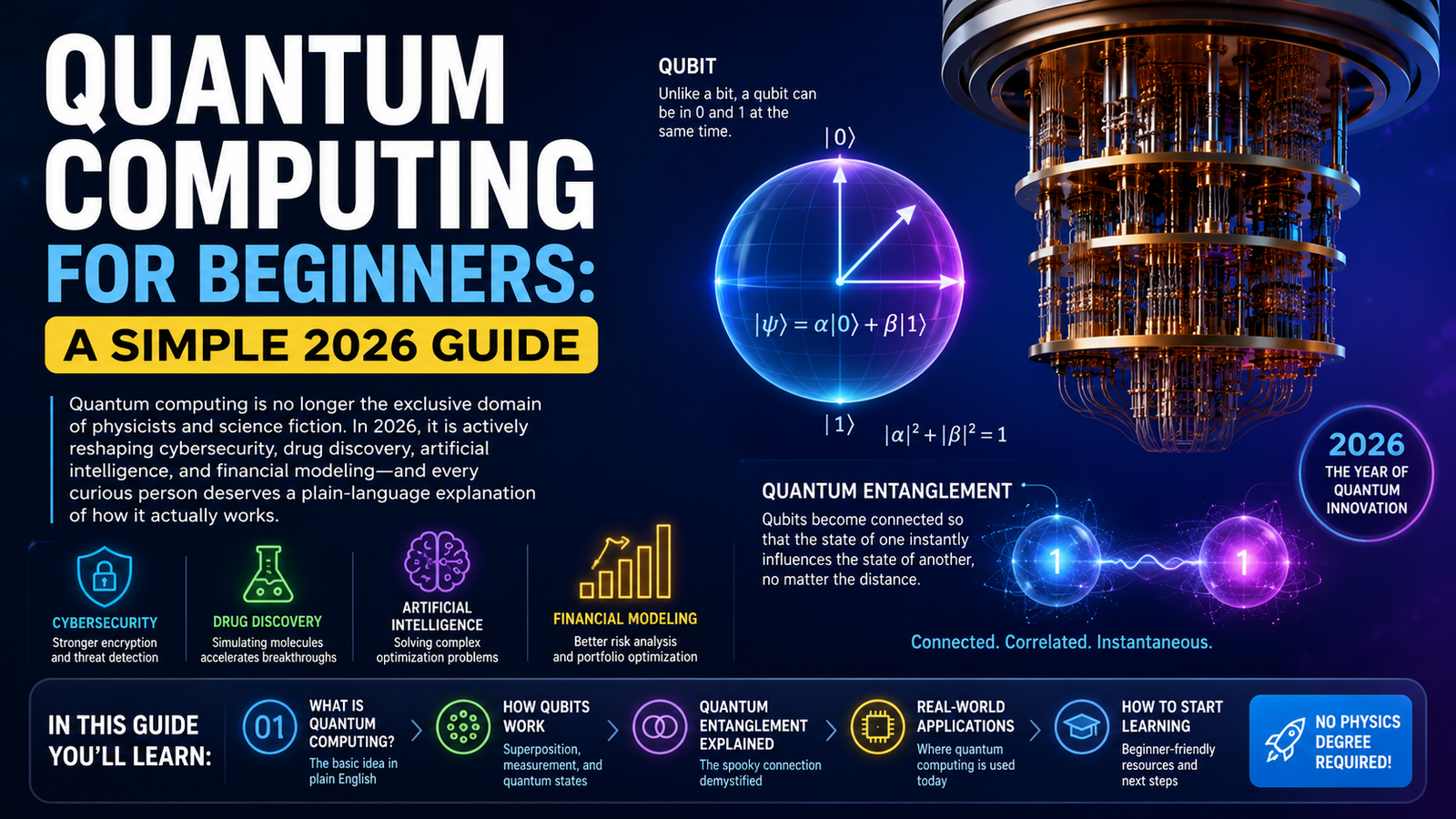
By Quantum computing is no longer the exclusive domain of physicists and science fiction. In 2026, it is actively reshaping cybersecurity, drug discovery, artificial intelligence, and financial modeling and every curious person deserves a plain-language explanation of how it actually works.
Quantum computing is a type of computation that uses quantum mechanical phenomena like superposition and quantum entanglement to process information in fundamentally different ways than traditional computers. Instead of binary bits (0 or 1), quantum computers use qubits that can exist in multiple states simultaneously, enabling them to solve certain complex problems exponentially faster.
This guide covers everything a beginner needs to understand: what quantum computing is, how qubits work, what quantum entanglement really means, where quantum computers are being used today, and how you can start learning no physics degree required.
What is Quantum Computing?
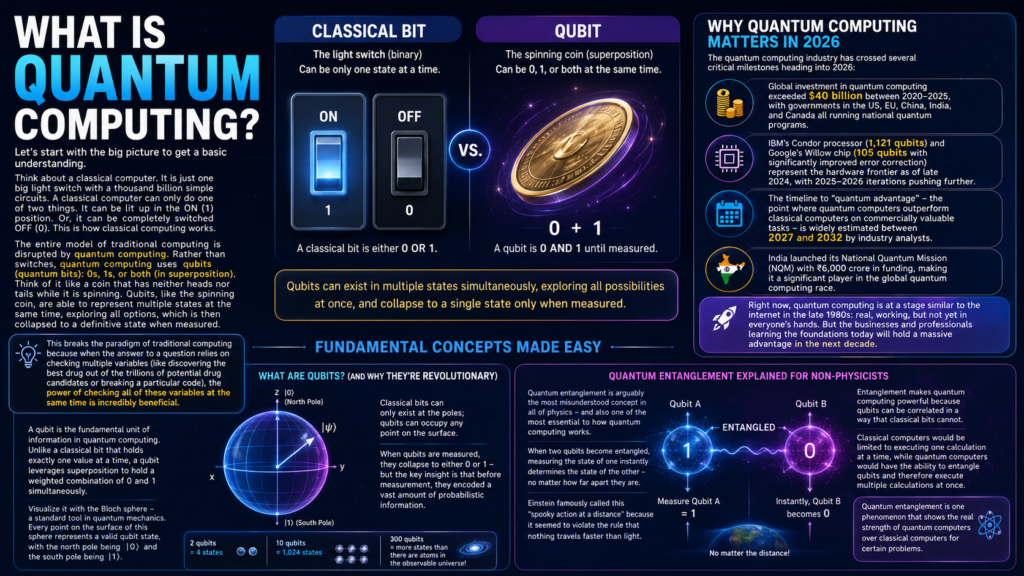
Let’s start with the big picture to get a basic understanding. Think about a classical computer. It is just one big light switch with a thousand billion simple circuits. A classical computer can only do one of two things. It can be lit up in the ON (1) position. Or, it can be completely switched OFF (0). This is how classical computing works.
The entire model of traditional computing is disrupted by quantum computing. Rather than switches, quantum computing uses qubits (quantum bits): 0s, 1s, or both (in superposition). Think of it like a coin that has neither heads nor tails while it is spinning. Qubits, like the spinning coin, are able to represent multiple states at the same time, exploring all options, which is then collapsed to a definitive state when measured.
This breaks the paradigm of traditional computing because when the answer to a question relies on checking multiple variables (like discovering the best drug out of the trillions of potential drug candidates or breaking a particular code), the power of checking all of these variables at the same time is incredibly beneficial.
Why Quantum Computing Matters in 2026
The quantum computing industry has crossed several critical milestones heading into 2026:
- Global investment in quantum computing exceeded $40 billion between 2020–2025, with governments in the US, EU, China, India, and Canada all running national quantum programs.
- IBM’s Condor processor (1,121 qubits) and Google’s Willow chip (105 qubits with significantly improved error correction) represent the hardware frontier as of late 2024, with 2025–2026 iterations pushing further.
- The timeline to “quantum advantage” the point where quantum computers outperform classical computers on commercially valuable tasks is widely estimated between 2027 and 2032 by industry analysts.
- India launched its National Quantum Mission (NQM) with ₹6,000 crore in funding, making it a significant player in the global quantum computing race.
Right now, quantum computing is at a stage similar to the internet in the late 1980s: real, working, but not yet in everyone’s hands. But the businesses and professionals learning the foundations today will hold a massive advantage in the next decade.
Fundamental Concepts Made Easy
What Are Qubits? (And Why They’re Revolutionary)
A qubit is the fundamental unit of information in quantum computing. Unlike a classical bit that holds exactly one value at a time, a qubit leverages superposition to hold a weighted combination of 0 and 1 simultaneously.
Visualize it with the Bloch sphere a standard tool in quantum mechanics. Every point on the surface of this sphere represents a valid qubit state, with the north pole being |0⟩ and the south pole being |1⟩. Classical bits can only exist at the poles; qubits can occupy any point on the surface.
When qubits are measured, they collapse to either 0 or 1 but the key insight is that before measurement, they encoded a vast amount of probabilistic information. String multiple qubits together, and the number of states you can explore simultaneously grows exponentially: 2 qubits = 4 states, 10 qubits = 1,024 states, 300 qubits = more states than there are atoms in the observable universe.
Quantum Entanglement Explained for Non-Physicists
Quantum entanglement is arguably the most misunderstood concept in all of physics and also one of the most essential to how quantum computing works.
When two qubits become entangled, measuring the state of one instantly determines the state of the other no matter how far apart they are. Einstein famously called this “spooky action at a distance” because it seemed to violate the rule that nothing travels faster than light.
Entanglement makes quantum computing powerful because qubits can be correlated in a way that classical bits cannot. Classical computers would be limited to executing one calculation at a time, while quantum computers would have the ability to entangle qubits and therefore execute multiple calculations at once. Quantum entanglement is one phenomenon that shows the real strength of quantum computers over classical computers for certain problems.
How Quantum Computers Work
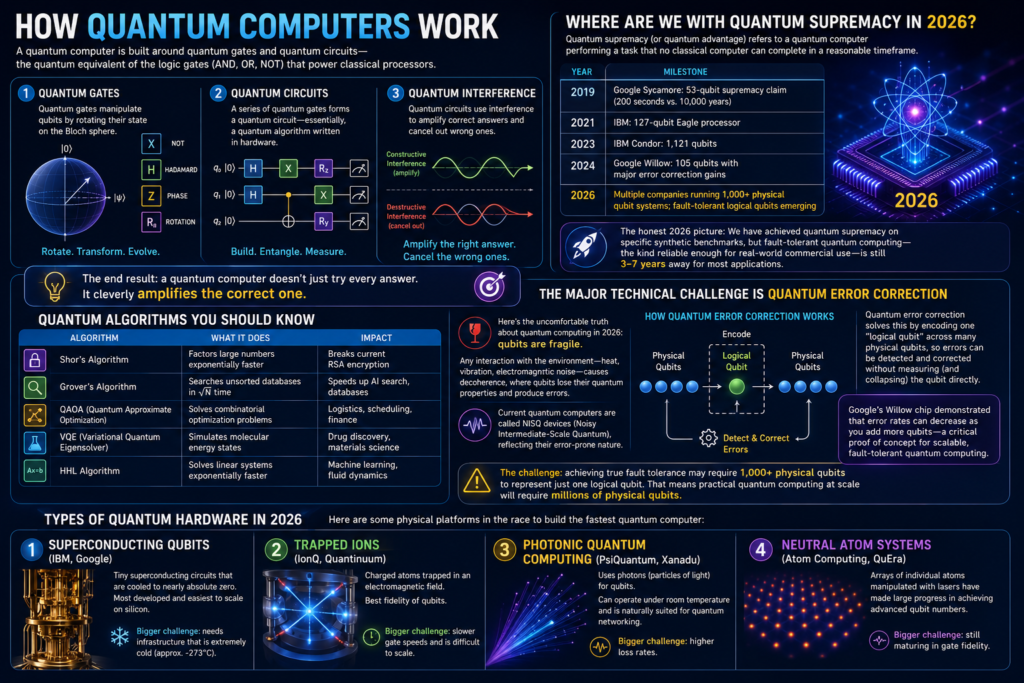
A quantum computer is built around quantum gates and quantum circuits the quantum equivalent of the logic gates (AND, OR, NOT) that power classical processors.
Quantum gates manipulate qubits by rotating their state on the Bloch sphere. A series of quantum gates forms a quantum circuit essentially, a quantum algorithm written in hardware.
A critical third phenomenon (alongside superposition and quantum entanglement) is quantum interference. Quantum circuits are designed so that wrong answers “cancel out” (destructive interference) and correct answers “amplify” (constructive interference) guiding the computation toward the right solution.
The end result: a quantum computer doesn’t just try every answer. It cleverly amplifies the correct one.
Where are we with Quantum Supremacy in 2026?
Quantum supremacy (or quantum advantage) refers to a quantum computer performing a task that no classical computer can complete in a reasonable timeframe.
Google first claimed this milestone in 2019 with their Sycamore processor. Since then, the goalposts have moved:
| Year | Milestone |
| 2019 | Google Sycamore: 53-qubit supremacy claim (200 seconds vs. 10,000 years) |
| 2021 | IBM: 127-qubit Eagle processor |
| 2023 | IBM Condor: 1,121 qubits |
| 2024 | Google Willow: 105 qubits with major error correction gains |
| 2026 | Multiple companies running 1,000+ physical qubit systems; fault-tolerant logical qubits emerging |
The honest 2026 picture: We have achieved quantum supremacy on specific synthetic benchmarks, but fault-tolerant quantum computing the kind reliable enough for real-world commercial use is still 3–7 years away for most applications.
The Major Technical Challenge is Quantum Error Correction
Here’s the uncomfortable truth about quantum computing in 2026: qubits are fragile.
Any interaction with the environment heat, vibration, electromagnetic noise causes decoherence, where qubits lose their quantum properties and produce errors. Current quantum computers are called NISQ devices (Noisy Intermediate-Scale Quantum), reflecting their error-prone nature.
Quantum error correction solves this by encoding one “logical qubit” across many physical qubits, so errors can be detected and corrected without measuring (and collapsing) the qubit directly. Google’s Willow chip demonstrated that error rates can decrease as you add more qubits a critical proof of concept for scalable, fault-tolerant quantum computing.
The challenge: achieving true fault tolerance may require 1,000+ physical qubits to represent just one logical qubit. That means practical quantum computing at scale will require millions of physical qubits.
Quantum Algorithms You Should Know
| Algorithm | What It Does | Impact |
| Shor’s Algorithm | Factors large numbers exponentially faster | Breaks current RSA encryption |
| Grover’s Algorithm | Searches unsorted databases in √N time | Speeds up AI search, databases |
| QAOA (Quantum Approximate Optimization) | Solves combinatorial optimization problems | Logistics, scheduling, finance |
| VQE (Variational Quantum Eigensolver) | Simulates molecular energy states | Drug discovery, materials science |
| HHL Algorithm | Solves linear systems exponentially faster | Machine learning, fluid dynamics |
Types of Quantum Hardware in 2026
Here are some physical platforms in the race to build the fastest quantum computer:
1) Superconducting Qubits (IBM, Google) – Tiny superconducting circuits that are cooled to nearly absolute zero. Most developed and easiest to scale on silicon. A bigger challenge is that it needs infrastructure that is extremely cold (approx. -273°C).
2) Trapped Ions (IonQ, Quantinuum) – Charge atoms and that are placed in an electromagnetic field. Best fidelity of qubits. A bigger challenge is slower gate speeds and is difficult to scale.
3) Photonic Quantum Computing (PsiQuantum, Xanadu) – uses quantum of light, or photons, for qubits. Can operate under room temperature and is naturally going to be suited for quantum networking. A larger challenge is that there are higher loss rates.
4) Neutral Atom Systems (Atom Computing, QuEra) – recently, an array of individual atoms that are manipulated with lasers, have made large progress in achieving advanced qubit numbers. A bigger challenge is that they are still maturing in gate fidelity.
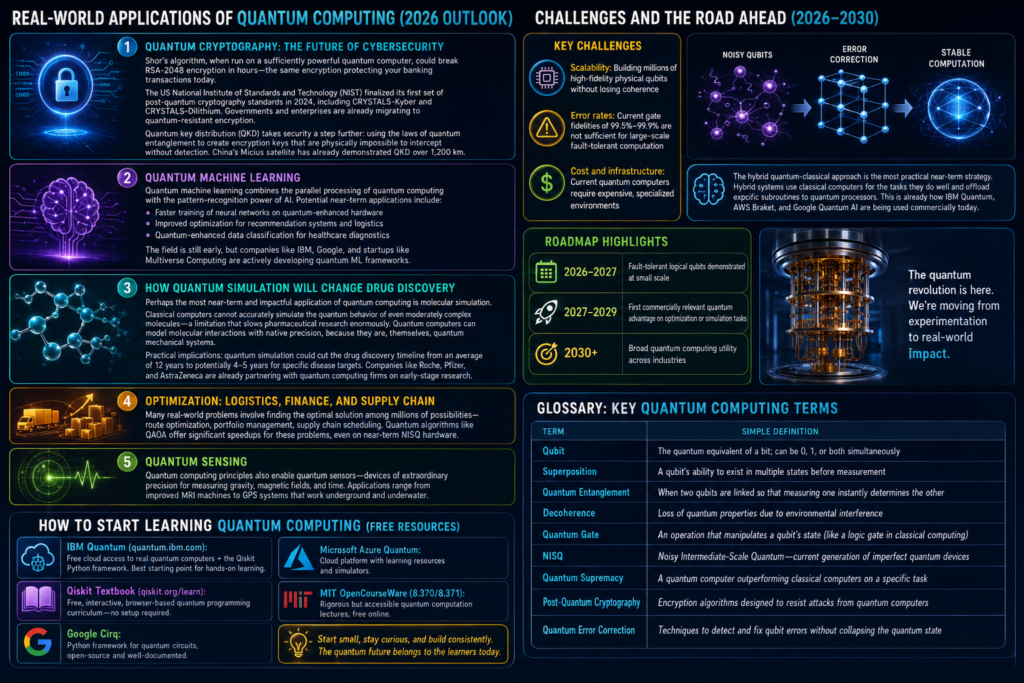
Real-World Applications of Quantum Computing (2026 Outlook)
1. Quantum Cryptography: The Future of Cybersecurity
Shor’s algorithm, when run on a sufficiently powerful quantum computer, could break RSA-2048 encryption in hours the same encryption protecting your banking transactions today.
This is not science fiction. The US National Institute of Standards and Technology (NIST) finalized its first set of post-quantum cryptography standards in 2024, including CRYSTALS-Kyber and CRYSTALS-Dilithium. Governments and enterprises are already migrating to quantum-resistant encryption.
Quantum key distribution (QKD) takes security a step further: using the laws of quantum entanglement to create encryption keys that are physically impossible to intercept without detection. China’s Micius satellite has already demonstrated QKD over 1,200 km.
2. Quantum Machine Learning
Quantum machine learning combines the parallel processing of quantum computing with the pattern-recognition power of AI. Potential near-term applications include:
- Faster training of neural networks on quantum-enhanced hardware
- Improved optimization for recommendation systems and logistics
- Quantum-enhanced data classification for healthcare diagnostics
The field is still early, but companies like IBM, Google, and startups like Multiverse Computing are actively developing quantum ML frameworks.
3. How Quantum Simulation Will Change Drug Discovery
Perhaps the most near-term and impactful application of quantum computing is molecular simulation.
Classical computers cannot accurately simulate the quantum behavior of even moderately complex molecules a limitation that slows pharmaceutical research enormously. Quantum computers can model molecular interactions with native precision, because they are, themselves, quantum mechanical systems.
Practical implications: quantum simulation could cut the drug discovery timeline from an average of 12 years to potentially 4–5 years for specific disease targets. Companies like Roche, Pfizer, and AstraZeneca are already partnering with quantum computing firms on early-stage research.
4. Optimization: Logistics, Finance, and Supply Chain
Many real-world problems involve finding the optimal solution among millions of possibilities route optimization, portfolio management, supply chain scheduling. Quantum algorithms like QAOA offer significant speedups for these problems, even on near-term NISQ hardware.
5. Quantum Sensing
Quantum computing principles also enable quantum sensors devices of extraordinary precision for measuring gravity, magnetic fields, and time. Applications range from improved MRI machines to GPS systems that work underground and underwater.
Challenges and the Road Ahead (2026–2030)
Key challenges:
- Scalability: Building millions of high-fidelity physical qubits without losing coherence
- Error rates: Current gate fidelities of 99.5%–99.9% are not sufficient for large-scale fault-tolerant computation
- Cost and infrastructure: Current quantum computers require expensive, specialized environments
The hybrid quantum-classical approach is the most practical near-term strategy. Hybrid systems use classical computers for the tasks they do well and offload specific subroutines to quantum processors. This is already how IBM Quantum, AWS Braket, and Google Quantum AI are being used commercially today.
Roadmap highlights:
- 2026–2027: Fault-tolerant logical qubits demonstrated at small scale
- 2027–2029: First commercially relevant quantum advantage on optimization or simulation tasks
- 2030+: Broad quantum computing utility across industries
How to Start Learning Quantum Computing (Free Resources)
You don’t need a physics PhD to start exploring quantum computing. Here’s a practical beginner roadmap:
- IBM Quantum (quantum.ibm.com): Free cloud access to real quantum computers + the Qiskit Python framework. Best starting point for hands-on learning.
- Qiskit Textbook (qiskit.org/learn): Free, interactive, browser-based quantum programming curriculum no setup required.
- Google Cirq: Python framework for quantum circuits, open-source and well-documented.
- Microsoft Azure Quantum: Cloud platform with learning resources and simulators.
- MIT OpenCourseWare (8.370/8.371): Rigorous but accessible quantum computation lectures, free online.
Glossary: Key Quantum Computing Terms
| Term | Simple Definition |
| Qubit | The quantum equivalent of a bit; can be 0, 1, or both simultaneously |
| Superposition | A qubit’s ability to exist in multiple states before measurement |
| Quantum Entanglement | When two qubits are linked so that measuring one instantly determines the other |
| Decoherence | Loss of quantum properties due to environmental interference |
| Quantum Gate | An operation that manipulates a qubit’s state (like a logic gate in classical computing) |
| NISQ | Noisy Intermediate-Scale Quantum current generation of imperfect quantum devices |
| Quantum Supremacy | A quantum computer outperforming classical computers on a specific task |
| Post-Quantum Cryptography | Encryption algorithms designed to resist attacks from quantum computers |
| Quantum Error Correction | Techniques to detect and fix qubit errors without collapsing the quantum state |
Ethical and Societal Implications
Quantum computing raises important questions beyond the technical:
- Encryption vulnerability: Nations and corporations with early quantum advantage could compromise global communications infrastructure
- AI amplification: Quantum machine learning could dramatically accelerate AI capabilities, with unpredictable societal impacts
- Access inequality: If quantum computing remains concentrated among wealthy nations and corporations, the gap between technological haves and have-nots could widen significantly
- National security: Quantum sensing and quantum cryptography are already reshaping military and intelligence capabilities
Conclusion
Quantum computing is not a distant fantasy it is a technology actively being built, funded, and deployed in 2026. The foundational concepts (qubits, superposition, quantum entanglement, quantum error correction) are accessible to anyone willing to spend a few hours learning.
The professionals, students, and curious minds who invest in understanding quantum computing today will be positioned to ride one of the most consequential technological waves of the 21st century.
Your next step: Head to IBM Quantum and run your first quantum circuit for free, today, on a real quantum computer.
Frequently Asked Questions About Quantum Computing
Q: What is quantum computing in simple terms?
Quantum computing is a computing technology that uses quantum mechanics principles like superposition and entanglement to process information much faster than traditional computers for certain complex problems.
Q: How is quantum computing different from classical computing?
Quantum computers use qubits, which can be 0, 1, or both at the same time (superposition), allowing them to process many possibilities simultaneously and solve certain complex problems much faster than classical computers, which use binary bits (0 or 1).
Q: Is quantum computing available in 2026?
Yes. Companies like IBM, Google, IonQ, and Quantinuum offer cloud access to real quantum computers today, with IBM providing free beginner access. However, practical large-scale quantum computing is still estimated to be 3–7 years away.
Q: What is quantum entanglement and why does it matter for quantum computing?
Quantum entanglement is when two qubits become linked so that the state of one is directly related to the state of the other, even when they are far apart. In quantum computing, entanglement helps perform powerful computations that are not possible with classical computers.
Q: Will quantum computing break encryption?
Yes. A powerful quantum computer running Shor’s algorithm could eventually break RSA-2048 and current ECC encryption. That’s why organizations are already adopting post-quantum cryptography standards finalized by NIST in 2024.
Q: What are the real-world applications of quantum computing?
Cybersecurity — Quantum cryptography and post-quantum encryption (NIST standards finalized 2024) protect against future quantum attacks
Drug discovery — Quantum simulation (VQE algorithm) models molecular interactions classical computers can only approximate
Optimization — Logistics, finance, and supply chain routing using QAOA algorithms
Quantum ML — Faster pattern recognition in genomics and financial risk modeling
Quantum sensing — Ultra-precise sensors for medical imaging and GPS-independent navigation
Q: How can a beginner start learning quantum computing?
Start with IBM Quantum (free cloud access + Qiskit), the free Qiskit Textbook, or Google Cirq. Basic Python knowledge helps, but no physics degree is required.
Q: What are qubits?
Qubits are the basic units of quantum information. Unlike classical bits, they can exist as 0, 1, or both at the same time (superposition). This enables quantum computers to process many possibilities simultaneously.
Q: What is quantum supremacy in 2026?
Quantum supremacy (quantum advantage) is when a quantum computer performs a task faster or better than classical computers. By 2026, Google’s Willow chip achieved a major breakthrough by reducing errors as systems scaled up. Experts expect practical, fault-tolerant quantum advantage for commercial use between 2027 and 2030.
Q: What is quantum error correction?
Quantum error correction protects qubits from errors caused by decoherence and environmental noise. Since qubits cannot be copied, information is distributed across hundreds or thousands of physical qubits to form one reliable logical qubit. In 2024, Google’s Willow chip became the first to demonstrate lower error rates as more qubits were added.
Q: How can beginners start learning quantum computing?
Visit IBM Quantum (quantum-computing.ibm.com) free access to real quantum hardware,
Try Qiskit IBM’s beginner-friendly Python framework,
Explore Google Cirq or Microsoft Azure Quantum for circuit simulation,
Take free courses on Coursera from MIT, Caltech, or IBM.
Further Readings-
Bug in Monitor: Causes, Signs, Fixes, and How to Remove a Bug Trapped in Your Screen
550 Watt Solar Panel: Price, Benefits & Power Output Guide
Solar Heat Pump: The Complete Guide to Efficient Heating and Hot Water
iOS 27 Beta: Release Date, Features, and Compatible iPhones
How to Successfully Rank in Google AI Overviews: Complete Guide for 2026
AI Agents Are Your New Coworkers: What Nobody Tells You
.